Construction timber · tropical hardwood plywood
Indonesian plywood
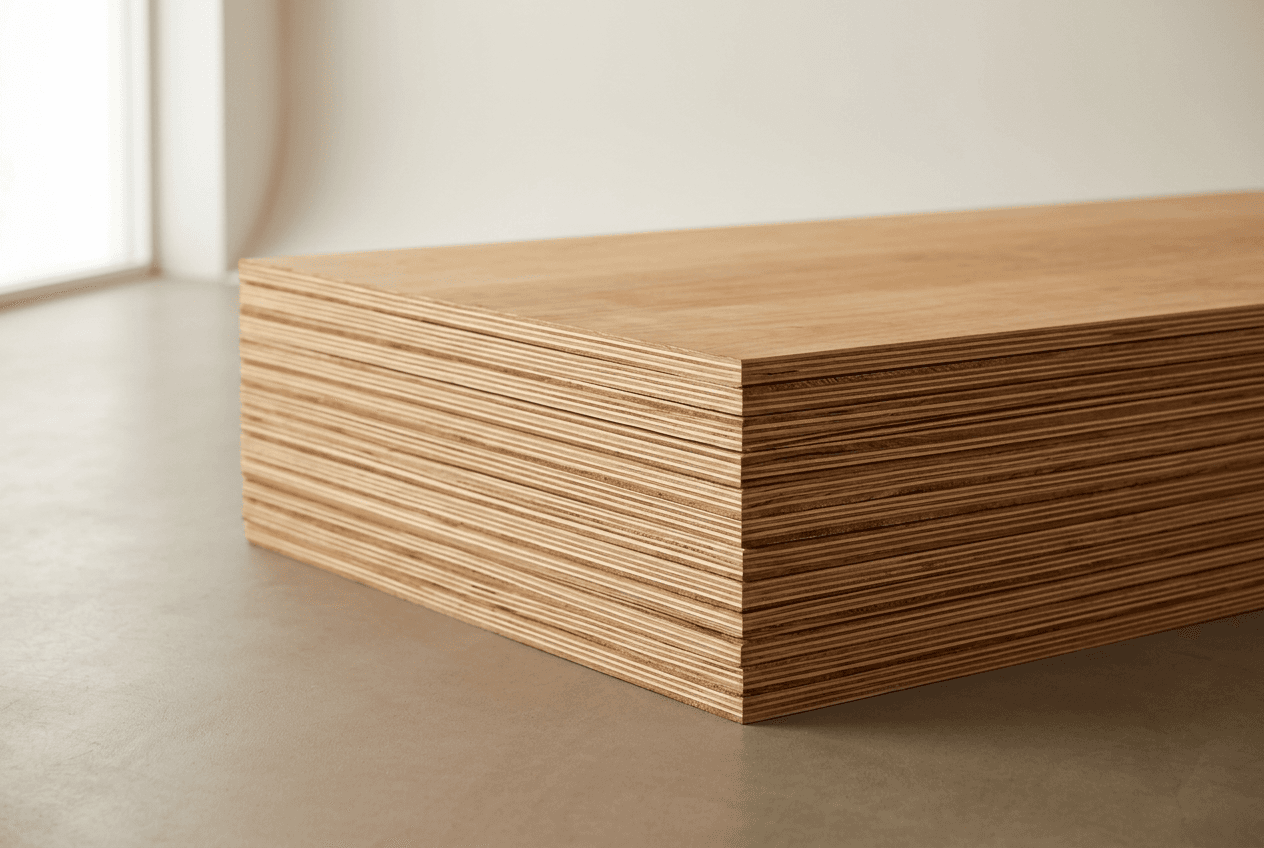
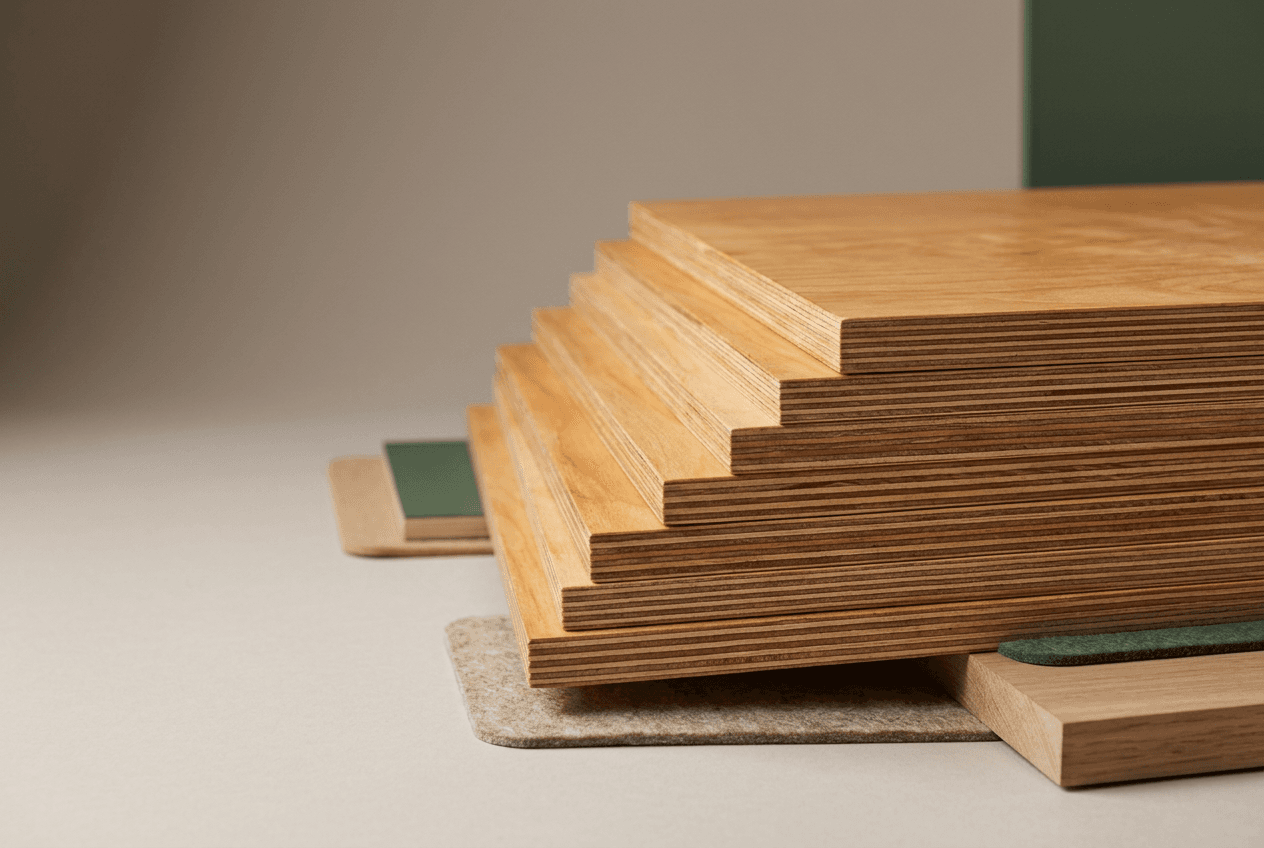
Indonesian plywood is an engineered panel made from cross-laminated layers of tropical hardwood veneer bonded with weather-and-boil-proof (WBP) phenolic resin. Stocked in Riyadh **at 122×244 cm with thicknesses of 4, 6, 9, 12, and 18 mm** — the workhorse panel for concrete formwork, interior cladding, and joinery across Saudi sites.
What is Indonesian plywood?
Indonesian plywood is an engineered wood panel built from cross-laminated layers of tropical hardwood veneer bonded with phenol-formaldehyde (WBP) resin. Mostly produced from meranti and keruing, it ships to Saudi Arabia at thicknesses 4–18 mm and is the standard sheet for concrete formwork and interior cladding.
Indonesian plywood production follows the WBP (Weather and Boil Proof) classification — the highest moisture grade in commercial plywood. The phenolic glue between layers withstands repeated water exposure without delamination, making the panel suitable for multi-pour formwork cycles in active construction sites.
Layer counts range from 3 plies in 4 mm sheets to 11 plies in 18 mm. Cross-grain lamination resists bending and warp, giving a flat, paint-ready surface. The standard 122 × 244 cm format is the dimension specified in nearly every BOQ on Riyadh sites.
Why is Indonesian plywood used in construction?
Indonesian plywood pairs reasonable cost with dimensional stability and load capacity, withstanding fresh concrete pressure of up to 45 kN/m² at 18 mm thickness. With proper release-oil treatment and flat storage, a single sheet is reusable for 5–8 form-pour cycles, which controls project material spend.
Indonesia is a major source of construction plywood for the Middle East per ITTO trade reports, ensuring continuity of supply for long-running projects without spec drift. That consistency is the primary reason large KSA contractors prefer it over cheaper short-cycle alternatives that vary batch-to-batch.
Indonesian plywood is specified at the formwork stage because it carries lateral concrete pressure, holds the cast surface flat, and reduces touch-up labour required on walls and columns after stripping the form.
What are the specifications of Indonesian plywood?
Indonesian plywood ships in 122×244 cm sheets at thicknesses 4, 6, 9, 12, and 18 mm, density 580–620 kg/m³, WBP-rated phenolic bond. The 18 mm sheet sustains up to 45 kN/m² pour pressure and survives 5–8 form-pour cycles. Each shipment carries ISO 9001, ISO 14001 certificates, and SBC 201 conformity.
| Product name | Indonesian WBP plywood |
|---|---|
| Country of origin | Indonesia |
| Wood species | Meranti / keruing / mixed tropical hardwood |
| Layer count | 3 – 11 plies (thickness-dependent) |
| Thicknesses (mm) | 4 · 6 · 9 · 12 · 18 |
| Sheet size (cm) | 122 × 244 (standard) |
| Density (kg/m³) | 580 – 620 |
| Bond type | Phenol formaldehyde (WBP) |
| Form-pour pressure tolerance | Up to 45 kN/m² at 18 mm |
| Reusability | 5 – 8 form-pour cycles |
| Certifications | ISO 9001 · ISO 14001 · SBC 201 |
| Quality guarantee | Replacement of any out-of-spec sheet |
What are the construction applications of Indonesian plywood?
Indonesian plywood serves five primary applications: concrete formwork (18 mm), interior wall cladding (9–12 mm), prefabricated joinery (12–15 mm), suspended ceilings (4–6 mm), and floor underlayment (12 mm). Each thickness maps to a load and span context defined by the project engineer.
- 01
Concrete formwork (18 mm)
Columns, beams, slabs, and load-bearing walls. The panel withstands lateral pressure up to 45 kN/m² and tolerates 5–8 form-pour cycles when stored flat.
- 02
Interior wall cladding (9–12 mm)
Decorative wall finishes and interior facade panels, paint-ready or accepting natural veneer overlay for premium residential and hospitality work.
- 03
Prefabricated joinery (12–15 mm)
Kitchen carcasses, shelving, doors. The hardwood density holds hinges and screws without splitting, unlike softer poplar-based plywoods.
- 04
Suspended ceilings (4–6 mm)
Mounted on timber or metal framing in villas and retail interiors. Accepts paint or fabric wall-cover application directly.
- 05
Floor underlayment (12 mm)
Levelling layer under parquet or carpet over tile or screed, smoothing height differences and adding acoustic separation.
What is the difference between Indonesian and Chinese plywood?
Indonesian plywood is built from tropical hardwood at 580–620 kg/m³, while Chinese plywood typically uses fast-grown poplar at 420–480 kg/m³. The Indonesian sheet survives 5–8 form-pour cycles, the Chinese 1–2 cycles, and the Chinese is 20–30% cheaper but is not recommended for structural formwork.
Chinese plywood serves as a defensible cost choice for small residential projects and decorative work. Indonesian plywood remains the working specification for tower formwork and commercial projects requiring repeated pours. Chinese sheets typically fail after 1–2 cycles in concrete contact, eroding the apparent saving.
| Attribute | Indonesian | Chinese |
|---|---|---|
| Base species | Meranti / keruing (hardwood) | Poplar / fast-grown softwood |
| Density | 580–620 kg/m³ | 420–480 kg/m³ |
| Glue rating | WBP — phenolic, boil-proof | MR — urea, moisture-resistant only |
| Form-pour reusability | 5–8 cycles | 1–2 cycles |
| Dimensional stability | Excellent — minimal warp | Moderate — prone to heat warp |
| Indicative price | 20–30% premium | Market floor |
| Recommended use | Structural formwork, heavy joinery | Light decoration, short-life uses |
How do I choose the right Indonesian plywood thickness?
Thickness is dictated by function: 4–6 mm for ceilings, 9 mm for cladding, 12 mm for furniture and light walls, 18 mm for load-bearing concrete formwork. As load increases or the span between supports widens, step up at least one thickness grade. The 18 mm sheet is standard for wall and slab formwork.
18 mm is standard for walls and slabs; 12 mm is acceptable for short columns and shallow beams. Support spacing exceeding 40 cm requires moving up a thickness to prevent deflection during the pour. The project engineer validates this against the pour height.
How is Indonesian plywood stored and installed on site?
Indonesian plywood stores flat on timber bearers 10–15 cm off the ground, in a dry area shielded from direct sun. Installation uses screws at 20–30 cm spacing along the framing with a 2–3 mm expansion gap between adjacent sheets to prevent buckling under thermal movement.
Before first formwork use, brush a release oil across the face at 250 ml/m² minimum to prevent concrete bonding. This single step extends the working life of the sheet from 2 to 6–8 pour cycles. Re-oil after each strip-down using the same coverage rate.
After stripping, scrape residual concrete with a plastic — never metal — scraper to avoid surface scoring. Between cycles, store flat under a breathable cover that allows airflow and prevents trapped moisture against the face.
Does Indonesian plywood meet Saudi Building Code requirements?
Indonesian plywood as supplied by Riyadh Timber meets SBC 201 structural requirements for residential and commercial buildings, and ships with ISO 9001 (quality) and ISO 14001 (environment) certificates. Critical egress applications — stairs, exit corridors — require additional verification under SBC 801 fire-safety provisions.
Each shipment arrives with a mill certificate of origin, density and moisture-resistance test reports, and shipping invoice. These documents satisfy engineering review on most residential and commercial projects in Riyadh and across the Kingdom.
Which Saudi projects use Indonesian plywood?
Indonesian plywood appears in concrete formwork on Vision 2030 sites including NEOM, Red Sea, Diriyah, Qiddiya, and New Murabba, in the King Abdullah Financial District towers, in private villa work in Hittin, Al Malqa, and Al Yasmin, and in retail interiors along King Fahd Road and Al Olaya.
- Vision 2030 mega-projects: NEOM, Red Sea, Diriyah, Qiddiya, New Murabba — sub-contractor formwork supply.
- King Abdullah Financial District and Olaya towers — formwork and interior office cladding.
- Villas and gated communities in Hittin, Al Malqa, Al Yasmin, Al Narjis — doors, cabinetry, decorative work.
- Retail centres and showrooms along King Fahd Road and Al Urubah — suspended ceilings and wall cladding.
What are common questions about Indonesian plywood?
**150 sheets** — the equivalent of a half-trailer load — is the effective minimum for delivery. Smaller orders are picked up from our Olaya yard, or are bundled with an existing project shipment near the contractor's site to absorb logistics cost.
15 mm is available on special order with a **300-sheet minimum** and 3–4 weeks lead time from Jakarta. Standard 12 mm and 18 mm thicknesses are continuously stocked in Riyadh and ship within 24–48 hours of order confirmation.
Under good site conditions a sheet lasts **6–8 form-pour cycles** or roughly 4–6 months of active site use. Poor storage cuts this to 2 cycles, eroding the cost-per-cycle quickly.
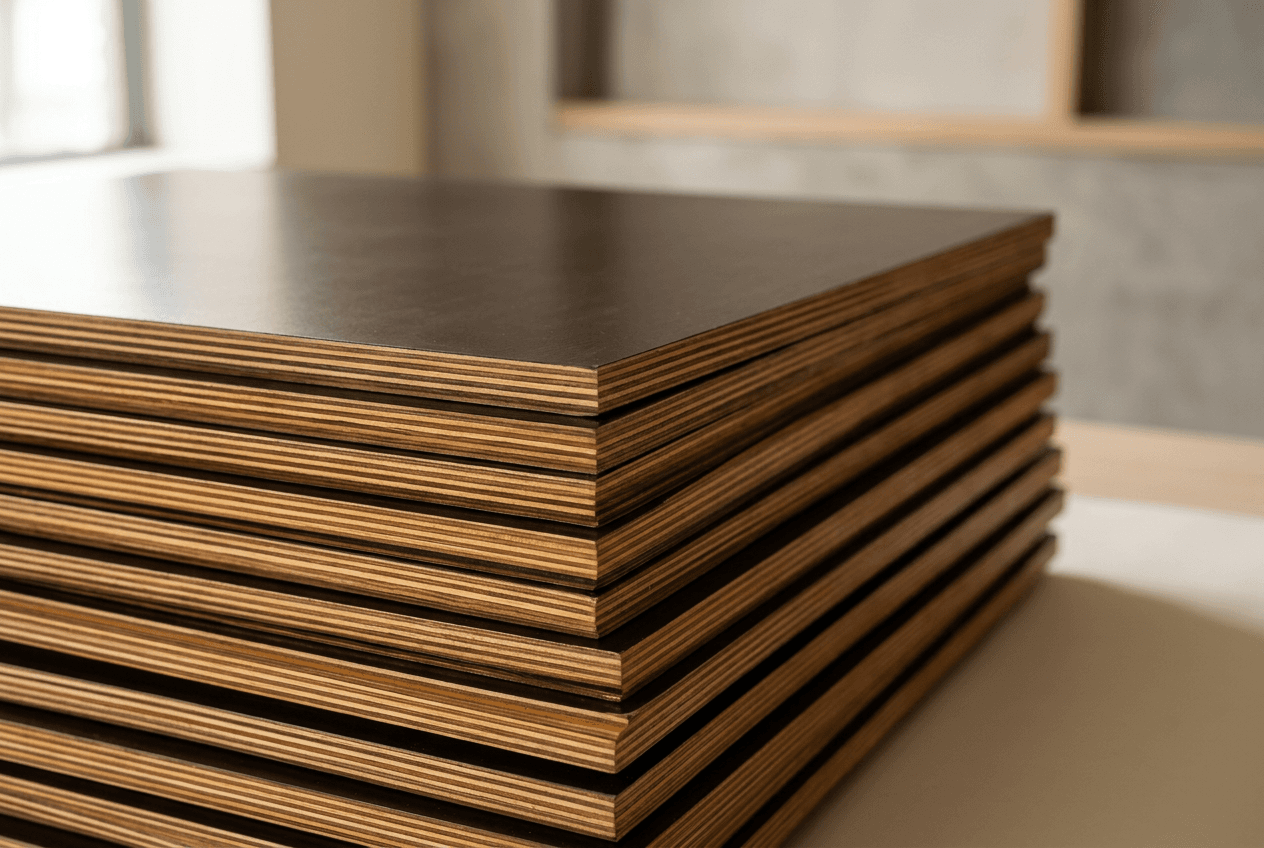
Indonesian plywood is not recommended for direct rain or sun exposure despite the WBP rating. For exterior applications, we supply **film-faced phenolic plywood** with a sealed black surface, or fibre-cement panels rated for prolonged outdoor use in Riyadh's climate.
Riyadh Timber's Indonesian plywood is rated **E1** — formaldehyde emissions ≤ 0.124 mg/m³ — meeting the European and Saudi standard for interior residential and commercial use, including bedrooms, kitchens, and children's spaces.
Indonesian plywood ships with **oak, walnut, or teak veneer overlays** on special order. Lead time is 3–5 weeks, in 122×244 cm sheets at 12 and 18 mm. Pricing adds SAR 40–70 per sheet depending on the veneer species and finish.
Our cutting department processes your cut list with a **±2 mm tolerance**. Service is available for all thicknesses up to 25 mm. Cut pieces ship numbered and bundled by drawing reference, accelerating the cladding phase on site.
What products relate to Indonesian plywood?
Selections that complement the work in Saudi construction projects.
Need a quote on Indonesian plywood for your project?
Send a quantity list with thicknesses and the delivery site. We respond with a formal quote within 4 working hours — unit price, total, lead time, and certificates included.