Construction timber · economy plywood
Chinese plywood
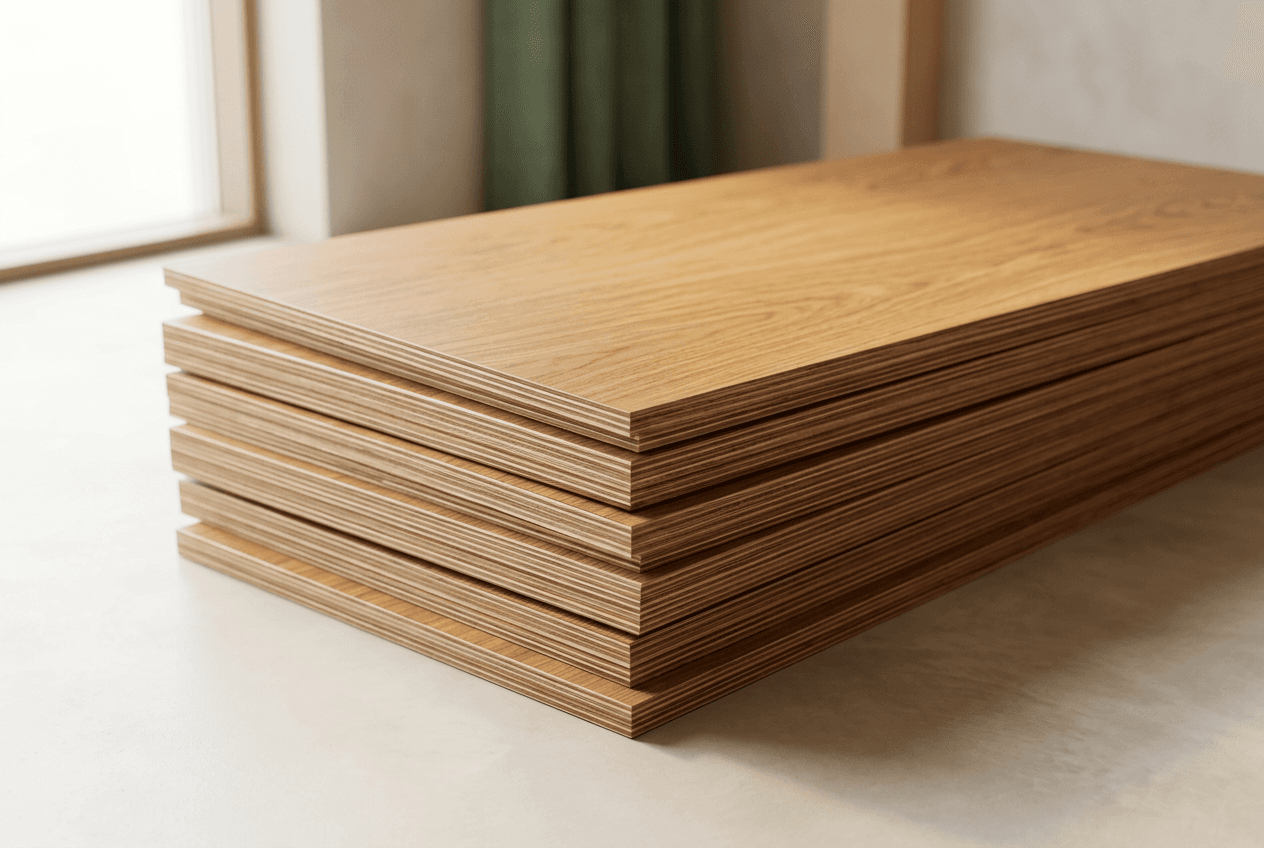
Chinese plywood is an engineered panel built from poplar and fast-grown softwood veneers, used for light decor, packaging, and suspended ceilings. Stocked in Riyadh **at 122×244 cm with thicknesses of 3, 5, 9, 12, and 18 mm**, MR-grade urea bond, CARB-P2 rated, from SAR 28 per sheet.
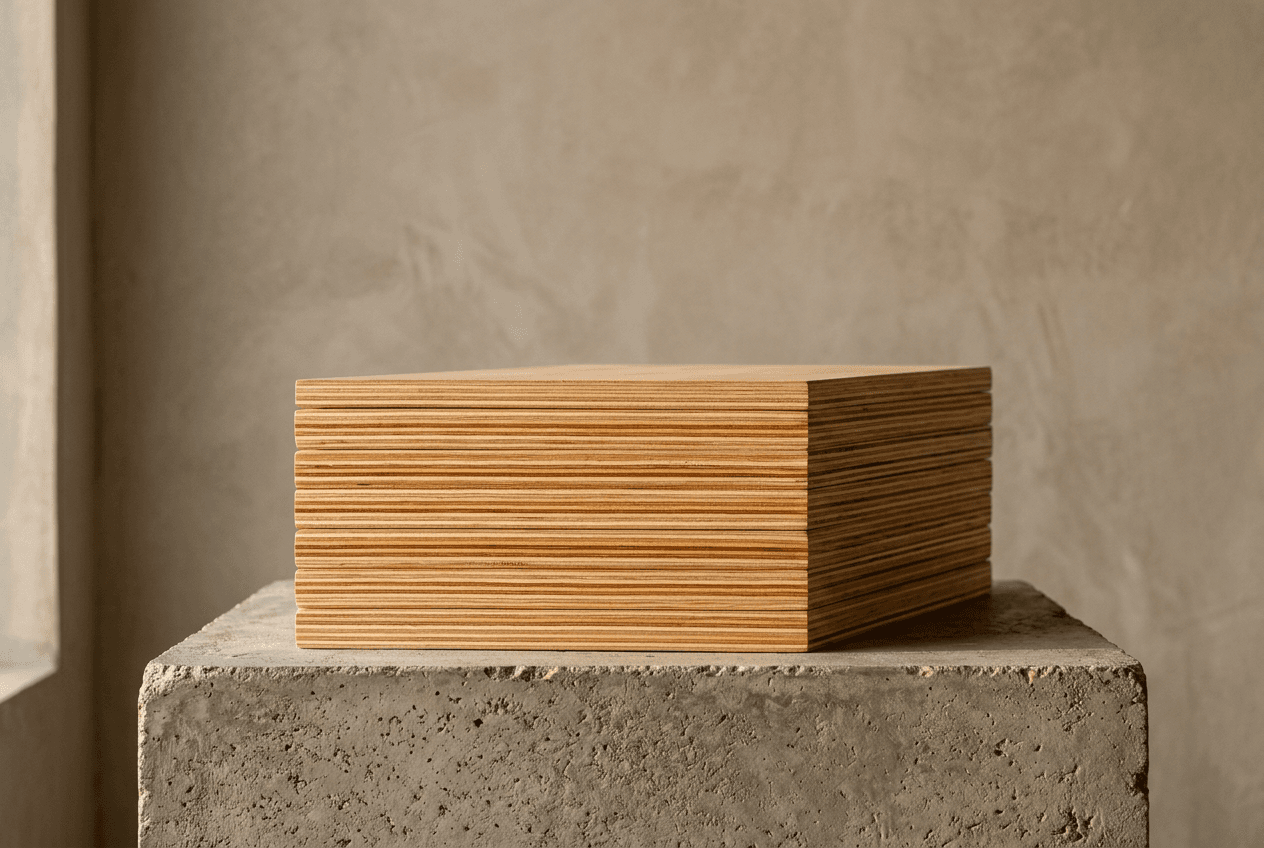
What is Chinese plywood?
Chinese plywood is an engineered panel built from cross-laminated poplar or fast-grown softwood veneers, bonded with urea-formaldehyde MR-grade resin. Manufactured to GB/T 9846 in 3 to 18 mm thicknesses, it is supplied to Saudi Arabia as the lowest-priced plywood option for decor, packaging, and short-life applications.
Chinese plywood typically uses poplar grown on commercial plantations with a 5–7 year harvest cycle. The fast-growth wood is inexpensive but lower-density than tropical hardwood. Density falls between 420 and 480 kg/m³, roughly 25% lower than Indonesian plywood made from meranti or keruing.
The bond resin used in most Chinese plywood is urea formaldehyde (UF) at MR (moisture-resistant) grade. UF resin does not survive boiling or repeated water exposure, so Chinese plywood is not recommended for multi-cycle concrete formwork or permanent wet zones.
Why is Chinese plywood used in construction?
Chinese plywood is specified primarily because it is 20–30% cheaper than Indonesian plywood at equivalent thickness. That price gap makes it the working choice for short-life decor, packaging, suspended ceilings, and projects without high moisture or repeated reuse demands.
On small residential villas and dry interior decor work, Chinese plywood completes the function at roughly one-third of the budget of tropical plywood. For contractors competing in affordable-housing tenders, that saving translates directly into bid competitiveness.
Chinese plywood is also a good fit for suspended ceilings in retail and exhibition fit-outs — it accepts paint, weighs roughly 20% less than Indonesian plywood, and reduces load on metal grid systems. Short service life is acceptable in those temporary or refurbishment contexts.
What are the specifications of Chinese plywood?
Chinese plywood ships at 122×244 cm in thicknesses 3, 5, 9, 12, and 18 mm, density 420–480 kg/m³, urea-formaldehyde MR bond. Layer counts run from 3 plies at 3 mm to 11 plies at 18 mm. Riyadh Timber's stock is rated E1 and CARB-P2 for indoor formaldehyde emissions.
| Product name | Chinese MR plywood |
|---|---|
| Country of origin | China — Shandong and Guangxi |
| Wood species | Poplar / fast-grown softwood |
| Layer count | 3 – 11 plies |
| Thicknesses (mm) | 3 · 5 · 9 · 12 · 18 |
| Sheet size (cm) | 122 × 244 (standard) |
| Density (kg/m³) | 420 – 480 |
| Bond type | Urea formaldehyde (MR) |
| Form-pour reusability | 1 – 2 cycles |
| Pressure tolerance | Up to 20 kN/m² at 18 mm |
| Emissions | E1 · CARB-P2 |
| Certifications | GB/T 9846 · CARB-P2 · ISO 9001 |
What are the construction applications of Chinese plywood?
Chinese plywood serves five primary contexts: suspended ceilings (3–5 mm), light decor and wall panels (9 mm), economy joinery (12–15 mm), industrial packaging and crates (5–9 mm), and low-load formwork (18 mm) for small residential builds.
- 01
Suspended ceilings (3–5 mm)
Temporary exhibitions, retail interiors, and budget offices. Mounted on light metal grid and finished with paint or wallpaper.
- 02
Interior decor panels (9 mm)
Decorative wall and TV-feature panels in affordable villas. Accepts engineered veneer and paint after light sanding.
- 03
Economy joinery (12–15 mm)
Bedroom wardrobes, computer desks, kitchen shelving in affordable housing and rental units. 3–5 year service life under light load.
- 04
Industrial packaging (5–9 mm)
Shipping crates, industrial packaging, exhibition stands. Low weight and low cost make it the default for single-use applications.
- 05
Low-load formwork (18 mm)
Small residential villas with one or two pour cycles only. 18 mm thickness is required to prevent sag under fresh concrete pressure.
What is the difference between Chinese plywood and Indonesian plywood?
Chinese plywood uses fast-grown poplar at 420–480 kg/m³, while Indonesian uses meranti and keruing hardwood at 580–620 kg/m³. Chinese is 20–30% cheaper but withstands only 1–2 form-pour cycles versus 5–8 cycles for Indonesian. The choice maps to project life, not unit price alone.
Chinese is a defensible choice for dry decor, packaging, and small residential projects. Indonesian remains the structural specification for tower and hospitality formwork. Specifying Chinese for repeated structural pours costs more on a per-cycle basis once early replacement is included.
| Attribute | Chinese | Indonesian |
|---|---|---|
| Base species | Poplar / softwood | Meranti / keruing (hardwood) |
| Density | 420–480 kg/m³ | 580–620 kg/m³ |
| Bond resin | MR — urea | WBP — phenolic |
| Form-pour reuse | 1–2 cycles | 5–8 cycles |
| Dimensional stability | Moderate — heat warp prone | Excellent — minimal warp |
| Indicative price/sheet | SAR 28–75 | SAR 45–120 |
| Recommended use | Light decor, packaging | Structural formwork, heavy joinery |
When should I choose Chinese plywood over Indonesian or Malaysian?
Chinese plywood is the right choice in three cases: dry interior decor, packaging, or formwork on a single-pour project. Avoid it for repeated formwork, wet zones, and joinery requiring heavy hinge loads — failure modes appear quickly and erode the apparent saving.
If the budget is tight and the project does not exceed one pour cycle (small residential villa, for example), Chinese phenolic plywood — not the MR grade — is acceptable. For projects beyond two pour cycles, Indonesian becomes cheaper on a per-cycle basis once replacement labour and transport are factored in.
How is Chinese plywood stored and installed?
Chinese plywood stores flat on bearers 10 cm off the ground in dry, shaded conditions, away from direct sun and water. Installation uses standard screws at 20–25 cm spacing, with care not to over-drive on 3–5 mm sheets. Lower density requires faster fastener placement than tropical plywood.
For decor applications, leave Chinese plywood on site for 48 hours before installation to acclimatise to ambient humidity — it absorbs and releases moisture faster than tropical plywood. Frame at 30 cm centre-to-centre spacing to prevent sag under veneer or wallpaper.
For formwork, Chinese plywood does not survive repeated release-oil treatment because UF resin partly dissolves under recurrent oil and water contact. Treat each sheet as a single-cycle consumable — do not plan reuse beyond the first pour.
Does Chinese plywood meet Saudi Building Code requirements?
Chinese MR plywood is not classified for structural formwork under SBC 201, but is accepted for decor and ceiling applications. Riyadh Timber's Chinese stock ships with GB/T 9846 mill certification and CARB-P2 / E1 emissions reports — sufficient for residential decor engineering review.
For projects requiring SBC 201 conformity (public buildings, structural formwork), specify Indonesian or Malaysian WBP plywood. For affordable-housing and interior decor work, Chinese plywood with documented emissions and mill certificates is sufficient for engineering sign-off and acceptance.
Which Saudi projects use Chinese plywood?
Chinese plywood ships into affordable-housing developments, temporary exhibitions, retail stands, rental apartments, and suburban housing. Applications cover decor and suspended ceilings, economy joinery for staff accommodation, and partition work in warehouses and logistics centres.
- Affordable-housing developments — interior decor and ceilings in apartments.
- Temporary exhibitions and retail stands in Riyadh and Jeddah — partition walls and stands.
- Furnished rental apartments in Al Aziziyah and Al Rabwah — economy joinery.
- Staff accommodation and workshop facilities — interior walls and room doors.
- Warehouses and logistics centres — shelving and light storage partitions.
What are common questions about Chinese plywood?
Chinese MR plywood is suitable for **a single pour cycle only** and is not recommended for tower formwork. Indonesian WBP is the correct choice for repeated structural pours. Chinese phenolic plywood (PF, premium grade) handles two cycles but its price approaches Indonesian.
**200 sheets** — equivalent to a half-trailer load — is the effective minimum for delivery, given the lower per-sheet value. Smaller quantities are picked up from our Olaya yard. Stock orders deliver within 3 working days inside Riyadh.
Riyadh Timber's Chinese plywood is rated **E1 and CARB-P2**, with formaldehyde emissions ≤ 0.124 mg/m³. These levels are accepted internationally for residential indoor use. Avoid undocumented stock from the informal market.
15 mm is on special order with a **500-sheet minimum** and 4–5 weeks lead time from Qingdao. Standard 12 mm and 18 mm thicknesses are continuously stocked in Riyadh and ship within 24–48 hours of order confirmation.
Chinese plywood accepts **water-based and oil-based paint, plus engineered and natural veneer** after light sanding with 120-grit paper. Surface finish is good for decor, but long-term stability is below tropical plywood — re-coat cycles are shorter.
Chinese phenolic WBP plywood costs **40–60% more** than its MR sibling and survives two pour cycles instead of one. For projects needing better moisture resistance on a tight budget, Chinese WBP sits between Chinese MR and Indonesian WBP.
Some larger Chinese mills produce FSC-certified plywood from plantation forests. These batches carry a 20% premium and longer lead time. For FSC-required projects, Malaysian or Indonesian FSC plywood is the more stable supply alternative.
What products relate to Chinese plywood?
Selections that complement the work in Saudi construction projects.
Need a quote on Chinese plywood for your project?
Send a quantity list with thicknesses and the delivery site. We respond with a formal quote within 4 working hours — unit price, total, lead time, and emissions certificates included.