Construction timber · Scandinavian structural pine
Swedish timber battens
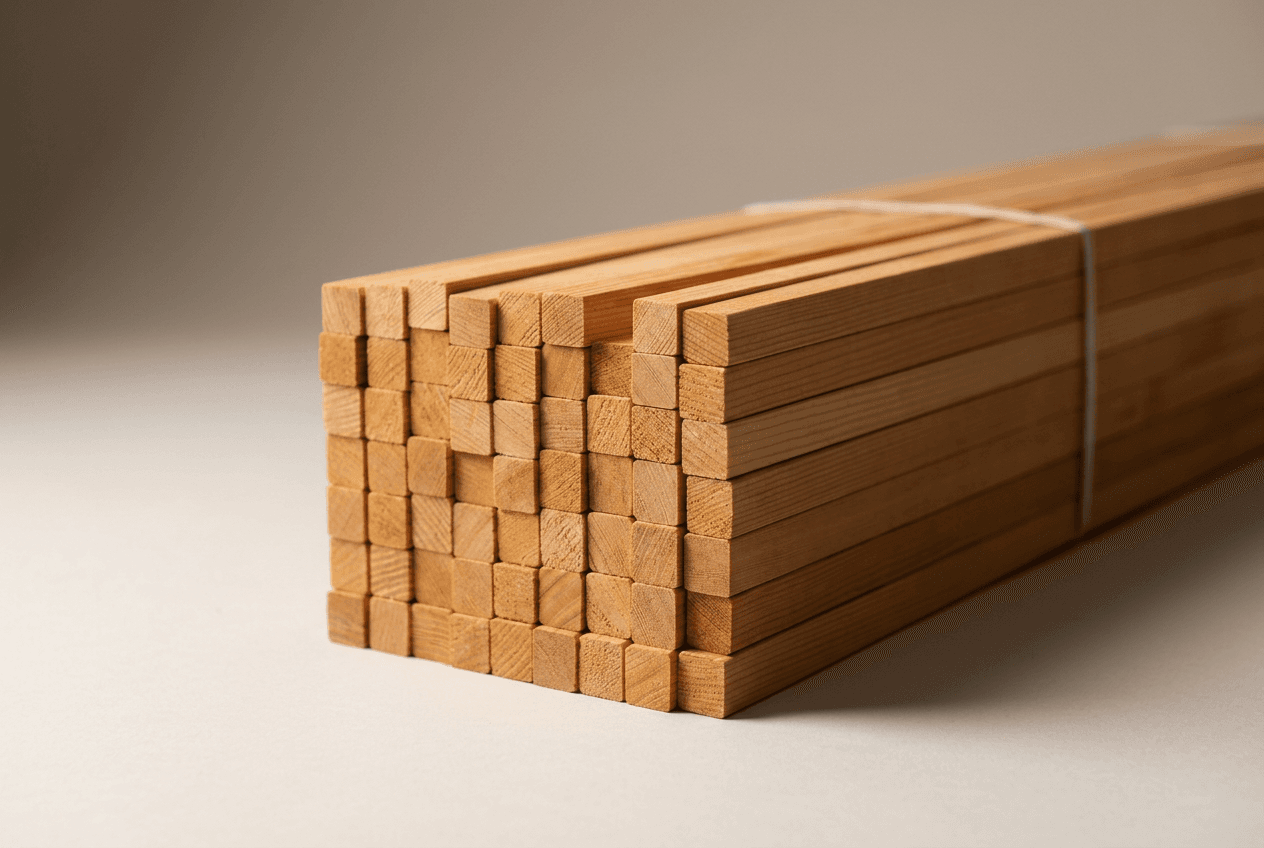
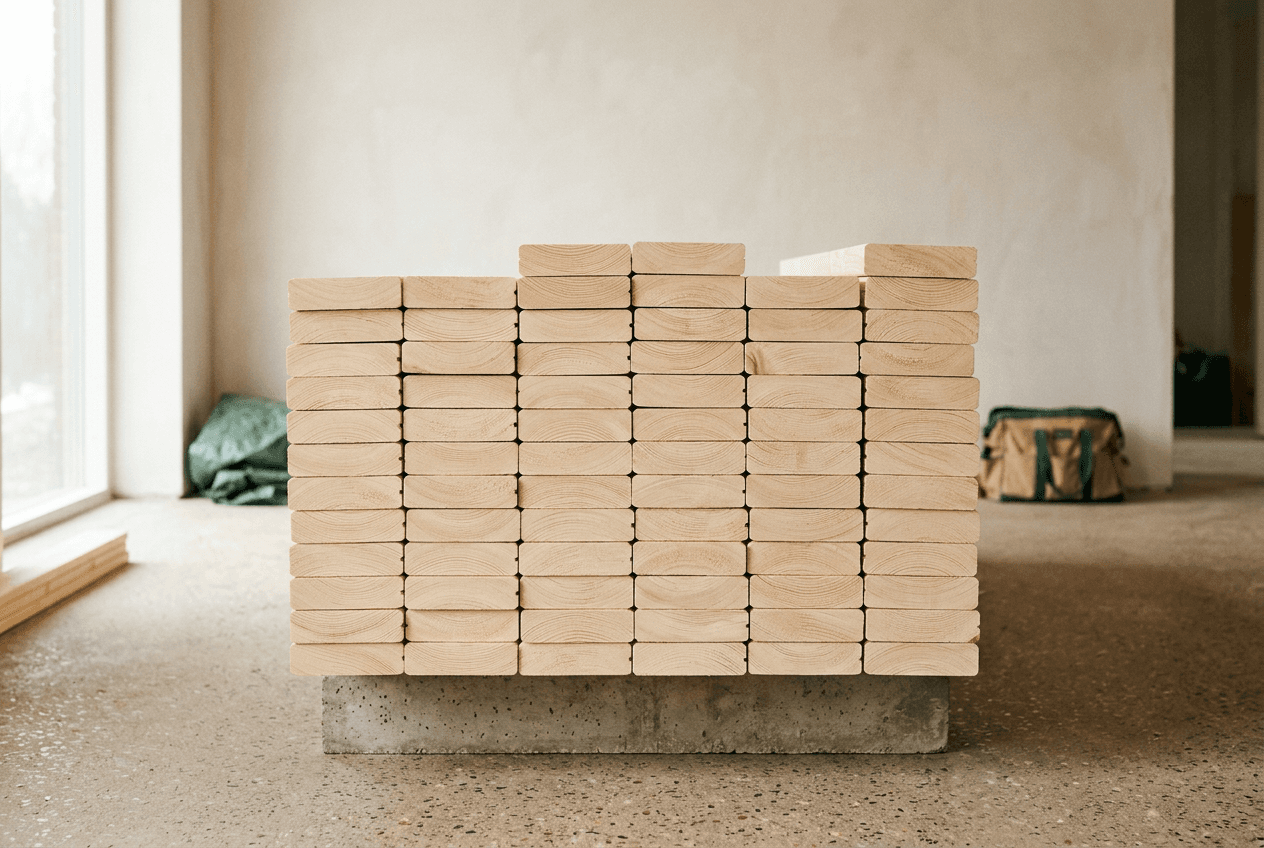
Swedish timber battens are sawn pieces of Pinus sylvestris (Scots pine) used in framing, trusses, and timber formwork. We stock **lengths of 3, 3.3, and 3.9 m in cross-sections of 4×6, 5×7.5, and 5×10 cm** — graded C24 to EN 14081 for structural roof, floor, and partition assemblies.
What are Swedish timber battens?
Swedish timber battens are kiln-dried sawn lengths of Pinus sylvestris from northern Sweden, cut to standard cross-sections and graded structurally to C24. They are used for roof trusses, wall framing, floor joists, and temporary formwork supports — anywhere the engineer needs a defined load-bearing softwood member.
Sweden's northern forests grow above 60° N latitude, where slow growth produces tight annual rings and high natural strength. Mills kiln-dry to a controlled 12–18% moisture content and grade each piece visually and mechanically against EN 14081 before bundling for export.
C24 is a strength class — not a wood species. It guarantees a bending strength of 24 N/mm² and a parallel-grain compression of 21 N/mm², which lets a structural engineer design loads against published values without testing each piece independently on site.
Why are Swedish battens used in construction?
Swedish battens combine low weight with high carrying capacity and dimensional stability after kiln drying. At 450–500 kg/m³ density and C24 grade, a 5×10 cm batten supports 3 kN/m² roof loads across a 3 m span, and the engineer specifies it without batch-by-batch verification — accelerating engineering review.
Riyadh contractors prefer Swedish over Russian or Baltic alternatives because of dimensional consistency and a knot ratio capped at 20%. Cheaper alternatives often arrive with 35–40% knot coverage, which inflates on-site waste once the crew sorts usable pieces from rejects.
Kiln-drying matters in Riyadh's dry climate. Air-dried battens lose 8–12% volume within two months of installation, which loosens fasteners and breaks insulation lines. Kiln-dried Swedish wood is already at equilibrium with low ambient humidity and stays straight.
What are the specifications of Swedish timber battens?
Swedish timber battens ship in lengths of 3.0, 3.3, and 3.9 m, cross-sections 4×6, 5×7.5, and 5×10 cm, graded C24 to EN 14081 with bending strength 24 N/mm², density 450–500 kg/m³, moisture 12–18%. Each shipment carries CE, PEFC, and FSC certificates.
| Product name | Swedish pine batten C24 |
|---|---|
| Country of origin | Sweden |
| Wood species | Pinus sylvestris — Scots pine |
| Lengths (m) | 3.0 · 3.3 · 3.9 |
| Cross-sections (cm) | 4×6 · 5×7.5 · 5×10 |
| Structural grade | C24 (EN 14081) |
| Bending strength | 24 N/mm² |
| Parallel-grain compression | 21 N/mm² |
| Density | 450 – 500 kg/m³ |
| Moisture content | 12 – 18% (kiln-dried) |
| Certifications | CE · PEFC · FSC · SBC 301 |
| Allowable knot area | ≤ 20% of face |
What are the construction applications of Swedish battens?
Swedish battens serve five primary applications: roof trusses (5×10 cm), light wall framing (4×6 cm), vertical formwork props (5×7.5 cm), parquet base battens (5×7.5 cm), and scaffolding members (5×10 cm). Cross-section is selected against the load and the spacing between supports.
- 01
Roof trusses (5×10 cm)
Pitched roofs in villas and rest houses. The truss carries roof tile or shingle load plus design snow load with rafter spacing at 60 cm centres.
- 02
Light wall framing (4×6 cm)
Drywall partitions inside villas. Vertical studs at 40 cm centres, horizontal rails at 240 cm — standard module for plasterboard sheets.
- 03
Vertical formwork props (5×7.5 cm)
Backing plywood face for wall pours. Spaced at 40 cm to carry lateral concrete pressure during placement and curing.
- 04
Floor base battens (5×7.5 cm)
Mounted on slab or screed as a base for solid parquet, with rubber acoustic isolation underneath to decouple impact noise.
- 05
Scaffolding and shoring (5×10 cm)
Temporary site columns and bracing for low-rise work, replaced by metal shoring in larger commercial and Vision 2030 projects.
How do Swedish battens compare to other European battens?
Swedish battens have tighter annual rings due to slow northern growth, giving 450–500 kg/m³ density and lower knot frequency. German and Austrian battens are 10–15% more expensive at similar quality. Russian battens cost 20% less but carry higher knot ratios and arrive at higher moisture content.
Structural projects with calculated loads specify C24-graded Swedish in Riyadh because it balances price, quality, and certificate availability (PEFC, FSC). Russian alternatives are accepted only for non-load-bearing work where engineering signoff is not required.
| Attribute | Swedish | German / Austrian | Russian |
|---|---|---|---|
| Wood species | Pinus sylvestris | Picea abies / Pinus | Pinus sylvestris |
| Annual ring tightness | Tight (slow growth) | Medium | Wider (medium growth) |
| Knot ratio | ≤ 20% | ≤ 20% | 25 – 40% |
| Structural grading | C24 standard | C24 standard | C18 typical |
| Moisture at dispatch | 12 – 18% | 12 – 18% | 18 – 22% |
| Certifications | PEFC + FSC | PEFC + FSC | Often non-standard |
| Indicative price | Baseline | + 10 – 15% | − 20% |
How do I choose the right batten section and length?
The project engineer specifies cross-section against load and span: 4×6 cm for non-load-bearing framing, 5×7.5 cm for floors and light load-bearing walls, 5×10 cm for roof trusses. Length follows the opening: 3 m for small rooms, 3.9 m for halls and corridors needing uninterrupted spans.
A useful field rule: a 5×10 cm batten spans 3 m unsupported under a 3 kN/m² load. Beyond 3 m, add an intermediate beam or step up to 7.5×15 cm. This is a sizing approximation only — the consulting engineer must verify against project-specific loads before construction.
How are Swedish battens stored and installed on site?
Swedish battens stack on stickers every 60 cm, 15 cm off the ground and 20 cm off any wall, under a breathable waterproof cover. Installation uses hot-dipped galvanised nails or screws of length 2.5× the batten thickness — minimum — to prevent withdrawal under live loads or thermal movement.
Inspect each piece visually for bow and twist before installation. Anything with bow over 10 mm across a 3 m length is rejected for structural use and downgraded to non-load-bearing applications such as floor base battens or shelving cleats.
In Riyadh's dry climate, allow battens to acclimatise on site for at least two days after delivery before installation. This lets the wood reach equilibrium with the local humidity, preventing fastener withdrawal due to post-installation shrinkage.
Do Swedish battens meet Saudi Building Code requirements?
C24-graded Swedish battens meet SBC 301 for structural timber and carry CE marking under EN 14081, plus PEFC or FSC environmental certification. Each shipment includes a mill certificate of origin, the grading report, and a moisture reading at point of dispatch — sufficient for engineering review on standard projects.
For government-tendered projects (schools, hospitals, public infrastructure), an independent third-party inspection report is issued by an accredited testing house. This adds 2–4 days to lead time and 3–5% to unit cost, but is required for certain consultant-specified procurement processes.
Which Saudi projects use Swedish battens?
Swedish battens are used in pitched-roof villas in Hittin, Al Malqa, and Diriyah, in coastal resort framing along the Red Sea and Umluj, in industrial framing across Riyadh's industrial zones, and as temporary structural shoring for sub-contractors at NEOM, Qiddiya, and other Vision 2030 sites.
- Villas and rest houses in Hittin, Al Malqa, Diriyah — pitched roof trusses and drywall framing.
- Red Sea and Umluj resorts — interior framing and exposed ceiling timberwork.
- Industrial shells in Wadi Al Dawasir and Al Kharj — light roof and partition framing.
- Vision 2030 sub-contractor scaffolding at NEOM and Qiddiya — graded structural temporary work.
What are common questions about Swedish timber battens?
The effective minimum for delivery is **3 m³ or 300 pieces** of a single cross-section. Smaller orders are released directly from the yard with no delivery surcharge for greater Riyadh sites and no minimum for yard pickup.
We cut to length on demand from **2 m to 4.2 m at ±5 mm tolerance**, charged at SAR 2 per piece. Lengths above 4.2 m are available on special order with a 3-week lead time from the Swedish mill.
**C24 carries a bending strength of 24 N/mm²; C18 carries 18 N/mm²**. The practical implication is span: C24 supports 3 m unsupported under typical load, while C18 supports 2.2 m under the same load. Most KSA projects specify C24 by default.
Battens ship with a preventive treatment to **EN 351**. For high-humidity zones — kitchens, bathrooms, exterior eaves — request the C2 enhanced treatment grade, which adds 8–12% to unit price and extends durability under wet-cycle exposure.
The standard sawn surface accepts **paint after light sanding**. For a smoother varnish-ready finish, request the planed (PSE) variant — adds SAR 3–5 per piece and saves on-site sanding time, particularly useful for exposed-timber interior work.
Density of kiln-dried Swedish pine is 450–500 kg/m³. **A 5×10×300 cm batten weighs roughly 7 kg**; an enclosed truck typically carries 3–4 m³ of battens. These figures estimate transport cost and trailer count for project deliveries.
What products relate to Swedish timber battens?
Selections that complement the work in Saudi construction projects.
Need a quote on Swedish battens for your project?
Send your quantity list by section and length. We respond with a formal quote within 4 working hours — including C24 grading reports, certificates, and delivery schedule.