Construction timber · northern Scots pine
Swedish timber
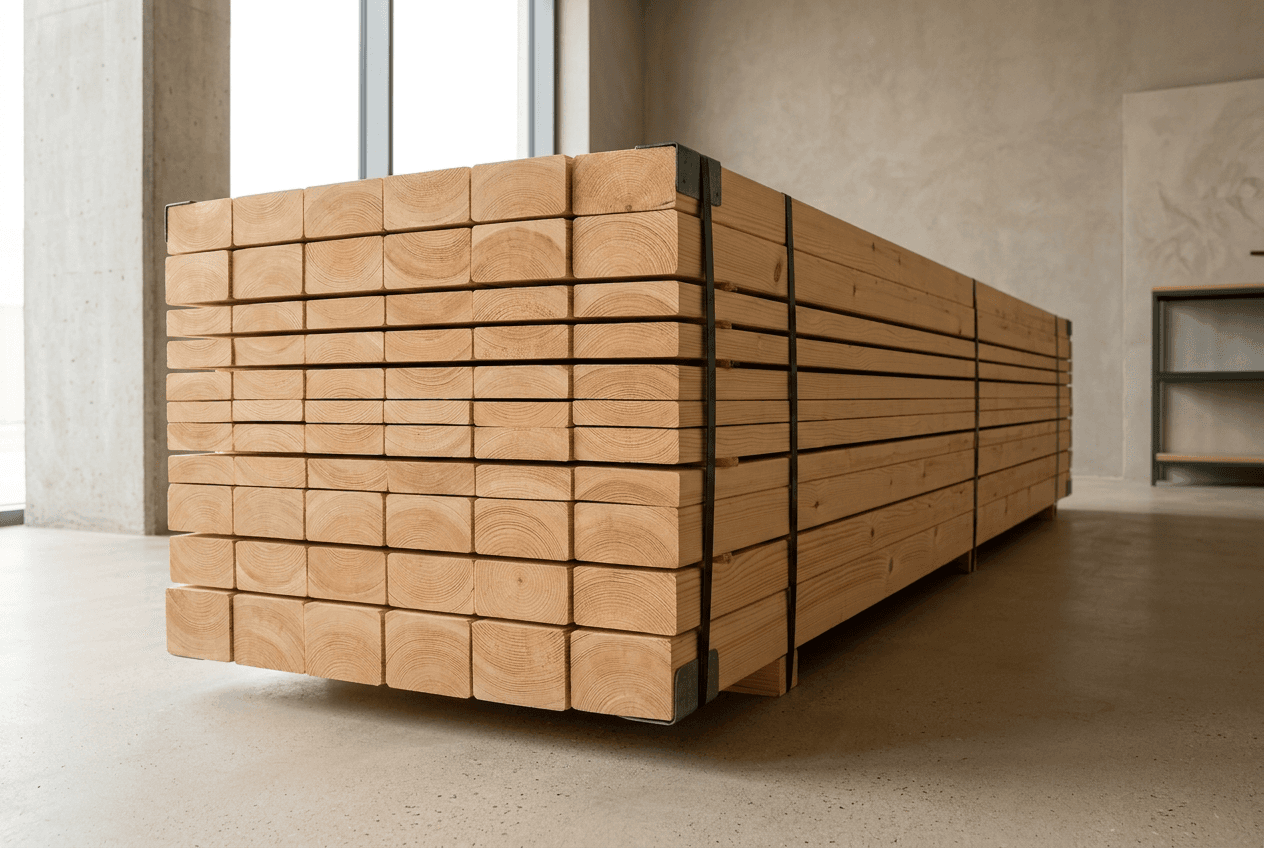
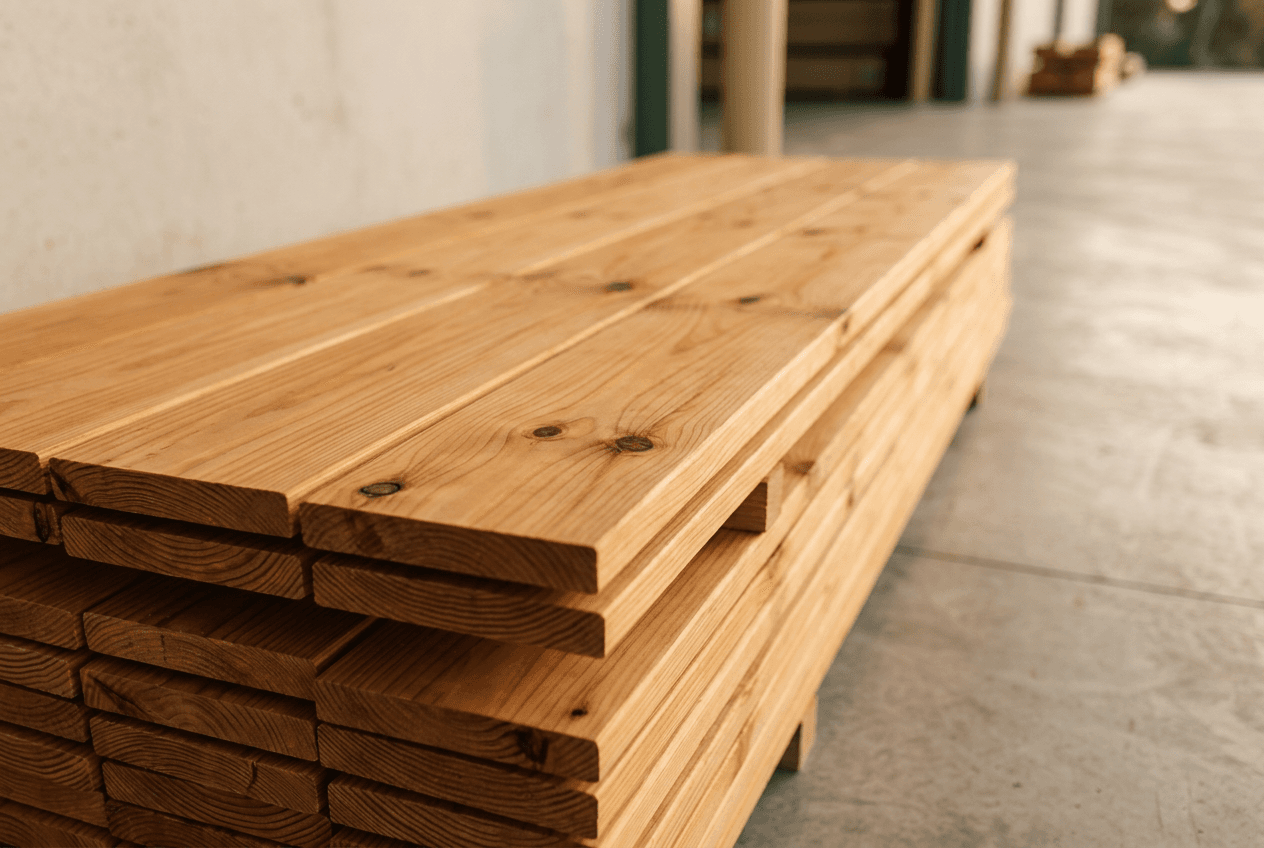
Swedish timber is northern **Scots pine (Pinus sylvestris) graded C24 to EN 14081**, kiln-dried and PEFC/FSC certified. Stocked daily in Riyadh in 4×6, 5×7.5, and 5×10 cm sections at 3, 3.3, and 3.9 m lengths — the structural framing standard for Saudi villas, trusses, and rest-house roofs.
What is Swedish timber?
Swedish timber is northern softwood milled from Scots pine (Pinus sylvestris) grown in Sweden's cold-latitude forests, kiln-dried to 12–18% moisture and graded C24 under European standard EN 14081. It ships into Saudi Arabia in 4×6, 5×7.5, and 5×10 cm sections at lengths of 3, 3.3, and 3.9 m.
Scots pine grown at high latitudes lays down narrow annual rings with few knots, producing uniform density between 450 and 500 kg/m³ and straight grain with high bending resistance. These cold-climate properties separate Swedish timber from tropical and locally-grown pine.
Swedish timber ships with PEFC and FSC chain-of-custody certificates for sustainable forest management and the European CE mark for structural conformity. Each bundle carries the C24 grade stamp, mill of origin, and kiln-drying date — adequate for engineer review under SBC 301.
Why is Swedish timber used in Saudi construction?
Swedish timber pairs 24 N/mm² bending strength with 450–500 kg/m³ density — high strength at low weight, easing transport and installation on Riyadh sites. Kiln-drying to 12–18% moisture controls post-install shrinkage and prevents surface checking on visible villa and rest-house framing.
Sweden produces over 17 million m³ of structural timber annually per Statistics Sweden, securing supply continuity for long-running Vision 2030 projects without spec drift between batches. That stability is why Saudi mega-project contractors prefer it over short-term sources.
Saudi contractors choose Swedish timber because it accepts nails and hinges without splitting, takes paint and oil-based finishes cleanly, and arrives in lengths matching local 270–300 cm wall heights with minimal off-cut waste.
What are the specifications of Swedish timber?
Swedish timber ships at C24 grade to EN 14081 — bending strength 24 N/mm², density 450–500 kg/m³, moisture 12–18% kiln-dried. Standard sections are 4×6, 5×7.5, 5×10 cm at 3, 3.3, and 3.9 m. Each bundle carries PEFC, FSC, CE marks and SBC 301 conformity.
| Product name | Swedish structural pine |
|---|---|
| Country of origin | Sweden |
| Species | Pinus sylvestris (Scots pine) |
| Lengths (m) | 3.0 · 3.3 · 3.9 |
| Sections (cm) | 4×6 · 5×7.5 · 5×10 |
| Structural grade | C24 to EN 14081 |
| Bending strength | 24 N/mm² |
| Parallel compression | 21 N/mm² |
| Density | 450–500 kg/m³ |
| Moisture content | 12–18% (kiln-dried) |
| Knot ratio cap | ≤ 20% of face |
| Certifications | CE · PEFC · FSC · SBC 301 |
| Indicative price | SAR 22–90 / piece |
| Availability | Daily stock |
What are the construction applications of Swedish timber?
Swedish timber serves five primary applications: villa wall framing, roof trusses, formwork backers, door and window frames, and light scaffolding. The 5×10 cm section carries structural loads; the 4×6 cm handles secondary framing and decorative work in residential and hospitality projects.
- 01
Villa and rest-house wall framing
5×10 cm sections at 3 or 3.3 m for light wall framing in timber-frame villas — carrying roof loads and resisting bending under C24 grading.
- 02
Roof trusses and rafters
5×10 and 7.5×15 cm sections at 3.9 m for truss top chords and rafters in rest houses and large villas, paired with metal connector plates.
- 03
Concrete formwork backers
4×6 and 5×7.5 cm sections as studs and bearers behind plywood form sheets for wall and slab pours, sized to engineer's stud spacing schedule.
- 04
Door and window frames
4×6 cm sections for interior door frames and timber window frames in villas — paint-ready and accepting hinges and locks without pre-drilling.
- 05
Light scaffolding and site canopies
5×10 cm uprights for timber scaffolding and temporary site canopies up to 4 m height, used during finishing trades on residential projects.
What is the difference between Swedish timber and Canadian timber?
Swedish timber is Scots pine at 450–500 kg/m³, graded C24 to EN 14081, while Canadian timber is Douglas fir or SPF at 480–550 kg/m³ graded to NLGA. Swedish is daily-stocked and 20–30% cheaper; Canadian is on-order and stronger for large trusses and exposed roofs.
Swedish timber is the daily working choice for villa and rest-house projects because it ships from stock at lengths matched to local construction. Canadian timber is specified on order for large trusses and exposed-roof rooflines requiring higher structural grade and the natural rough appearance favoured in rustic decor.
| Attribute | Swedish | Canadian |
|---|---|---|
| Species | Pinus sylvestris | Douglas fir / SPF |
| Density | 450–500 kg/m³ | 480–550 kg/m³ |
| Grade | C24 to EN 14081 | NLGA No.1 / C24 |
| Lengths | 3 · 3.3 · 3.9 m | 3 · 4 · 6 m |
| Indicative price | SAR 22–90 / piece | SAR 30–75 / piece |
| Availability | Daily stock | On order |
| Recommended use | Villa framing, medium trusses | Large trusses, exposed roofs |
How do I select the right Swedish timber section and length?
Select 5×10 cm for load-bearing studs and frames, 5×7.5 cm for medium joists, and 4×6 cm for secondary and decorative work. Choose 3 m for 270 cm walls, 3.3 m for 240–300 cm walls with low waste, and 3.9 m for trusses and wide-span halls.
Saudi villa wall heights are 270–300 cm — the 3.3 m length removes any need for splice joints in framing. For trusses spanning beyond 4 m, step up to 7.5×15 cm or substitute with Finnish C30 or Canadian timber where engineer-specified loads exceed Swedish C24 capacity.
How is Swedish timber stored and installed in the Riyadh climate?
Swedish timber stores stacked horizontally on stickers every 60 cm, 15–20 cm off the ground, in a shaded area away from direct sun. Acclimatise 3–5 days before cutting, then fix with helical nails 70–120 mm sized to section thickness using galvanised hardware against fresh-concrete corrosion.
The differential between supply moisture (12–18%) and Riyadh interior humidity (4–8% in summer) can drive minor shrinkage — site acclimatisation in a shaded stack before installation closes that gap and prevents joint gaps after fit-out.
Coat exposed end-grain with a moisture sealer before installing exterior framing, and leave 2–3 mm expansion gaps at long-frame joints. Use galvanised nails throughout to resist corrosion from fresh concrete and ambient salt where sites lie near the coast.
Does Swedish timber meet Saudi Building Code requirements?
Swedish timber as supplied by Riyadh Timber meets SBC 301 structural requirements for residential and commercial buildings, carries the European CE mark, EN 14081 C24 grade certification, and PEFC/FSC chain-of-custody. Critical egress applications require additional verification under SBC 801 fire-safety provisions.
Each shipment arrives with mill certificate of origin, the C24 grade stamp on every piece, density and moisture test reports, and shipping invoice. These documents satisfy engineering review for villas, residential compounds, and commercial projects under municipal review across the Kingdom.
Which Saudi projects use Swedish timber?
Swedish timber is specified on Vision 2030 mega-projects including NEOM, Red Sea, Diriyah, Qiddiya, and New Murabba for structural framing and trusses, in private villas across Hittin, Al Malqa, and Al Yasmin, in agricultural rest houses east of Riyadh, and in boutique hotels in Old Diriyah.
- Vision 2030 mega-projects: NEOM, Red Sea, Diriyah, Qiddiya, New Murabba — structural framing and service-building trusses.
- Villas in Hittin, Al Malqa, Al Narjis, Al Yasmin — light wall framing and timber door frames.
- Rest houses and farms east and west of Riyadh — pergola trusses and outdoor canopy framing.
- Boutique hotels in Diriyah and AlUla — exposed gable-roof framing and decorative timber lintels.
What are common questions about Swedish timber?
**50 pieces** — equivalent to a quarter trailer load — is the effective minimum for delivery. Smaller orders ship from our Olaya yard or piggyback on an active project delivery near the contractor's site, dispatched within 24–48 hours of order confirmation.
Yes. The **C24 grade to EN 14081** suits trusses up to 4 m span. For longer spans, step up to 7.5×15 cm sections, or substitute with Finnish C30 or Canadian Douglas fir where engineer-specified loads exceed C24 capacity for ridge beams.
Yes. Exterior installations require **Tanalith or Wolmanit preservative treatment** for moisture and insect resistance, and a UV-stable topcoat. Interior installations need no further treatment beyond the kiln-drying already applied at the Swedish mill.
**C24 carries 24 N/mm² bending strength** versus 18 N/mm² for C18. C24 is the standard structural grade in Saudi residential and commercial work; C18 is acceptable only for non-load uses such as light formwork backers, packaging, and visible-decorative trim.
Kiln-dried Swedish timber is dimensionally stable to **60 °C surface temperature** without warp. Storage in shade and installation in air-conditioned interiors maintain dimensional stability across the building lifecycle without measurable shrinkage on visible framing.
Standard 4×6, 5×7.5, and 5×10 cm sections ship from stock. Custom sections such as 7.5×15 and 10×10 cm are available on order with a **200-piece minimum** and 4–6 week lead time from the port of Gothenburg, Sweden.
Yes. Every Swedish timber shipment ships with **PEFC/SE-01-01 and FSC C014955 chain-of-custody certificates** plus the C24 grade stamp on each piece. Certificates are required for green-building submissions under Saudi Mostadam and LEED rating systems.
What products relate to Swedish timber?
Selections that complement the work in Saudi construction projects.
Need a quote on Swedish timber for your project?
Send a list of sections, lengths, quantities, and delivery site. We respond with a formal quote within 4 working hours — unit price, total, lead time, and certificates included.