Construction timber · economical Russian pine
Moscovi Russian timber
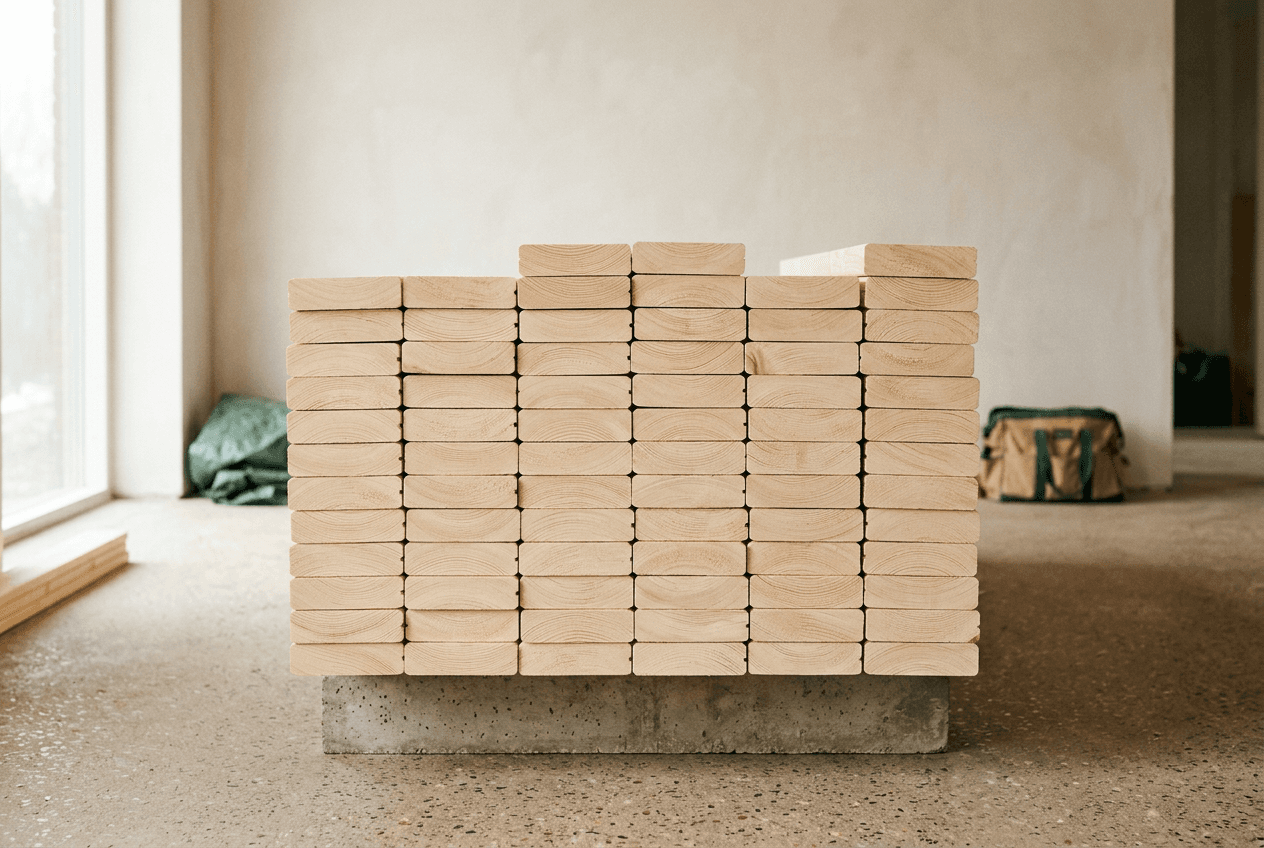
Moscovi is a softwood from **Russian northern Scots pine and Siberian larch graded C18/C24 to GOST 8486**, supplied in 2.4, 3, 4, and 6 m lengths in 5×10 and 5×7.5 cm sections. The economical choice for formwork and non-load framing on Riyadh sites — SAR 18–38 per piece, weekly stock.
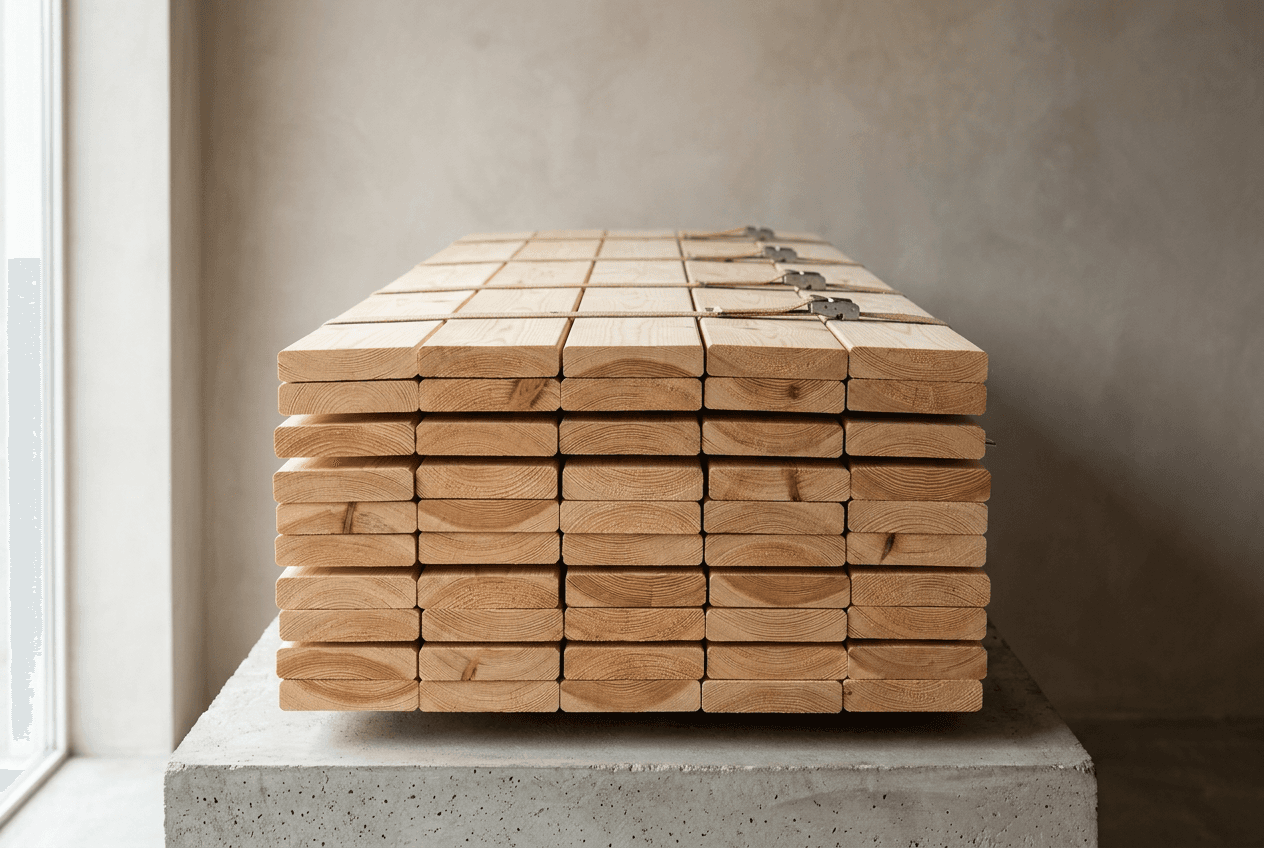
What is Moscovi Russian timber?
Moscovi is a softwood from Russian northern Scots pine (Pinus sylvestris) and Siberian larch (Larix sibirica), graded C18 or C24 under Russian standard GOST 8486. It ships into Saudi Arabia at lengths 2.4, 3, 4, and 6 m in 5×10 and 5×7.5 cm sections — the working choice for formwork and light framing.
The trade name 'Moscovi' references timber loaded at Saint Petersburg and northern Russian ports. Russian timber grows in vast low-light boreal forests producing long fibres and high bending resistance — the cheapest northern timber in the Saudi market while retaining workable structural performance.
Moscovi is typically air-dried rather than kiln-dried, leaving moisture at 18–22% — higher than Swedish or Finnish timber. This requires a longer site acclimatisation period before installation to prevent post-fit-out shrinkage gaps in finished framing.
Why is Moscovi timber used in Saudi projects?
Moscovi is the cheapest northern timber at SAR 18–38 per piece — 20–30% below Swedish at near-equivalent grade. It suits non-visible work like formwork, hidden framing, and temporary bracing where cost is the deciding factor and dimensional perfection or visible appearance is not required.
Russia is the world's largest structural timber producer, exceeding 200 million m³ annually per FAO data, securing Saudi market supply continuity despite global price volatility. This production capacity keeps Moscovi pricing structurally low across market cycles.
On large concrete formwork projects, contractors prefer Moscovi because it is used once or twice and discarded. The low cost makes the loss economically acceptable, unlike premium timber that demands careful storage and re-use cycles to justify the higher unit cost.
What are the specifications of Moscovi timber?
Moscovi ships at C18 or C24 grade to GOST 8486, bending strength 18–24 N/mm², density 440–490 kg/m³, moisture 18–22%. Sections 5×10 and 5×7.5 cm at lengths 2.4, 3, 4, and 6 m, priced SAR 18–38 per piece, with SBC 301 conformity for non-critical work.
| Product name | Russian Moscovi timber |
|---|---|
| Country of origin | Russia |
| Species | Pinus sylvestris / Larix sibirica |
| Lengths (m) | 2.4 · 3 · 4 · 6 |
| Sections (cm) | 5×10 · 5×7.5 |
| Grade | C18 / C24 to GOST 8486 |
| Bending strength | 18–24 N/mm² |
| Parallel compression | 18–21 N/mm² |
| Density | 440–490 kg/m³ |
| Moisture content | 18–22% (air-dried) |
| Knot ratio cap | ≤ 30% of face |
| Certifications | GOST 8486 · SBC 301 |
| Price | SAR 18–38 / piece |
| Availability | Weekly stock |
What are the construction applications of Moscovi timber?
Moscovi serves five core applications: concrete formwork, non-load wall framing, light scaffolding, temporary bracing, and site infrastructure. It is not recommended for structural trusses or visible work due to higher knot allowance and air-drying moisture content above kiln-dried grades.
- 01
Concrete formwork
Studs and bearers behind plywood form sheets for wall and column pours, in 5×10 cm at 2.4 or 3 m lengths. Low cost makes single-use deployment economically acceptable.
- 02
Non-load wall framing
Interior partitions and decorative non-load walls, in 5×7.5 cm. Load-bearing walls require Swedish or Finnish C24 kiln-dried timber, not Moscovi.
- 03
Light scaffolding
Site scaffolding uprights for finishing trades up to 3 m height, in 5×10 cm section. Higher structural work uses metal scaffolding instead of timber.
- 04
Temporary bracing
Diagonal braces and temporary props supporting freshly cast walls and columns before they reach design strength, in 4 and 6 m lengths.
- 05
Site infrastructure
Site barriers, fencing, and temporary site offices, in 5×7.5 cm. Dismantled at project end and typically discarded as recovery is uneconomic.
What is the difference between Moscovi and Swedish timber?
Moscovi is C18/C24 to GOST 8486 at 18–22% moisture (air-dried), while Swedish is C24 to EN 14081 at 12–18% (kiln-dried). Moscovi is 20–30% cheaper and suits formwork; Swedish has higher dimensional stability and suits structural framing and visible work.
The fundamental difference is drying method: kiln drying reduces moisture quickly without warp, while air drying is slower and leaves higher residual moisture. This means Moscovi requires longer site acclimatisation and may shrink after fit-out — making it suitable for non-critical work only.
| Attribute | Moscovi | Swedish |
|---|---|---|
| Country of origin | Russia | Sweden |
| Grade | C18/C24 GOST 8486 | C24 EN 14081 |
| Moisture | 18–22% (air-dried) | 12–18% (kiln-dried) |
| Density | 440–490 kg/m³ | 450–500 kg/m³ |
| Knot ratio cap | ≤ 30% | ≤ 20% |
| Price | SAR 18–38 / piece | SAR 22–90 / piece |
| Recommended use | Formwork, non-load framing | Structural framing, visible work |
When do I choose Moscovi over Swedish or Finnish timber?
Choose Moscovi when the application is non-load-bearing (formwork, temporary bracing, site barriers) and appearance is not critical. Choose Swedish C24 for load-bearing walls and visible framing, and Finnish C30 for structural trusses with large spans. Moscovi's cost only justifies short-life applications.
Per-piece price difference between Moscovi and Swedish runs SAR 10–15, or SAR 1500–2000 across a 150-piece batch. On large projects with heavy formwork volumes, the saving is material. On small projects with limited quantities, the difference is marginal — Swedish becomes the better choice for the quality lift.
How is Moscovi timber stored and installed in Riyadh?
Stack on stickers every 60 cm, 15 cm off the ground in a shaded area, and acclimatise for 7–10 days due to its 18–22% moisture content. Fix with 70–120 mm nails. Expect 2–3 mm shrinkage in framing after fit-out as the timber equilibrates to interior humidity.
The differential between Moscovi supply moisture (around 20%) and Riyadh interior humidity (4–8% in summer) is large, driving visible shrinkage. Moscovi is therefore not used in visible work or sun-exposed exterior framing where uneven shrinkage would open joints and gaps.
In concrete formwork, the small post-pour shrinkage is irrelevant because the timber is stripped within seven days. This makes Moscovi practical for formwork where moisture is a non-issue and unit cost dominates the procurement decision in repetitive structural work.
Is Moscovi timber approved under the Saudi Building Code?
Moscovi is approved under SBC 301 for non-critical applications like formwork and non-load framing, carrying the GOST 8486 stamp at C18 or C24. Load-bearing structural work requires Swedish or Finnish timber under EN 14081, the European grade certified for Saudi structural use.
Each shipment arrives with the GOST 8486 certificate, structural grading test report, and shipping invoice from Saint Petersburg port. Documentation suffices for non-critical work under engineer review, but does not satisfy green-building submissions requiring FSC or PEFC chain-of-custody.
Which Saudi projects use Moscovi timber?
Moscovi appears in formwork on Vision 2030 sites including NEOM, Red Sea, and Qiddiya, in non-load framing in villas and residential compounds, in light scaffolding on commercial tower sites, and in temporary site barriers across major infrastructure projects across the Kingdom.
- Vision 2030 mega-projects: NEOM, Red Sea, Qiddiya — concrete formwork on wall and slab pours.
- Villas and compounds in Al Yasmin, Al Narjis — non-load framing and hidden decorative partitions.
- Financial District and Olaya towers — light timber scaffolding during finishing trades.
- Infrastructure and roadworks projects — temporary site barriers and mobile site offices.
What are common questions about Moscovi timber?
**100 pieces** — about a quarter trailer load — is the effective minimum for delivery. Smaller orders ship from our Olaya yard or piggyback on an active project shipment in a nearby district. Supply from weekly stock within 2–4 working days of order confirmation.
Not recommended for structural load-bearing trusses. **C18 to GOST 8486 does not exactly match European C24**, and 18–22% air-dried moisture causes post-install shrinkage that may show in trusses. Swedish or Finnish kiln-dried timber is preferred for trusses.
**C18 carries 18 N/mm² bending strength**; C24 carries 24 N/mm². C18 is the more common Moscovi grade, suitable for formwork and non-load framing. C24 Moscovi is available with a 200-piece minimum at a 15% price premium over C18 stock.
Short-term site use needs no treatment. For deployments exceeding 6 months in damp areas, treat with **Borate or Tanalith preservative** for moisture and insect resistance. Sun-exposed exterior use requires an additional UV-stable topcoat for Riyadh climate.
Not suitable for more than **two re-use cycles** due to higher knot allowance and air-drying shrinkage post first pour. For formwork requiring 5+ cycles, choose kiln-dried Swedish C24 with proper release-oil treatment between cycles to extend service life.
Delivery within **2–4 working days** for orders under 500 pieces from weekly stock. Larger orders are special-ordered with 1000-piece minimum and 3–4 weeks lead time from Saint Petersburg port to Riyadh delivery, including documentation and clearance.
Not standard. Moscovi carries **GOST 8486 certification only**. Projects requiring FSC or PEFC for green-building submissions (Mostadam, LEED) must use Swedish or Finnish timber instead, which carry the European environmental certifications recognised by Saudi authorities.
What products relate to Moscovi Russian timber?
Selections that complement the work in Saudi construction projects.
Need a quote on Moscovi timber?
Send a list of sections, lengths, quantities, and delivery site. We respond with a formal quote within 4 working hours — unit price, total, lead time, and certificates included.