Construction timber · general structural pine
Pine timber
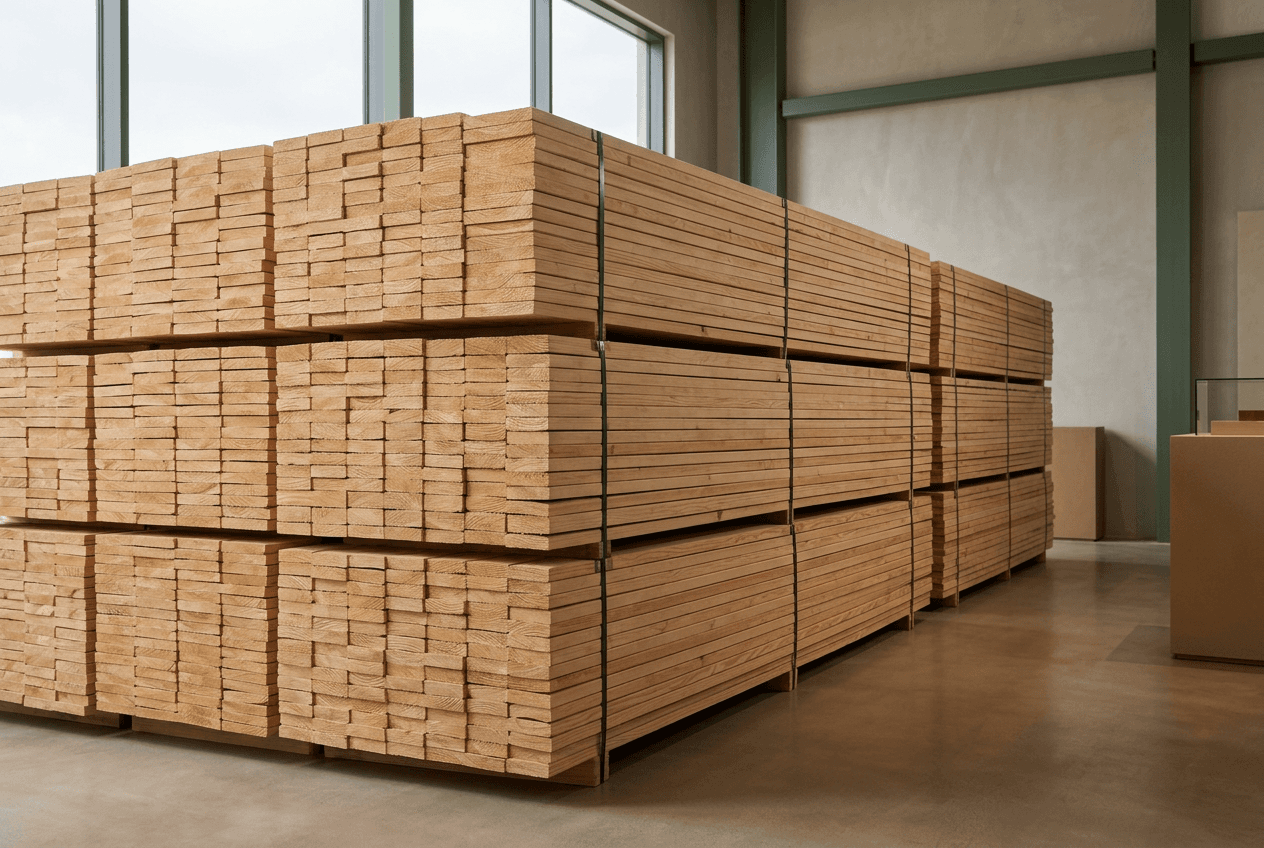
Pine timber is **Pinus sylvestris from Sweden, Finland, Russia, and Brazil graded C18/C24 to EN 14081**. The most widely-used construction timber on Riyadh sites, in 5×10, 5×15, and 10×10 cm sections at 3 to 6 m lengths, priced SAR 18–40 per piece — daily Riyadh stock with multiple origins available.
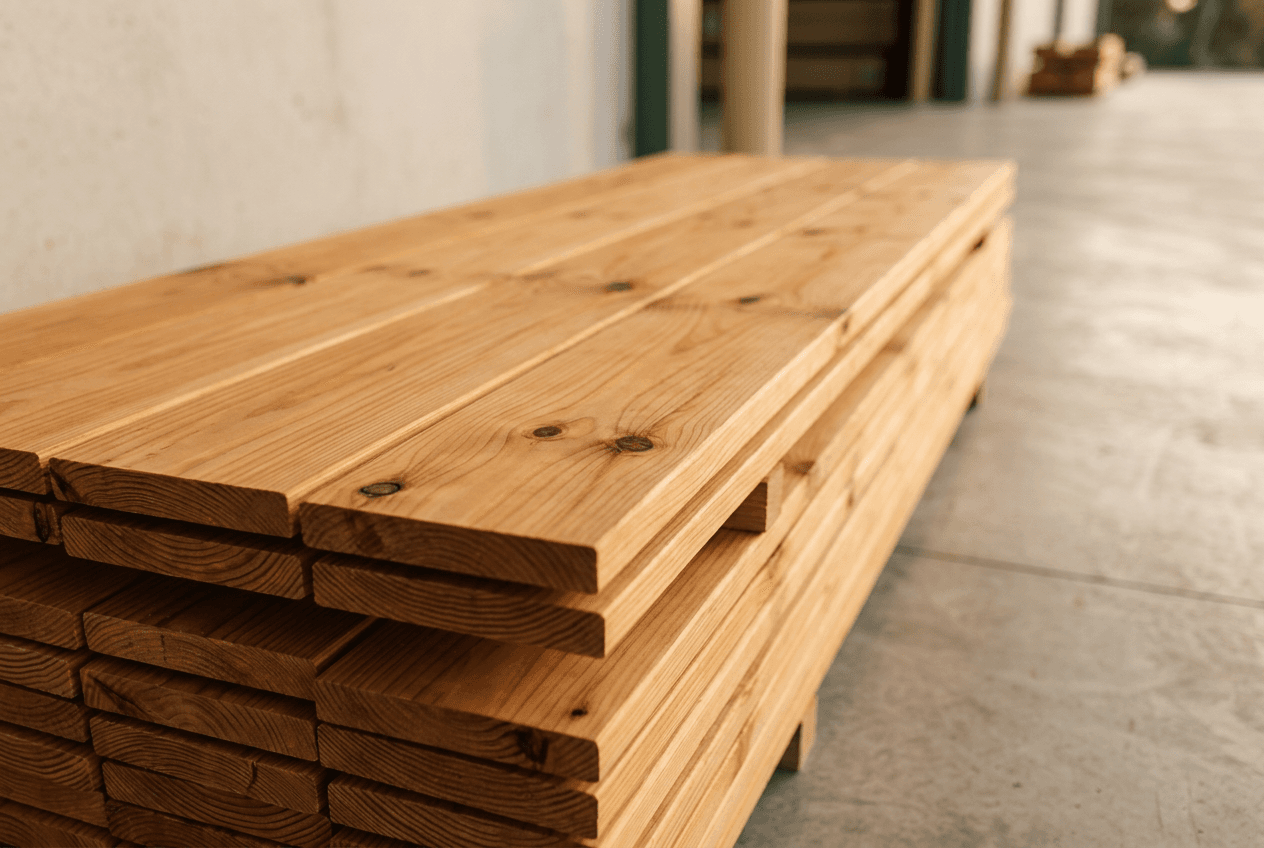
What is structural pine timber?
Pine timber is a softwood from Scots pine (Pinus sylvestris) grown in Sweden, Finland, Russia, and Brazil, graded C18 or C24 under EN 14081. It is the most widely-used construction timber globally, supplied to Saudi Arabia in varied sections and lengths up to 6 metres for diverse residential and commercial applications.
The label 'pine' in the Saudi market includes Pinus sylvestris of any northern European or Brazilian origin. Differences between Swedish, Finnish, Russian, and Brazilian pine relate to drying method, knot ratio, and grading rather than the underlying species. Swedish and Finnish pine are kiln-dried; Russian is air-dried; Brazilian is mixed.
Pine ships with PEFC and sometimes FSC chain-of-custody and carries the C18 or C24 grade stamp on each piece. Per-piece pricing runs SAR 18–40 depending on origin, section, and length — making it the most cost-effective reliable structural timber in the Saudi market.
Why is pine the most-used timber on Saudi projects?
Pine is the most-used timber because it pairs continuous multi-source availability, reliable C24 structural grade, and low SAR 18–40 per piece pricing. This combination makes it the default choice for framing, furniture, and formwork on most Saudi sites — from villas through to large commercial towers across the Kingdom.
Per FAO data, world pine production exceeds 400 million m³ annually, making it the most supply-stable structural timber in trade. This production capacity keeps prices stable and prevents supply interruption even during global market disruption affecting other timber categories.
Multi-origin sourcing (Sweden, Finland, Russia, Brazil) gives contractors flexibility to choose by budget and required quality. Premium villa projects choose Swedish and Finnish; economy housing chooses Russian and Brazilian — all the same Pinus sylvestris species at different price-grade combinations.
What are the specifications of structural pine timber?
Pine ships at C18 or C24 to EN 14081, bending strength 18–24 N/mm², density 440–500 kg/m³, moisture 12–22% by origin. Sections 5×10, 5×15, and 10×10 cm at 3, 4, and 6 m lengths, with PEFC, CE marks and SBC 301 conformity, priced SAR 18–40 per piece from daily Riyadh stock.
| Product name | Structural pine timber |
|---|---|
| Origin | Sweden / Finland / Russia / Brazil |
| Species | Pinus sylvestris |
| Lengths (m) | 3 · 4 · 6 |
| Sections (cm) | 5×10 · 5×15 · 10×10 |
| Grade | C18 / C24 to EN 14081 |
| Bending strength | 18–24 N/mm² |
| Parallel compression | 18–21 N/mm² |
| Density | 440–500 kg/m³ |
| Moisture content | 12–22% by origin |
| Knot ratio cap | ≤ 20–30% of face |
| Certifications | CE · PEFC · SBC 301 |
| Price | SAR 18–40 / piece |
| Availability | Daily stock |
What are the construction applications of pine timber?
Pine timber serves five core applications: general villa construction, timber furniture, concrete formwork, structural framing, and site temporary work. It is the multi-purpose timber covering 70% of Saudi site needs thanks to broad availability and operational flexibility on residential and commercial projects.
- 01
General villa construction
Structural framing, roof trusses, and opening lintels in villas and rest houses, in 5×10 and 5×15 cm sections sized to engineer's structural calculation.
- 02
Timber furniture
Carcasses for cabinets, bookshelves, and beds, in 5×7.5 cm. The golden pine tone accepts clear varnish and traditional stains, completing classical decor.
- 03
Concrete formwork
Studs and bearers behind plywood form sheets for wall and column pours, in 5×10 cm. Low pricing justifies single-use or two-cycle deployment.
- 04
Structural framing
Load-bearing wall studs at C24 grade, 5×10 cm at 40 cm centres. For non-load partitions, C18 stock is acceptable at 10–15% lower cost than C24.
- 05
Site temporary work
Site barriers, temporary site offices, canopies, and workshops, in 5×7.5 cm at 3 or 4 m lengths. Low cost makes end-of-project disposal economically acceptable.
What is the difference between Swedish and Brazilian pine?
Swedish grows slowly in cold climate at 450–500 kg/m³, C24 to EN 14081, 12–18% moisture (kiln). Brazilian grows fast in tropical climate at 440–480 kg/m³, C18/C24, 15–20% moisture. Swedish is more dimensionally stable and suits premium projects; Brazilian is 15–20% cheaper.
The fundamental difference is growth rate and density: Swedish pine grows slowly with narrow annual rings and uniform density, while Brazilian pine grows fast with greater moisture variability. Swedish therefore remains the structural standard, while Brazilian serves as an acceptable economical alternative for non-critical work.
| Attribute | Swedish pine | Brazilian pine |
|---|---|---|
| Country of origin | Sweden | Brazil |
| Growth rate | Slow (cold climate) | Fast (tropical) |
| Density | 450–500 kg/m³ | 440–480 kg/m³ |
| Grade | C24 EN 14081 | C18 / C24 |
| Moisture | 12–18% (kiln) | 15–20% |
| Price | SAR 22–90 / piece | SAR 18–32 / piece |
| Recommended use | Structural and visible | Economy and non-visible |
How do I choose the right pine origin for my project?
Choose Swedish/Finnish for visible structural work, Russian for formwork and non-load framing, and Brazilian for furniture and economy decor. Rule: the more structural or visible the application, the more justifying northern European origin; the more temporary or non-critical, the more acceptable Brazilian or Russian origin.
Per-piece pricing differs 20–30% between Swedish and Brazilian, so the decision hinges on budget and application criticality. Premium villa projects with open budgets specify Swedish/Finnish; economy housing with constrained budgets specifies Russian/Brazilian to meet structural minimums at lower cost.
How is pine timber stored and installed in Riyadh?
Stack pine on stickers every 60 cm, 15–20 cm off the ground in a shaded area. Acclimatise 3–7 days depending on origin moisture. Fix with 70–120 mm nails. Expect minor shrinkage in Russian and Brazilian pine due to higher moisture content at supply.
For exterior use, treat pine with preservatives (Tanalith, Wolmanit) for moisture and ground-insect resistance. Swedish and Finnish kiln-dried pine acclimatise in 3 days; Russian and Brazilian require 7 days to reduce the moisture differential against interior site conditions.
Seal end-grain with a moisture barrier before exterior installation, and leave 2 mm expansion gaps in long frames. Use galvanised helical nails throughout to resist corrosion from fresh mortar moisture and ambient salt at sites near the coast.
Is pine timber approved under the Saudi Building Code?
Pine is approved under SBC 301 structural requirements for load-bearing work at C24 grade, carrying the EN 14081 stamp (Swedish/Finnish) or equivalent quality certification (Russian/Brazilian). PEFC and FSC environmental certificates required for green-building projects ship standard with Swedish and Finnish stock.
Each shipment ships with mill certificate of origin, structural grading test, density and moisture reports, and shipping invoice. Documentation suffices for engineer review on all villa, residential, and commercial projects under Riyadh and Greater Saudi municipal authority requirements.
Which Saudi projects use pine timber?
Pine is used on most Vision 2030 projects including NEOM, Red Sea, Qiddiya, in villas and residential compounds across all Riyadh districts, in commercial towers and retail centres, and in AlUla and Diriyah resorts. It is the default timber covering most Saudi-site needs across project types.
- Vision 2030 mega-projects: NEOM, Red Sea, Qiddiya, Diriyah — general construction, framing, formwork, and finishing trades.
- Villas and residential compounds across all Riyadh districts — load-bearing framing, opening lintels, and interior doors.
- Financial District towers and retail centres — timber scaffolding, formwork, and interior decor.
- AlUla and Al Baha resorts — gable roof framing, pergolas, and timber tourist cabin construction.
What are common questions about pine timber?
**50 pieces** — about a quarter trailer load — is the effective delivery minimum. Smaller orders pick up from our Olaya yard. Pine ships from daily stock with delivery within 24–48 hours of order confirmation across most major Riyadh districts.
**C24 carries 24 N/mm² bending strength; C18 carries 18 N/mm²**. C24 is approved for load-bearing structural work in the Kingdom; C18 is for non-load applications. Per-piece price differs 10–15%, with C24 specified for load-bearing walls and C18 for partitions and decor.
In interior use protected from moisture, pine lasts **over 50 years** without significant degradation. In untreated exterior use, lifespan is 5–10 years before signs of decay. Tanalith treatment extends exterior life to 25+ years even in harsh climate exposure.
Pine is **not naturally resistant to termites and ground insects**. For exposed deployments, treat with Borate or Tanalith E preservative for insect and fungal resistance. Interior use away from soil contact requires no further treatment beyond the original mill kiln-drying.
Not suitable for high-traffic visible floors due to lower density (440–500 kg/m³). For floors, **oak or beech** at 700+ kg/m³ are preferred. Pine is suitable as parquet subfloor and for decorative floors in lower-traffic tourist cabins and rural rest houses.
Yes — Swedish and Finnish pine carry standard **PEFC and FSC certificates** for sustainable forest management. Russian pine carries GOST 8486 only; Brazilian pine sometimes carries FSC. Green-building projects (Mostadam, LEED) use Swedish/Finnish for the recognised certifications.
Cracking results from rapid drying in direct sun. To prevent: store under shade, **seal end-grain with End Sealer compound**, and lightly moisten before installation in summer. Gradual drying prevents checking and preserves dimensional stability over the building lifecycle.
What products relate to Pine timber?
Selections that complement the work in Saudi construction projects.
Need a quote on pine timber?
Send a list of sections, lengths, quantities, and delivery site. We respond with a formal quote within 4 working hours — unit price, total, lead time, and certificates included.