Construction timber · Canadian Douglas fir & SPF
Canadian timber
Canadian timber is structural softwood from **Douglas fir (Pseudotsuga menziesii) and SPF (spruce, pine, fir) graded NLGA No.1**, with density 480–550 kg/m³ and a natural golden-brown colour. Stocked on order in large sections up to 10×15 cm and lengths to 6 m for major structural and rustic decorative projects, priced at SAR 30–75 per piece.
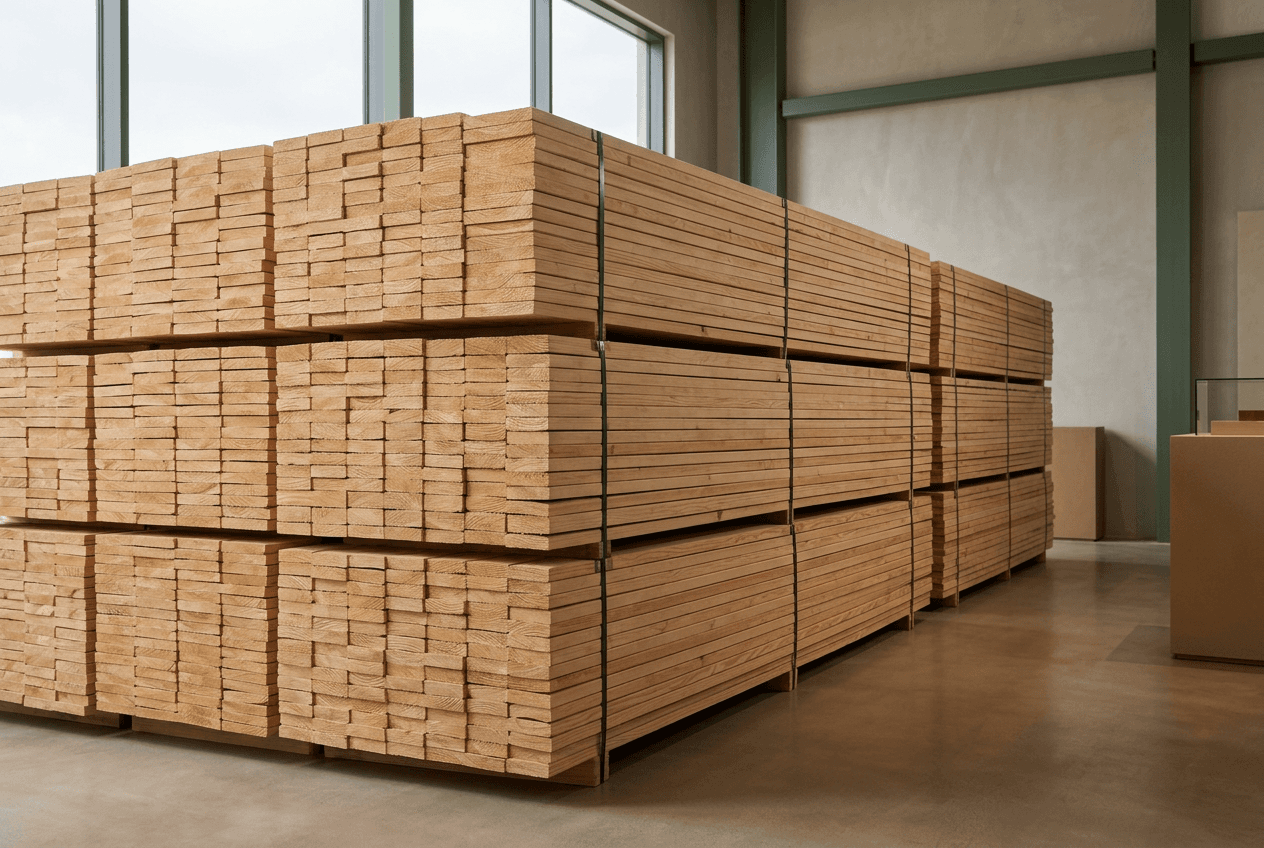
What is Canadian structural timber?
Canadian timber is structural softwood from Douglas fir (Pseudotsuga menziesii) and SPF (spruce-pine-fir blend) grown in the forests of British Columbia and Alberta, graded NLGA No.1 to the Canadian standard CSA O141. It reaches the Saudi market by special order for large truss work, exposed-roof structures, and rustic decorative projects.
British Columbia produces 60% of Canadian structural lumber according to Statistics Canada, and its forests are characterised by a 90–120-year rotation that produces high-density timber with long fibres. Douglas fir specifically is the strongest commercial pine species, with bending strength of 24–30 N/mm² in NLGA No.1 grade.
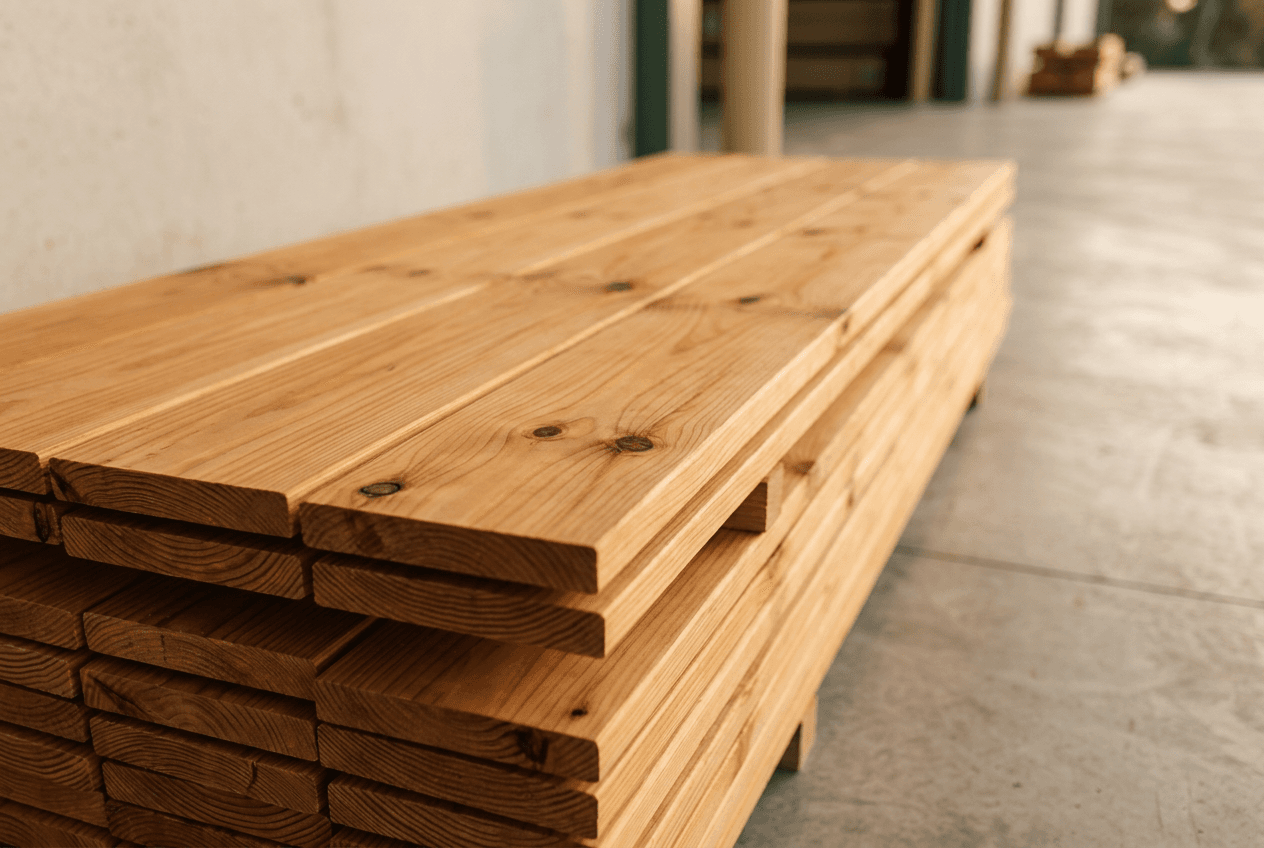
The natural colour is golden-brown with a darker red core — a visual signature distinguishing it from lighter Scandinavian pine. This colour is sought-after for rustic décor and visible exposed truss roofs, where the wood is left in its natural shade after a clear oil finish without staining.
Why is Canadian timber chosen for large structural work?
Canadian timber combines density 480–550 kg/m³, NLGA No.1 (≈ C24) grading, large sections to 10×15 cm, and lengths to 6 m. These specifications make it the strongest softwood available in the Saudi market for large trusses and visually exposed roofs spanning multiple metres.
Douglas fir specifically carries structural loads 20% higher than Swedish pine of the same section, making it the mandatory choice for trusses spanning ≥ 5 m. A licensed engineer may specify Douglas fir explicitly for large-roof projects without accepting Swedish or Finnish substitution.
The natural golden-brown colour is highly desired in American and Canadian rustic décor and mountain-style resorts. The wood is left in its natural shade without staining and finished only with clear natural oil that preserves colour and accentuates the long, straight grain.
What are the specifications of Canadian timber?
Canadian timber ships graded NLGA No.1 to CSA O141, equivalent to European C24 — bending strength 24–30 N/mm², density 480–550 kg/m³, moisture 12–19%. Sections are 5×10, 5×15, and 10×15 cm in lengths of 3, 4, and 6 m, with FSC and SBC 301 certification, priced at SAR 30–75 per piece.
| Product name | Canadian structural timber |
|---|---|
| Country of origin | Canada — British Columbia |
| Species | Pseudotsuga menziesii / SPF |
| Lengths (m) | 3, 4, 6 |
| Cross-sections (cm) | 5×10, 5×15, 10×15 |
| Grade | NLGA No.1 / C24 |
| Bending strength | 24–30 N/mm² |
| Parallel compression | 22–24 N/mm² |
| Density | 480–550 kg/m³ |
| Colour | Golden-brown with red heartwood |
| Moisture | 12–19% (kiln-dried KD-19) |
| Max knot ratio | ≤ 15% of face (NLGA No.1) |
| Certifications | NLGA · CSA O141 · FSC · SBC 301 |
| Indicative price | SAR 30–75 per piece |
| Availability | Special order |
What are the applications of Canadian timber in construction?
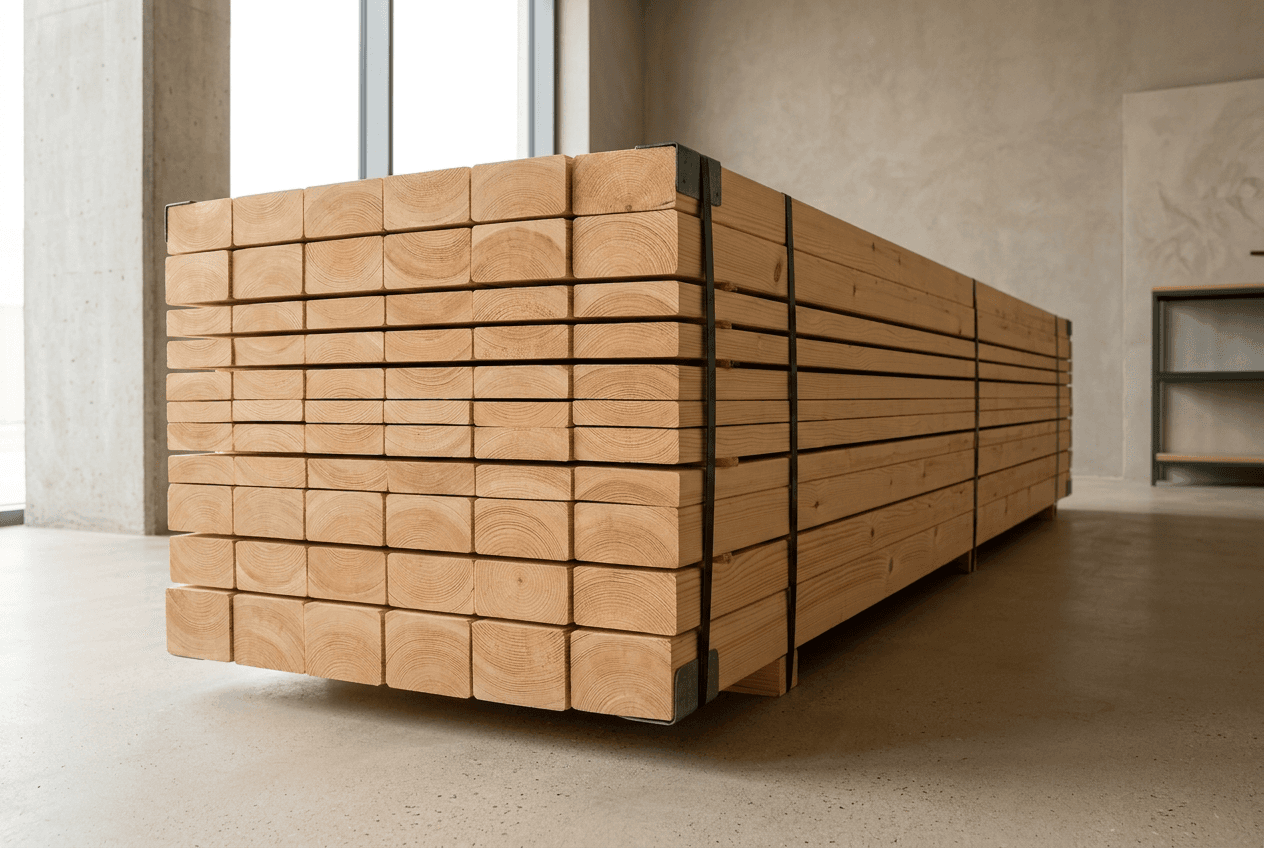
Canadian timber serves five primary uses: large-span trusses ≥ 5 m, visually exposed roofs, rustic décor, large pergola posts, and structural framing in resorts. It is the strongest structural choice for projects requiring large spans combined with a visible natural-wood appearance.
- 01
Large-span trusses
Truss top chords spanning 5–6 m in luxury villa halls and resorts, in 10×15 cm section and NLGA No.1 grade for the dead and live loads of exposed gabled roofs.
- 02
Visually exposed roofs
Beams of visible gabled roofs in rustic villas and mountain resorts, in 5×15 or 10×15 cm sections. Finished with clear oil that brings out the natural golden-brown colour.
- 03
Rustic décor
Decorative ceiling beams in classical American and Canadian-style villas, in 5×10 cm section. The natural yellow-brown colour eliminates the need for staining and conveys an authentic rustic feel.
- 04
Large pergola posts
Vertical posts for pergolas at heights of 5–6 m in resorts and large estates, in 10×15 cm section with galvanised steel base plates fixing the posts to floor pavers.
- 05
Resort structural framing
Tourist cabin and mountain-resort framing in Al-Ula and Al-Bahah, in 5×10 cm section. NLGA No.1 grading guarantees wind- and snow-load resistance (in higher elevations).
What is the difference between Canadian and Swedish timber?
Canadian has density 480–550 kg/m³, NLGA No.1 ≈ C24, sections to 10×15 cm and lengths to 6 m, and a natural golden-brown colour. Swedish has 450–500 kg/m³, C24 EN 14081, sections to 5×10 cm and lengths to 3.9 m, and a lighter colour. Canadian is 20% stronger; Swedish is 30% cheaper and stocked daily.
Canadian is the choice for large-span trusses and natural-coloured rustic décor; Swedish is the choice for standard framing at lower cost with daily stock. The price gap between the two is 25–40%, so the decision depends on whether large spans and natural wood colour are required. For projects without those needs, Swedish is more economical.
Canadian timber's special-order availability requires 4–6 weeks of advance planning, so urgent projects favour Finnish C30 (faster availability). For projects planned ahead and seeking structural quality and natural appearance, Canadian remains the optimal choice.
| Attribute | Canadian | Swedish |
|---|---|---|
| Species | Douglas fir / SPF | Pinus sylvestris |
| Density | 480–550 kg/m³ | 450–500 kg/m³ |
| Grade | NLGA No.1 / C24 | C24 EN 14081 |
| Largest section | 10×15 cm | 5×10 cm |
| Longest length | 6 m | 3.9 m |
| Colour | Natural golden-brown | Light golden |
| Indicative price | SAR 30–75 / piece | SAR 22–90 / piece |
| Availability | Special order | Daily stock |
When should I choose Canadian over Swedish or Finnish timber?
Choose Canadian when the structural span is ≥ 5 m, the roof is visually exposed and a golden-brown colour is desired, or the engineer specifies Douglas fir explicitly. For shorter spans and standard framing, Swedish and Finnish are more economical with daily stock and 25–40% lower cost.
Canadian timber's special-order availability requires 4–6 weeks of advance planning. Urgent projects must consider Finnish C30 (faster availability). For projects planned in advance and seeking structural quality and a natural look, Canadian remains the right answer.
How is Canadian timber stored and installed in Riyadh?
Canadian timber is stored on wood spacers every 70–80 cm at 15–20 cm above ground in a shaded, level site. Allow 5–7 days for site acclimation. Installation uses 100–150 mm screws for large sections and bolted metal connectors for tight engineered truss assemblies.
For large 10×15 cm sections at 6 m lengths, transport requires flatbed trucks of at least 7 m, and lifting on site requires a forklift or boom truck due to the high per-piece weight (≥ 50 kg).
For visually exposed roofs, select pieces with the fewest knots and finish with a natural oil such as Tung Oil or Linseed Oil that preserves the colour and gives a satin finish acceptable for rustic décor. Use galvanised black screws to harmonise with the brown wood tone.
Is Canadian timber approved under the Saudi Building Code?
Canadian timber is approved under SBC 301 structural for load-bearing work, carrying the NLGA No.1 stamp per Canadian CSA O141, equivalent to European C24 grading. The certification is accepted in Saudi construction schedules with shipment documents proving origin and meeting structural-test requirements specified by the consulting engineer.
Each shipment includes the NLGA stamp from the Canadian mill, structural-stress test reports per CSA O86, density and moisture reports, the shipping invoice from the port of Vancouver, and a container content list. These documents satisfy consultant review on resort and luxury-villa projects across the Kingdom.
Which Saudi projects use Canadian timber?
Canadian timber is used in Vision 2030 projects such as NEOM, Red Sea, and Qiddiya, in rustic-style luxury villas in Al Yasmin and Al Malqa, in boutique hotels in historic Diriyah, and in mountain resorts in Al-Ula and Al-Bahah for large gabled roof trusses and visually exposed décor in natural wood colour.
- Vision 2030 projects: NEOM, Red Sea, Qiddiya — for trusses in large administrative halls and structures with exposed roofs.
- Rustic luxury villas in Al Yasmin and Al Malqa — for visible gabled roofs and large pergola posts.
- Boutique hotels in historic Diriyah — for structural trusses in large halls and heritage-style décor.
- Mountain resorts in Al-Ula and Al-Bahah — for tourist cabins and large pergolas in natural rustic décor.
What are common questions about Canadian timber?
Special-order minimum is **100 pieces** for standard sections, or 50 pieces for large 10×15 cm sections. Lead time is 4–6 weeks from the port of Vancouver to Riyadh, including customs clearance and inland transport to the project site.
**Douglas fir is high-density structural timber (520–550 kg/m³)** with bending strength 30 N/mm² and golden-brown colour. SPF (Spruce-Pine-Fir) is a blend with density 480–520 kg/m³, bending strength 24 N/mm², and lighter colour. Douglas fir is 20% stronger and pricier; SPF is the economical choice for less critical work.
Douglas fir is **moderately resistant to termites and ground-dwelling insects** because of its natural resin content. Outdoor ground-contact use still requires additional treatment with Borate or Tanalith for full protection. Indoor use needs no treatment.
Douglas fir is **15–20% harder than Swedish pine**, so it requires sharp carbide-toothed cutting tools. Simple cuts with a hand saw are possible; complex shaping requires power tools. Drilling needs a pilot hole before fixing large screws.
Untreated Douglas fir lasts **10–15 years** outdoors before signs of decay, longer than ordinary pine. With Tanalith E treatment and UV-resistant coating, service life reaches 30+ years. This makes it the preferred choice for tourist resorts with exterior wood décor.
Yes — Canadian timber ships with **FSC C015007** or equivalent certification for sustainable forest management. Certification is required for green-building projects (Saudi Mostadam and LEED) and for environmentally certified luxury tourist resort projects.
Natural Canadian is **SAR 30–75 per piece**; glulam is SAR 120–250 per equivalent piece. Glulam is composed of glued laminations and spans 7+ m. For spans up to 6 m, natural Canadian is more economical and aesthetically preferable for its uniform natural grain.
What products relate to Canadian timber?
Selections that complement the work in Saudi construction projects.
Need a quote on Canadian timber?
Send a list of sections, lengths, quantities, and the delivery site. We respond with a formal quote within 4 working hours — unit price, total, and lead time included.