Engineered panels · medium-density fibreboard
MDF
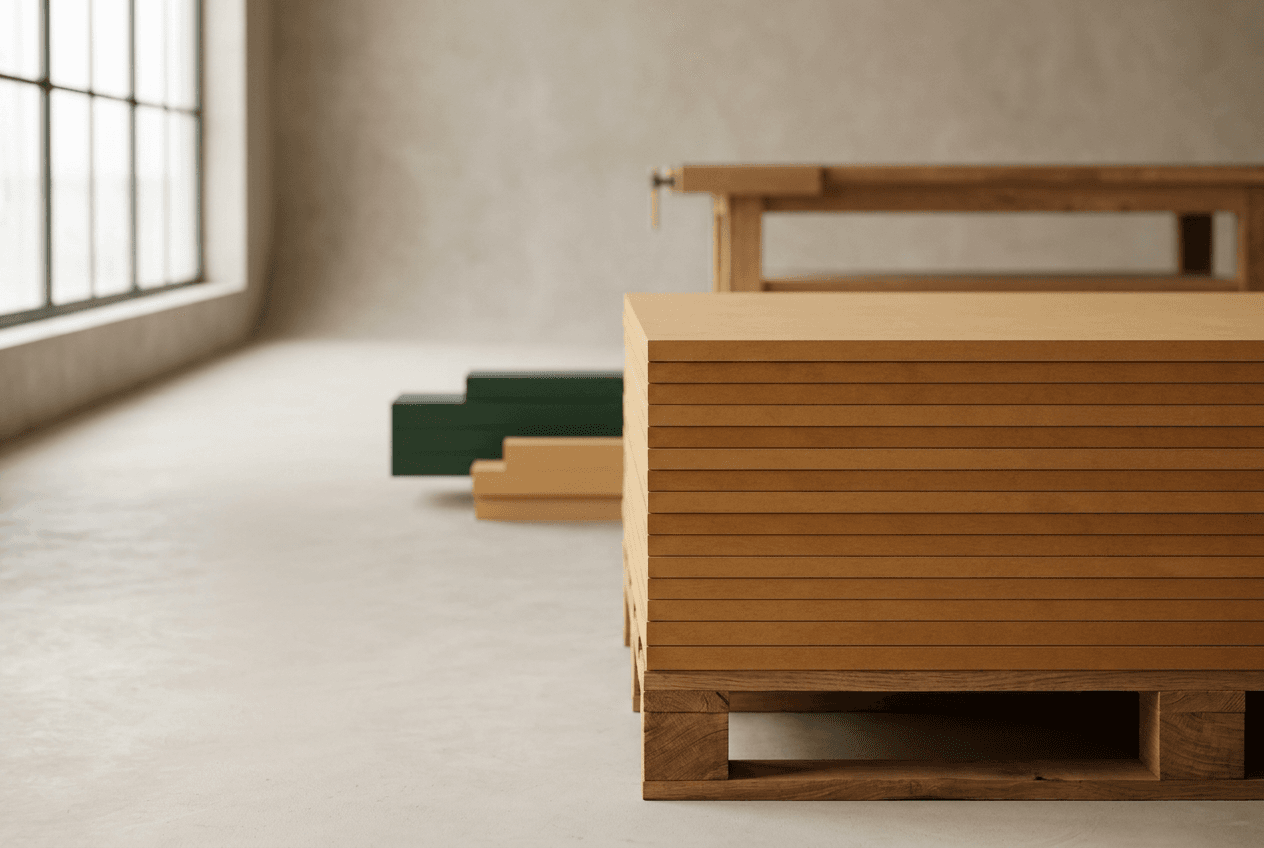
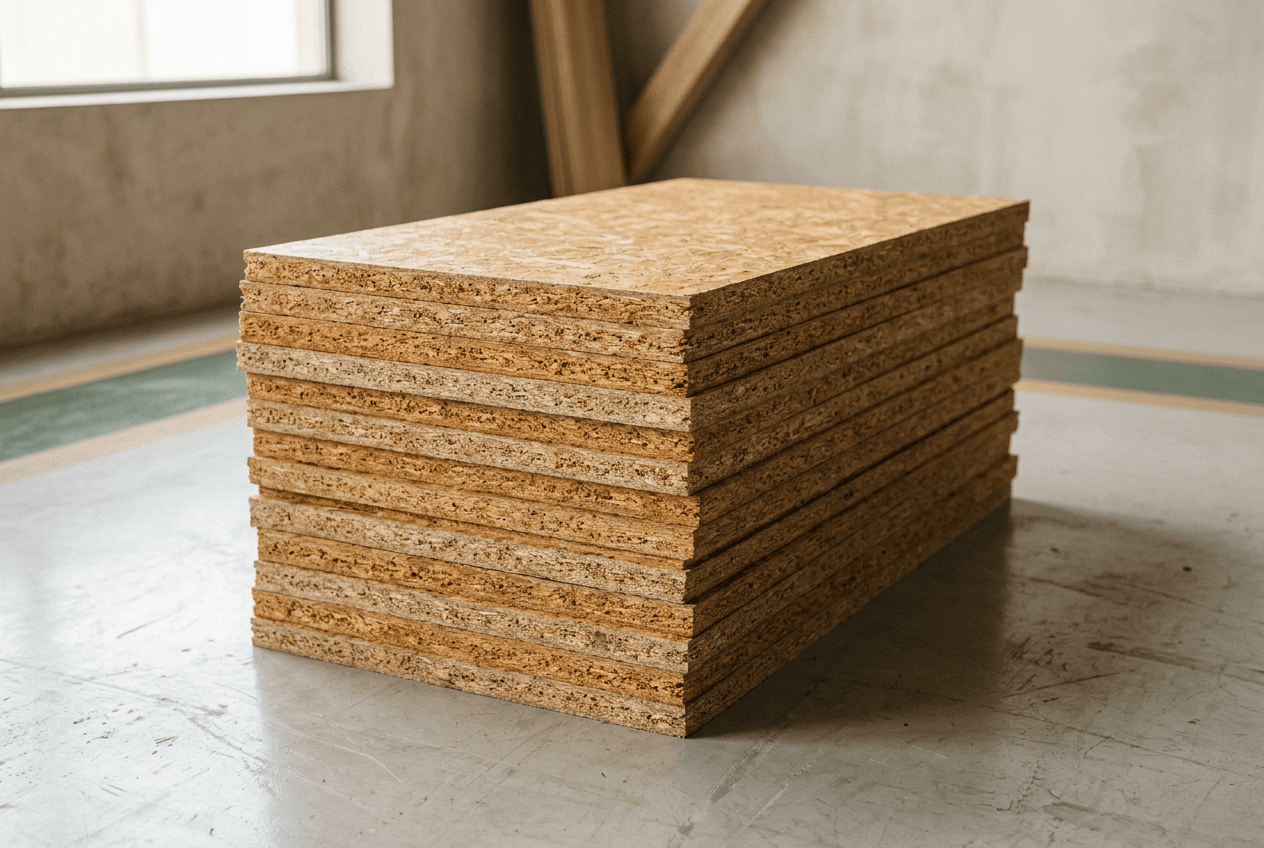
MDF (medium-density fibreboard) is an engineered panel pressed from refined wood fibres bonded with synthetic resin under heat and pressure. Stocked in Riyadh **at 183×244 cm with thicknesses of 6, 9, 12, 15, 18, and 25 mm** — the workhorse panel for furniture carcasses, interior doors, decorative wall panelling, and joinery on Saudi sites.
What is MDF board?
MDF is an engineered wood panel pressed from refined softwood and hardwood fibres bonded with urea-formaldehyde resin under heat and pressure. Density is 720–780 kg/m³ — denser than particleboard and more uniform than plywood. The Riyadh standard sheet is 183×244 cm at thicknesses 6 to 25 mm.
MDF production follows EN 622-5 — the European standard for dry-conditions fibreboard. Wood fibres are refined to a uniform texture, mixed with resin and wax, then hot-pressed into a homogeneous panel with no grain, no knots, and no voids. The result is a sheet with consistent density edge-to-edge.
Because MDF has no fibre direction, it routes, drills, and shapes cleanly in every direction. Furniture manufacturers and joinery shops select MDF for its smooth, paint-ready face and its predictable behaviour on CNC machines, where plywood and particleboard chip or tear.
Why is MDF used in furniture and interiors?
MDF combines a smooth paintable surface with bending strength of 23 N/mm² and density of 720–780 kg/m³, making it the default substrate for cabinet doors, painted carcasses, mouldings, and decorative panelling. Cost is 30–40% lower than equivalent plywood, and the surface accepts paint, melamine, veneer, or PVC foil directly.
MDF holds detail in routed edges and profiled mouldings that plywood and particleboard cannot. Joinery shops in Riyadh route raised-panel doors, decorative wall trim, and cornices from 18 mm MDF, paint them, and deliver a finish indistinguishable from solid wood at 40% of the cost.
The uniform fibre core prevents the surface telegraphing of grain or knots through paint — the dominant defect in painted plywood. This makes MDF the specification of choice for white painted furniture, lacquered doors, and high-gloss kitchen fronts across KSA residential projects.
What are the specifications of MDF board?
MDF ships in 183×244 cm sheets at thicknesses 6, 9, 12, 15, 18, and 25 mm, density 720–780 kg/m³, bending strength 23 N/mm², and emissions class E1 / CARB-P2. Each shipment carries EN 622-5 and ANSI A208.2 conformity, with origin certificates from Turkey, Malaysia, UAE, or Saudi Arabia.
| Product name | MDF — medium-density fibreboard |
|---|---|
| Country of origin | Turkey / Malaysia / UAE / Saudi Arabia |
| Thicknesses (mm) | 6 · 9 · 12 · 15 · 18 · 25 |
| Sheet size (cm) | 183 × 244 (standard) |
| Density (kg/m³) | 720 – 780 |
| Bending strength (MOR) | 23 N/mm² |
| Internal bond | ≥ 0.60 N/mm² |
| Modulus of elasticity | 2,700 N/mm² |
| Thickness swell (24 h) | ≤ 12% |
| Emissions class | E1 · CARB-P2 |
| Standards | EN 622-5 · ANSI A208.2 · CARB-P2 · E1 |
| Quality guarantee | Replacement of any out-of-spec sheet |
What are the applications of MDF in construction and interiors?
MDF serves five primary applications: furniture carcasses (18 mm), interior doors (12–18 mm), decorative wall panelling (9–12 mm), routed mouldings and cornices (12–18 mm), and ceiling panels (6–9 mm). Each thickness maps to a structural and finishing context defined by the joiner.
- 01
Furniture carcasses (18 mm)
Painted cabinet boxes, wardrobes, vanity units, and shelving. The 18 mm thickness holds 32 mm system-screw fittings and concealed hinges without splitting.
- 02
Interior doors (12–18 mm)
Flush and panelled door skins for villas, hotels, and offices. MDF accepts paint, primer, and decorative foil with a flawless surface impossible to match in plywood.
- 03
Decorative wall panelling (9–12 mm)
Wainscoting, slat walls, and feature walls in residential and hospitality interiors. Routed grooves and CNC patterns hold sharp edges through paint.
- 04
Routed mouldings and cornices (12–18 mm)
Skirting, architraves, crown mouldings, and door casings. MDF profiles cleanly on shaper and CNC, replacing solid wood at lower cost and zero shrinkage.
- 05
Ceiling panels (6–9 mm)
Suspended decorative ceilings in retail, hospitality, and commercial fit-outs. Light enough to mount on standard T-bar grid, rigid enough to span 60 cm without sag.
What is the difference between MDF and particleboard?
MDF is pressed from refined wood fibres at 720–780 kg/m³, while particleboard is pressed from coarser wood chips at 650–700 kg/m³. MDF routes and paints cleanly; particleboard does not. Particleboard is 30–40% cheaper but limited to flat surfaces and concealed structural use under laminate.
Particleboard remains the cost choice for cabinet boxes finished in melamine, where the substrate is fully concealed. MDF is the working specification for any visible painted face, routed edge, or profiled moulding because the fibre core holds detail and primes uniformly.
Both panels are interior-only without a moisture-resistant grade. For wet zones, specify moisture-resistant MDF (V313) instead of standard MDF or particleboard.
| Attribute | MDF | Particleboard |
|---|---|---|
| Core composition | Refined wood fibres | Coarse wood chips |
| Density | 720–780 kg/m³ | 650–700 kg/m³ |
| Bending strength | 23 N/mm² | 13 N/mm² |
| Surface finish | Smooth, paint-ready | Coarse, requires laminate |
| Routed edge quality | Sharp profile retained | Crumbles on profile |
| Indicative price | SAR 45–130 / sheet | SAR 30–90 / sheet |
| Recommended use | Painted furniture, doors, mouldings | Concealed cabinet boxes under laminate |
How do I choose the right MDF thickness?
Thickness follows function: 6–9 mm for ceilings and door skins, 12 mm for wall panelling and back panels, 15–18 mm for cabinet boxes and doors, and 25 mm for shelving and counters. As span between supports widens or load rises, step up at least one thickness grade.
18 mm is standard for cabinet sides, fixed shelves, and routed door panels — it accepts 32 mm system screws without splitting. 25 mm is used for free-spanning shelves over 80 cm or for thick decorative trim. 12 mm and below should never be drilled for cabinet hardware.
For painted finishes, prefer 15 mm or 18 mm sides — thinner sheets telegraph fastener stress through paint over time. For melamine-faced sides hidden inside the cabinet, particleboard at 16 mm is the cost-equivalent choice.
How is MDF cut, routed, and finished on site?
MDF cuts on a sliding-table saw with a carbide tooth count of 60+ at 4,500 rpm for chip-free edges. Route at 18,000 rpm with a sharp carbide bit. Seal cut edges with primer or PVA before painting to prevent fibre swelling. Use 32 mm system screws or confirmat fasteners — never standard wood screws.
Always wear an FFP2 respirator and use dust extraction during cutting and routing. MDF dust is fine and respirable, and Saudi OSH regulations require local exhaust ventilation in joinery shops processing MDF in volume.
Painting requires two coats of primer with a light 240-grit sand between coats, followed by two finish coats. Skipping the primer leaves visible fibre raise after the first wash. For high-gloss lacquer, add a third primer coat and sand to 320 grit before topcoat.
Does MDF meet Saudi Building Code and emissions requirements?
MDF supplied by Riyadh Timber meets EN 622-5 (European fibreboard standard), ANSI A208.2 (American), and emissions class E1 / CARB-P2, satisfying SBC 201 for residential and commercial interiors. Each shipment ships with mill certificates of origin, density test reports, and formaldehyde emission verification.
E1 caps formaldehyde emissions at 0.124 mg/m³, the level required for bedrooms, kitchens, and children's spaces under the Saudi standard. CARB-P2 is the stricter California Air Resources Board limit, accepted by all KSA hospitality and government project specifications.
Standard MDF is not fire-rated. For egress corridors, hospitals, and hotel public areas requiring SBC 801 compliance, specify fire-retardant MDF at a minimum, or reserve standard MDF for non-critical interior fit-out.
Which Saudi projects use MDF board?
MDF appears in furniture, doors, and interior decor on Vision 2030 sites including NEOM, Red Sea, Diriyah, Qiddiya, and New Murabba, in the King Abdullah Financial District office fit-outs, in private villa joinery in Hittin, Al Malqa, and Al Yasmin, and in retail interiors along King Fahd Road and Al Olaya.
- Vision 2030 mega-projects: NEOM, Red Sea, Diriyah, Qiddiya, New Murabba — joinery sub-contractor supply for hotel and residential fit-out.
- King Abdullah Financial District and Olaya towers — office cabinetry, doors, and decorative wall panelling.
- Villas and gated communities in Hittin, Al Malqa, Al Yasmin, Al Narjis — kitchens, wardrobes, painted internal doors.
- Retail centres and showrooms along King Fahd Road and Al Urubah — display fixtures, ceiling panels, feature walls.
What are common questions about MDF?
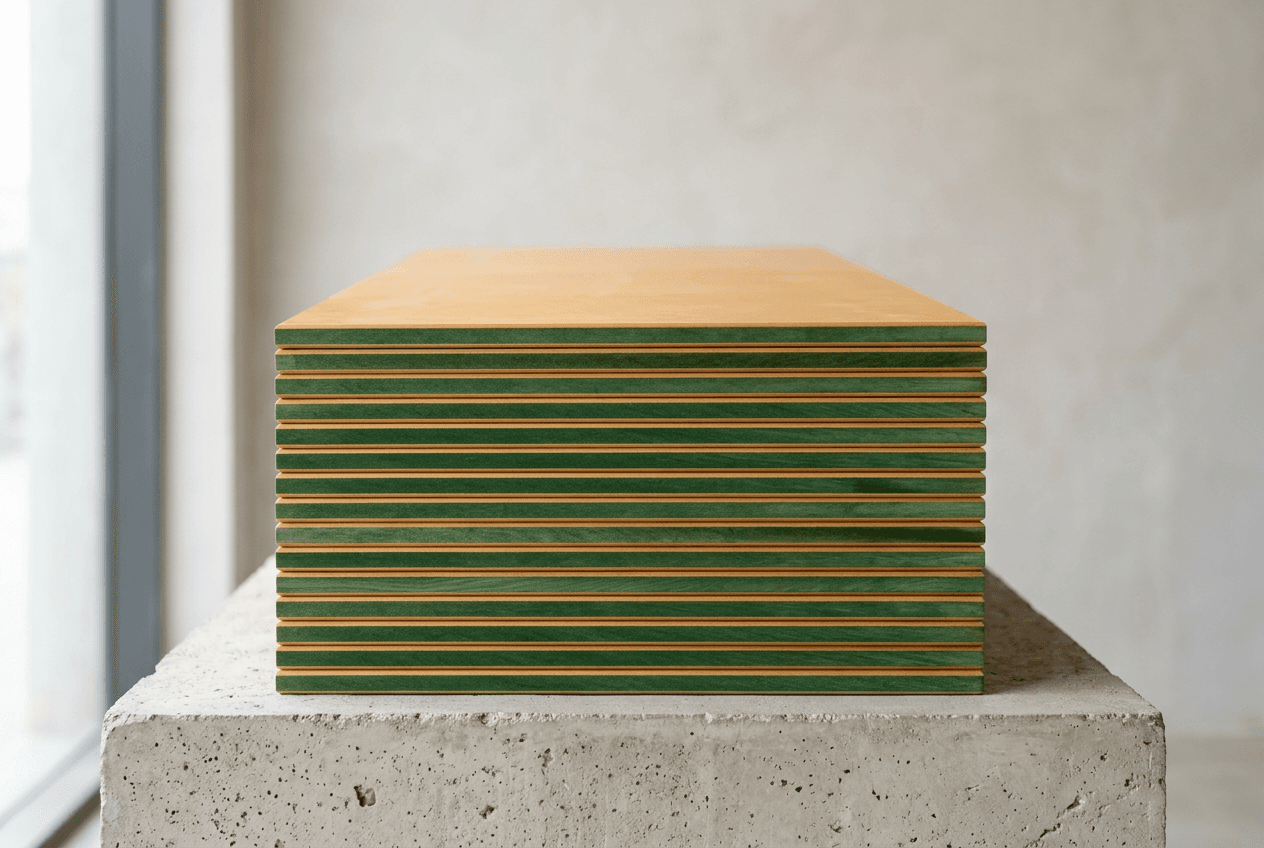
Standard MDF is **not water-resistant** and swells permanently if exposed to liquid water or sustained humidity above 70%. For kitchens, bathrooms, and any wet zone, specify moisture-resistant MDF (V313 grade) — the green-tinted variant designed for humid conditions.
**100 sheets** — the equivalent of a half-trailer load — is the effective minimum for delivery within Riyadh. Smaller orders are picked up from our Olaya yard, or are bundled with an existing project shipment near the joinery workshop to absorb logistics cost.
Standard MDF is acceptable for **cabinet doors, drawer fronts, and decorative panels** in kitchens, especially painted or lacquered. For carcass sides exposed to under-sink condensation, specify moisture-resistant MDF instead — the green-tinted V313 grade.
Riyadh Timber's MDF is rated **E1 — formaldehyde emissions ≤ 0.124 mg/m³** — and CARB-P2, meeting the European, Saudi, and Californian standards for interior residential and commercial use, including bedrooms, kitchens, and children's spaces.
MDF is **not suitable for exterior use**. Sun, rain, and humidity swell the fibre core within weeks. For exterior doors specify solid wood or marine plywood; for exterior cladding specify fibre-cement or HPL panels rated for outdoor exposure.
Our cutting department processes your cut list with **±1 mm tolerance** on a sliding-table saw with chip-free 60-tooth carbide blades. Service is available for all thicknesses up to 25 mm. Cut pieces ship numbered and bundled by drawing reference.
HDF (high-density fibreboard) is a denser MDF variant at **850–950 kg/m³** versus 720–780 kg/m³ for MDF. HDF is used for laminate flooring, cabinet backs, and door skins where high impact resistance and a thinner profile (3–9 mm) are required.
What products relate to MDF?
Selections that complement the work in Saudi construction projects.
Need a quote on MDF for your project?
Send a quantity list with thicknesses and the delivery site. We respond with a formal quote within 4 working hours — unit price, total, lead time, and certificates included.