Engineered panels · high-density fibreboard
HDF
HDF (high-density fibreboard) is a denser variant of MDF pressed at higher pressure to **850–950 kg/m³**, used where impact resistance and a thinner profile are required. Stocked in Riyadh **at 183×244 cm with thicknesses of 3, 4, 6, and 9 mm** — the production substrate for laminate flooring, cabinet backs, and internal door skins.
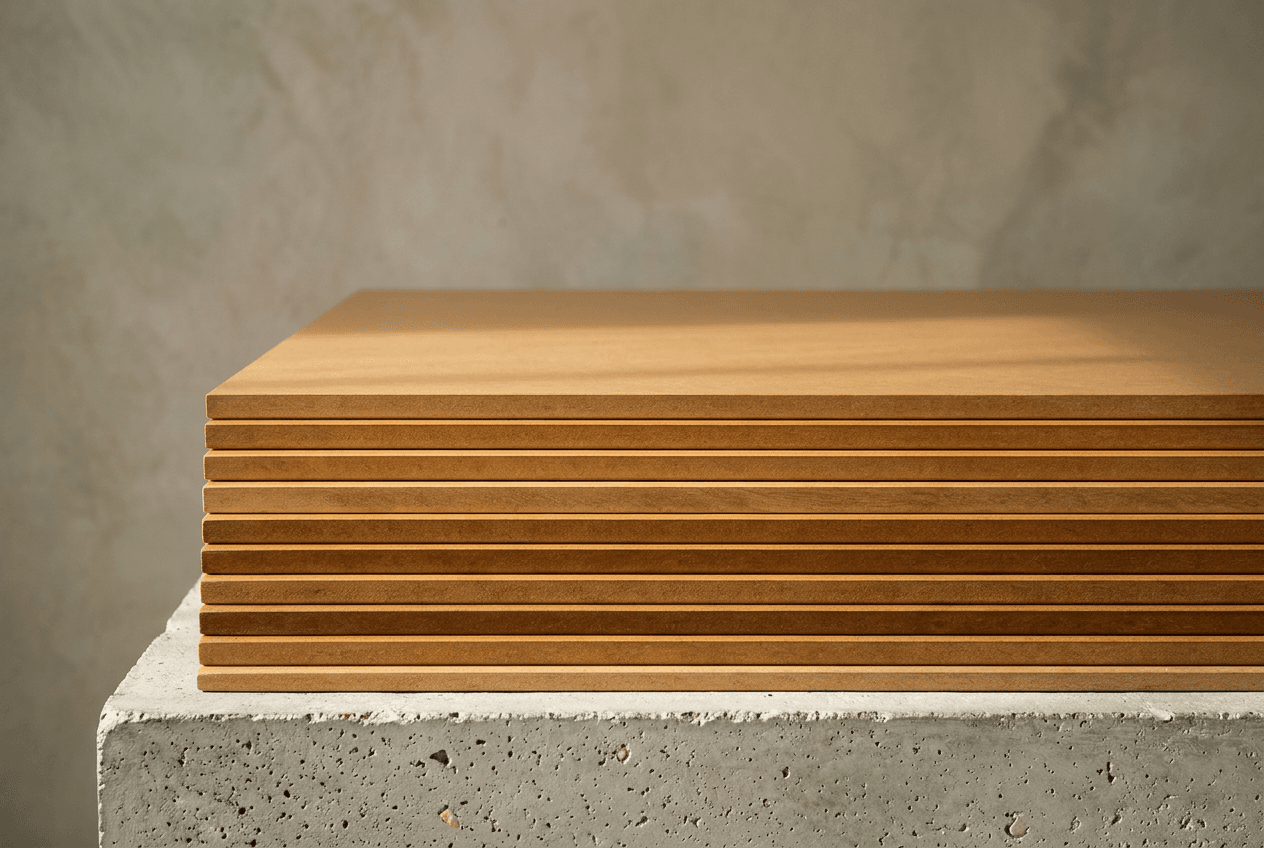
What is HDF board?
HDF is a high-density fibreboard pressed from refined wood fibres at 850–950 kg/m³ — about 20% denser than MDF. Production follows EN 622-5 and ISO 16895. The higher density provides bending strength of 34 N/mm² (vs 23 N/mm² in MDF), allowing thinner profiles of 3–9 mm to carry equivalent load.
HDF is manufactured by the same wet- or dry-process line as MDF, but with finer fibre refinement, higher resin loading, and pressing pressure of 350–500 N/cm² versus 200–300 for MDF. The higher pressure compresses the fibre matrix to a glass-smooth face suitable for laminate flooring overlay.
Density is the defining specification: at 900 kg/m³, HDF approaches solid wood density, allowing 3 mm sheets to perform structurally where 9 mm MDF or 12 mm plywood would otherwise be required. This thickness reduction is the cost driver in flooring and door-skin applications.
Why is HDF used for laminate flooring and door skins?
HDF is the global standard core for laminate flooring because the 900 kg/m³ density resists 1,500 N concentrated point load impact required by EN 13329, while the smooth face accepts melamine flooring overlay without telegraphing. For door skins, 3–4 mm HDF replaces 6–9 mm plywood at lower cost and weight.
Click-lock laminate flooring depends on HDF's stable density for the precision-machined tongue-and-groove edge that locks panels together without glue. MDF is too soft to hold the click profile under foot traffic; HDF retains the lock geometry across a 25-year service life.
Door skin applications use HDF because the smooth face accepts paint, primer, or veneer overlay directly without telegraphing fibre or grain. The 3 mm thickness is sufficient for rigid bonding to a hollow-core door frame, reducing the door weight by 40% versus plywood-skinned alternatives.
What are the specifications of HDF board?
HDF ships in 183×244 cm sheets at thicknesses 3, 4, 6, and 9 mm, density 850–950 kg/m³, bending strength 34 N/mm². Each shipment carries EN 622-5, ISO 16895, CARB-P2, and E1 emissions certification. Origin is typically Turkey, China, or Malaysia.
| Product name | HDF — high-density fibreboard |
|---|---|
| Country of origin | Turkey / China / Malaysia |
| Thicknesses (mm) | 3 · 4 · 6 · 9 |
| Sheet size (cm) | 183 × 244 (standard) |
| Density (kg/m³) | 850 – 950 |
| Bending strength (MOR) | 34 N/mm² |
| Internal bond | ≥ 0.85 N/mm² |
| Modulus of elasticity | 3,300 N/mm² |
| Thickness swell (24 h) | ≤ 9% |
| Surface hardness | Rockwell M-65 minimum |
| Emissions class | E1 · CARB-P2 |
| Standards | EN 622-5 · ISO 16895 · CARB-P2 · E1 |
What are the applications of HDF board?
HDF serves five primary applications: laminate flooring core (6–9 mm), internal door skins (3–4 mm), cabinet back panels (3 mm), drawer bottoms (3 mm), and pegboard panels (6 mm). The high density and smooth face define applications where MDF would be too soft or too thick.
- 01
Laminate flooring core (6–9 mm)
The structural core of click-lock laminate flooring under melamine overlay. The 900 kg/m³ density resists 1,500 N impact and holds the precision tongue-and-groove edge over a 25-year service life.
- 02
Internal door skins (3–4 mm)
Bonded to hollow-core door frames for residential and hotel internal doors. The smooth face accepts paint, primer, or PVC overlay with a flawless finish at 40% the weight of plywood-skinned alternatives.
- 03
Cabinet back panels (3 mm)
Rear panels of wardrobes, kitchen cabinets, and office storage. The thin profile reduces cabinet weight and shipping cost while the rigid HDF holds the cabinet square during transport and installation.
- 04
Drawer bottoms (3 mm)
Bottom panels of kitchen, office, and wardrobe drawers. HDF resists sagging under load where 3 mm MDF would deflect under typical drawer contents within a year.
- 05
Pegboard panels (6 mm)
Tool-storage walls in workshops, garages, and retail back-of-house. The high density holds drilled pegholes without crumbling under repeated tool insertion and removal.
What is the difference between HDF and MDF?
HDF density is 850–950 kg/m³ versus MDF's 720–780 kg/m³ — about 20% denser. Bending strength is 34 N/mm² for HDF versus 23 for MDF. HDF is sold in thinner sheets (3–9 mm) for flooring, door skins, and cabinet backs; MDF is sold in thicker sheets (6–25 mm) for furniture carcasses and doors.
Specify HDF wherever a thin (3–9 mm), dense, smooth-faced panel is required — laminate flooring core, door skins, cabinet backs, drawer bottoms. Specify MDF for thicker (12–25 mm) painted furniture carcasses, routed mouldings, and decorative panels.
The two are not interchangeable on a thickness-for-thickness basis. A 9 mm HDF sheet weighs and costs more than a 9 mm MDF sheet, but it carries the load of a 12 mm MDF sheet — the optimization is structural, not cosmetic.
| Attribute | HDF | MDF |
|---|---|---|
| Density | 850–950 kg/m³ | 720–780 kg/m³ |
| Bending strength | 34 N/mm² | 23 N/mm² |
| Internal bond | ≥ 0.85 N/mm² | ≥ 0.60 N/mm² |
| Standard thicknesses | 3 / 4 / 6 / 9 mm | 6–25 mm |
| Surface smoothness | Glass-smooth, flooring-grade | Smooth, paint-grade |
| Indicative price | SAR 65–160 / sheet | SAR 45–130 / sheet |
| Recommended use | Flooring, door skins, cabinet backs | Furniture, doors, mouldings |
How do I choose HDF over MDF for a specific application?
Specify HDF when the application requires a thin profile (3–9 mm), high impact resistance, or a glass-smooth face for laminate overlay. Specify MDF when the application requires a thicker profile (12–25 mm), routed mouldings, or a painted decorative face. Match panel selection to load and finish, not generic substitution.
For laminate flooring, only HDF performs — MDF cannot hold the click-lock geometry under foot traffic. For internal door skins, HDF at 3 mm is structurally equivalent to MDF at 6 mm, saving weight and cost. For cabinet backs and drawer bottoms, HDF at 3 mm replaces MDF at 6 mm.
For furniture carcasses, painted doors, and routed mouldings, MDF remains the working specification. HDF is too dense to route to a fine profile, and the 3–9 mm thickness range does not cover typical 18 mm cabinet construction.
How is HDF cut and installed for flooring and joinery?
HDF cuts on a carbide blade with 80+ teeth at 5,000 rpm for chip-free edges — the high density requires more teeth than MDF. For flooring installation, leave a 10 mm expansion gap at walls, install a 2 mm foam underlay, and lock click-edge panels at 45°. For door skins, bond with PVA glue under 25 N/cm² press pressure.
Wear an FFP2 respirator and use dust extraction during cutting. HDF dust is finer and respirable, and the higher density means more dust per metre of cut than MDF. Saudi OSH regulations require local exhaust ventilation in workshops processing HDF in volume.
For flooring overlay, apply melamine decor paper and overlay paper to the HDF face under heat (200 °C) and pressure (25 bar) — a factory process, not a site one. Do not attempt to laminate HDF flooring on site; specify pre-laminated finished flooring panels instead.
Does HDF meet Saudi Building Code and emissions requirements?
HDF supplied by Riyadh Timber meets EN 622-5 (European fibreboard standard), ISO 16895 (international fibreboard), CARB-P2 emissions, and E1 formaldehyde class, satisfying SBC 201 for residential, commercial, and hospitality interiors. Each shipment ships with mill certificates of origin and density test reports.
ISO 16895 specifies the bending strength, internal bond, and dimensional stability requirements for HDF used in flooring and structural panel applications. Panels supplied by Riyadh Timber exceed the ISO 16895 minimums for type HDF flooring grade.
Standard HDF is not fire-rated. For egress corridors and hospitality public-area flooring requiring SBC 801 compliance, specify fire-rated laminate flooring or alternative substrate. Standard HDF flooring is acceptable in residential, office, and retail interior use.
Which Saudi projects use HDF board?
HDF appears as flooring core, door skins, and cabinet backs on Vision 2030 sites including NEOM, Red Sea, Diriyah, Qiddiya, and New Murabba hotel and residential builds, in luxury villa flooring and door projects in Hittin and Al Malqa, and in office laminate flooring across the King Abdullah Financial District.
- Vision 2030 builds: NEOM, Red Sea, Diriyah, Qiddiya, New Murabba — laminate flooring, internal door skins, cabinet backs.
- King Abdullah Financial District and Olaya towers — laminate office flooring, door skins for partition systems.
- Luxury villas in Hittin, Al Malqa, Al Yasmin, Al Narjis — laminate parquet flooring, internal door skins, cabinet backs.
- Retail centres along King Fahd Road and Al Urubah — laminate flooring, drawer bottoms in display fixtures.
What are common questions about HDF?
Yes. HDF bending strength is **34 N/mm² versus 23 for MDF** — about 50% stronger. Internal bond is 0.85 N/mm² versus 0.60. The higher density makes HDF more impact-resistant and dimensionally stable, but harder to route and machine.
HDF is **available in 3–9 mm only**, which is too thin for cabinet sides, fixed shelves, or routed door panels. For furniture carcasses use MDF (12–25 mm). HDF in furniture is reserved for cabinet backs, drawer bottoms, and door skins.
**Yes — HDF is the global standard core for click-lock laminate flooring**. The 900 kg/m³ density resists 1,500 N point load and holds the click-lock edge across a 25-year service life. MDF is not suitable for flooring as it deforms under foot traffic.
Standard HDF has **9% thickness swell at 24 hours** — better than MDF (12%) but not waterproof. For wet-zone applications specify moisture-resistant HDF (V313 grade) on special order, or use HPL flooring or marine plywood for direct water contact.
Riyadh Timber's HDF is rated **E1 — formaldehyde emissions ≤ 0.124 mg/m³** and CARB-P2, meeting Saudi, European, and Californian standards for interior residential and commercial use including bedrooms, kitchens, and children's spaces.
HDF is a **fibreboard substrate at 3–9 mm**. HPL (high-pressure laminate) is a **decorative facing material at 0.6–1.5 mm bonded to a substrate**. They are different products: HDF is the core panel; HPL is the surface overlay applied to HDF or other substrates.
Our cutting department processes cut lists with **±0.5 mm tolerance** on HDF — tighter than MDF due to flooring industry requirements. Cut pieces ship numbered and bundled by drawing reference. Service is available for all thicknesses 3–9 mm.
What products relate to HDF?
Selections that complement the work in Saudi construction projects.
Need a quote on HDF for your project?
Send a quantity list with thicknesses and the delivery site. We respond with a formal quote within 4 working hours — unit price, total, lead time, and certificates included.