Engineered panels · solid-core composite panel
Blockboard
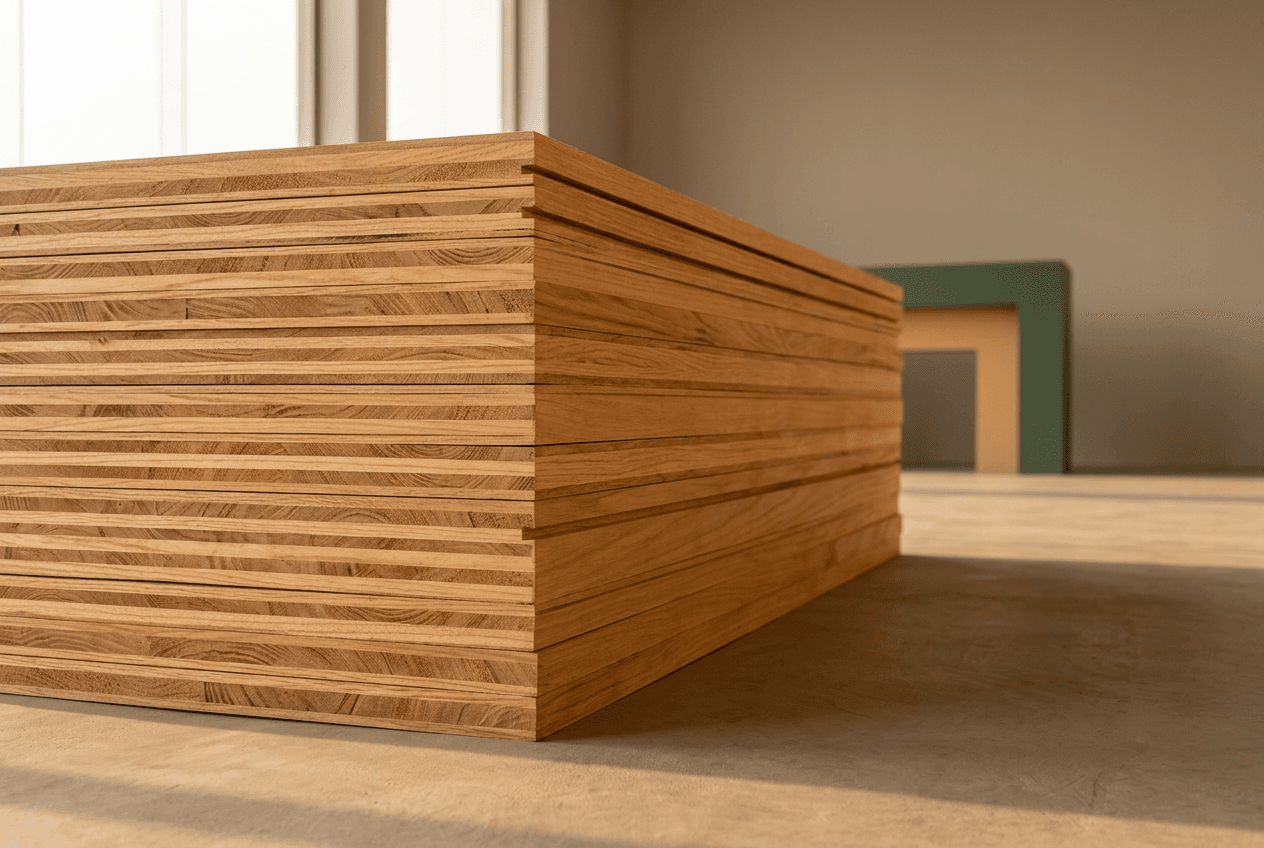
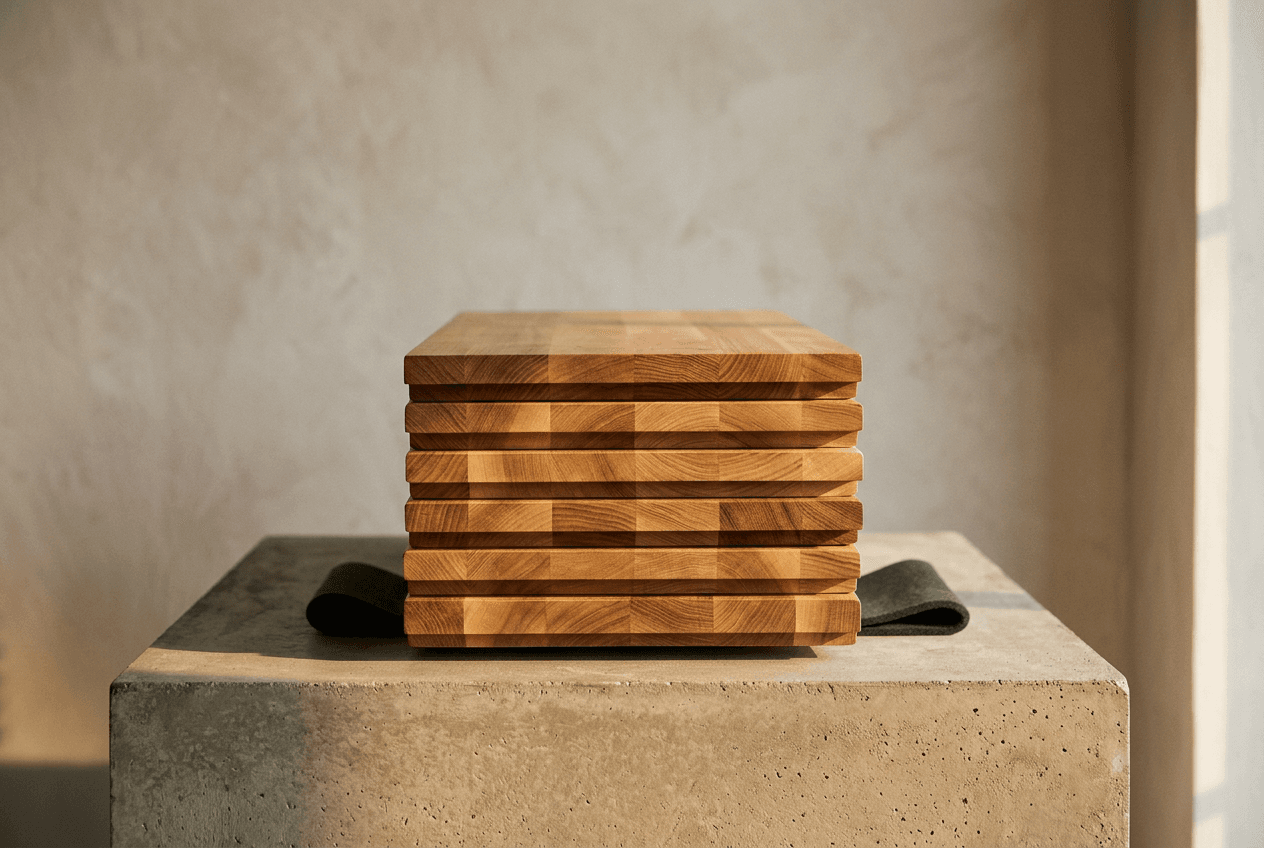
Blockboard is a composite panel with a **bonded softwood-block core sandwiched between premium plywood faces**, delivering rigidity and screw-holding strength superior to MDF or particleboard. Stocked in Riyadh **at 122×244 cm with thicknesses of 12, 15, 18, 25, and 30 mm** in BWR (water-resistant) grade — the heavy-duty substrate for bookshelves, solid internal doors, and free-spanning shelving.
What is blockboard?
Blockboard is a composite wood panel with rectangular softwood blocks (typically 25–30 mm wide pine or fir) edge-glued and laminated between two layers of premium plywood face. The block core gives blockboard the strength and screw-holding capacity of solid wood at a fraction of the cost, with the dimensional stability of plywood from the cross-laminated face.
Production follows IS 1659 (Indian Standard) for blockboard, the dominant specification in Asian and Middle Eastern markets. The standard governs block-bond strength, face-veneer quality, and water-resistance grading: MR (moisture-resistant), BWR (boiling-water resistant), and BWP/WBP (waterproof).
Riyadh Timber stocks BWR grade — the construction-standard moisture rating sufficient for interior use including kitchens and bathrooms. The premium plywood face accepts veneer overlay, laminate, paint, or polish directly, making blockboard a finished panel with no internal substrate visible.
Why is blockboard used for bookshelves and solid doors?
Blockboard delivers bending strength of 35 N/mm² and screw-holding capacity 50% higher than MDF through the solid block core, while remaining lighter than equivalent plywood. For free-spanning bookshelves over 80 cm, solid internal doors, and any application requiring solid-wood-equivalent strength, blockboard is the engineered substrate of choice.
Free-spanning bookshelves at 80–120 cm span sag visibly when made from MDF or particleboard within 2–5 years under typical book loads. Blockboard at 25 mm carries the same load without measurable sag across a 15-year service life, justifying the 50–80% price premium over MDF.
Solid internal doors at 35–45 mm overall thickness use blockboard cores with face veneer or laminate overlay. The solid core gives the door rigidity, sound-blocking mass, and high-cycle hinge-holding capacity that hollow-core doors cannot match in commercial and premium residential applications.
What are the specifications of blockboard?
Blockboard ships in 122×244 cm sheets at thicknesses 12, 15, 18, 25, and 30 mm, with bonded softwood block core and 2–3 ply premium plywood face. BWR water-resistance grade. Each shipment carries IS 1659 conformity, BWR or WBP certification, and origin certificates from India, Malaysia, or Indonesia.
| Product name | Blockboard (BWR grade) |
|---|---|
| Country of origin | India / Malaysia / Indonesia |
| Core composition | Bonded softwood blocks (pine / fir, 25–30 mm wide) |
| Face composition | 2–3 ply premium plywood face (gurjan / meranti) |
| Thicknesses (mm) | 12 · 15 · 18 · 25 · 30 |
| Sheet size (cm) | 122 × 244 (standard) |
| Water-resistance grades | MR · BWR · WBP |
| Bending strength (MOR) | 35 N/mm² parallel to blocks |
| Screw-holding strength | 1,400 N (face) · 1,100 N (edge) |
| Density | 560 – 620 kg/m³ |
| Bond type | Phenol-formaldehyde (BWR / WBP) |
| Standards | IS 1659 · BWR · WBP |
What are the applications of blockboard?
Blockboard serves five primary applications: free-spanning bookshelves (25–30 mm), solid internal doors (30 mm cores), heavy furniture (18–25 mm), partition walls and panel doors (18 mm), and counter table tops (25–30 mm). The solid core and screw-holding capacity define applications where MDF and particleboard would fail.
- 01
Free-spanning bookshelves (25–30 mm)
Library shelving, retail display shelves, and home study bookshelves spanning 80–120 cm without intermediate support. The block core resists sag under continuous book loads where MDF would deflect within 2–3 years.
- 02
Solid internal doors (30 mm cores)
Premium internal doors for villas, hotels, and offices with face veneer or laminate overlay. The solid core provides rigidity, sound-blocking mass, and high-cycle hinge-holding strength versus hollow-core alternatives.
- 03
Heavy furniture (18–25 mm)
Wardrobe sides for tall (240+ cm) wardrobes, kitchen cabinet sides for premium kitchens, and reception-counter substrates. The screw-holding capacity supports heavy hardware and concealed-hinge cabinet doors.
- 04
Partition walls and panel doors (18 mm)
Half-height office partitions, room divider panels, and panel-door cores in commercial fit-out. The block core provides dimensional stability across 244 cm height where particleboard would warp.
- 05
Counter table tops (25–30 mm)
Reception counters, retail counters, and study desk tops with solid-feel response and weight. The block core handles point loads and impact better than MDF or particleboard substrates of equivalent thickness.
What is the difference between blockboard and commercial plywood?
Blockboard has a solid softwood-block core with plywood face — bending strength 35 N/mm², lighter than plywood at equivalent thickness. Commercial plywood is fully cross-laminated veneer — bending strength 40+ N/mm² with higher density. Blockboard is preferred for shelving and doors; commercial plywood for structural sheathing and formwork.
Specify blockboard for free-spanning shelves, solid doors, and heavy furniture where solid-wood feel and screw-holding are valued. Specify commercial plywood for formwork, structural sheathing, and any application with sustained moisture or load-bearing requirement.
Blockboard is 15–25% lighter than equivalent plywood at the same thickness — relevant for tall furniture and door installations where weight affects hardware life. Commercial plywood is 10–20% cheaper per sheet but delivers a different structural response.
| Attribute | Blockboard | Commercial plywood |
|---|---|---|
| Core | Bonded softwood blocks | Cross-laminated veneer (full) |
| Bending strength | 35 N/mm² parallel | 40+ N/mm² parallel |
| Screw-holding (face) | 1,400 N | 1,200 N |
| Density | 560–620 kg/m³ | 580–650 kg/m³ |
| Weight at 18 mm | 12 kg/sheet | 14 kg/sheet |
| Indicative price | SAR 80–220 / sheet | SAR 70–180 / sheet |
| Recommended use | Bookshelves, solid doors, heavy furniture | Sheathing, formwork, structural panels |
How do I choose the right blockboard thickness and grade?
Thickness scales with span and load: 18 mm cabinet sides, 25 mm free-spanning bookshelves under 100 cm span, 30 mm bookshelves over 100 cm and solid door cores. Grade follows exposure: MR for dry interiors, BWR (default) for kitchens and bathrooms, WBP for sustained-humidity applications.
BWR is the Riyadh stock default — phenolic-bonded blocks resist boiling-water immersion for 4 hours without delamination. This rating covers all interior cabinet and shelving applications including kitchens. WBP (waterproof) is on order for marine and exterior applications.
For solid-door cores, specify 30 mm blockboard with face veneer overlay. The combined door thickness reaches 35–45 mm with veneer/laminate face and edge-banding, matching premium hotel-grade door specifications. For internal doors at 35 mm overall, specify 25 mm blockboard core.
How is blockboard cut, finished, and assembled?
Blockboard cuts on a carbide blade with 60+ teeth at 4,500 rpm for chip-free face veneer. Cut perpendicular to the block direction when possible — parallel cuts may follow the block-glue line. Edge-band exposed cuts to seal the block core. The plywood face accepts paint, veneer overlay, or laminate without preparation.
When drilling for hardware, locate fasteners through the solid block portion of the panel — not through the gap between blocks. The face veneer can hide a block-gap, so drill a test hole if hardware fastening location is critical. System screws and Confirmat fasteners hold strongly in the block core.
Polish or seal the face veneer if a natural-wood finish is desired. The 2–3 ply face accepts spirit polish, water-based varnish, or polyurethane finish directly without primer. For paint finish, apply two coats of primer-sealer before paint to prevent veneer grain telegraphing.
Does blockboard meet Saudi standards for interior and humid use?
Blockboard supplied by Riyadh Timber meets IS 1659 BWR (boiling-water resistant) grade, satisfying SBC 201 for residential and commercial interior use including kitchens and bathrooms. Each shipment ships with IS 1659 grade certification, water-immersion test reports, and origin certificates from India, Malaysia, or Indonesia.
BWR grading verifies the phenolic block-bond resists 4-hour boiling-water immersion without delamination — the construction-standard rating for sustained humidity and incidental water contact. WBP grade extends this to indefinite immersion, used for marine and exterior applications.
Standard blockboard is not fire-rated. For applications requiring SBC 801 fire performance (egress doors, hospital rooms), specify fire-retardant treated blockboard or alternative substrate. Standard BWR blockboard is acceptable in residential and commercial interior cabinetry and joinery.
Which Saudi projects use blockboard?
Blockboard appears in solid doors, heavy furniture, and free-spanning shelves on Vision 2030 sites including NEOM, Red Sea, Diriyah, Qiddiya, and New Murabba premium hotel and residential builds, in luxury villa libraries and studies in Hittin and Al Malqa, in office cabinetry and reception counters at King Abdullah Financial District, and in retail display fixtures along King Fahd Road.
- Vision 2030 premium builds: NEOM, Red Sea, Diriyah, Qiddiya — solid hotel guestroom doors, library shelving, premium villa cabinetry.
- King Abdullah Financial District and Olaya towers — solid office doors, reception counters, partition walls.
- Luxury villas and palaces in Hittin, Al Malqa, Al Yasmin, Al Narjis — library shelving, study desks, master bedroom solid doors.
- Retail centres along King Fahd Road and Al Urubah — heavy display shelving, counter substrates, partition walls.
What are common questions about blockboard?
Yes. Blockboard bending strength is **35 N/mm² versus 23 for MDF** — about 50% stronger. Screw-holding capacity is 1,400 N face versus 800 N for MDF. The solid block core delivers solid-wood-equivalent rigidity for shelving and door applications.
BWR grade blockboard is **water-resistant — withstands 4-hour boiling-water immersion** but is not waterproof. For waterproof applications specify WBP grade (on order). For marine and exterior use specify marine plywood instead. BWR covers kitchen and bathroom interior use.
**BWR (boiling-water resistant)** withstands 4-hour boiling water without delamination — sufficient for interior humid use. **WBP (waterproof)** withstands indefinite water immersion — used for marine, exterior, and pool-deck applications. Riyadh stock is BWR; WBP available on 2-week special order.
Yes — the **2–3 ply premium plywood face accepts paint, polish, varnish, or laminate** directly without primer. Apply two coats of primer-sealer before paint to prevent veneer grain telegraphing. For natural wood finish, sand to 240-grit before applying spirit polish or polyurethane.
Yes — **BWR grade blockboard at 18 mm is suitable for kitchen cabinet sides, shelves, and solid drawer fronts**. The water-resistant phenolic bond and solid core handle kitchen humidity and screw fastening better than particleboard. For cost-sensitive specifications use moisture-resistant MDF instead.
Blockboard has a **bonded softwood-block core (lighter, more stable) with plywood face**, while solid wood is single-piece lumber. Blockboard costs 60–70% less than equivalent solid hardwood, weighs 25% less, and resists warp and twist better across changing humidity.
Our cutting department processes cut lists with **±2 mm tolerance** on all blockboard thicknesses up to 30 mm. Cut pieces ship numbered and bundled by drawing reference. Edge-banding service is available to seal the block-core edges before delivery.
What products relate to Blockboard?
Selections that complement the work in Saudi construction projects.
Need a quote on blockboard for your project?
Send a quantity list with thicknesses, grade (BWR or WBP), and the delivery site. We respond with a formal quote within 4 working hours — unit price, total, lead time, and IS 1659 certificates included.