Engineered panels · wood-chip cabinet board
Particleboard
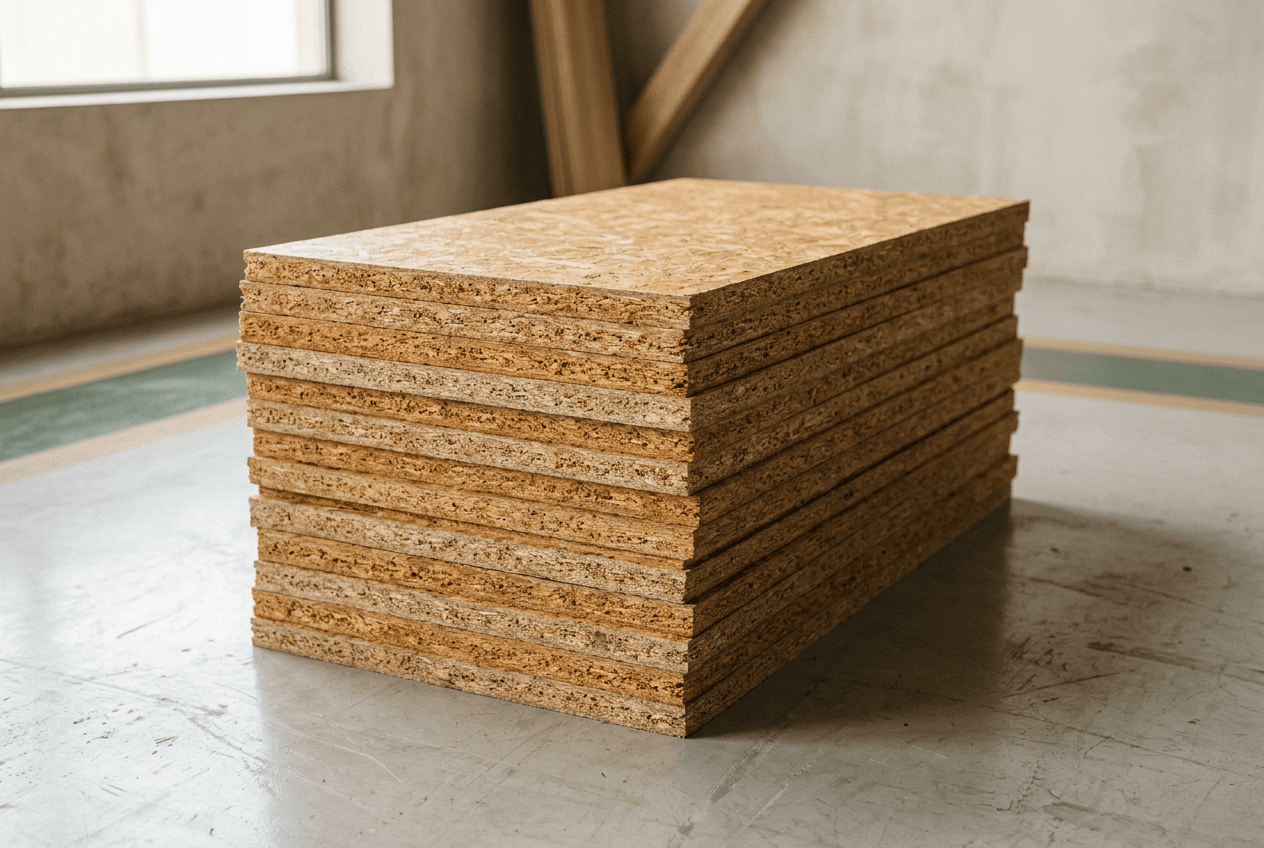
Particleboard is an engineered panel pressed from coarse wood chips bonded with urea-formaldehyde resin under heat and pressure. Stocked in Riyadh **at 183×366 cm and 183×244 cm with thicknesses of 8, 12, 16, 18, and 25 mm** in P2 (dry interior) and P3 (humid) grades — the cost substrate for cabinet boxes, drawer bodies, and concealed furniture work.
What is particleboard?
Particleboard is an engineered wood panel pressed from 5–20 mm wood chips bonded with urea-formaldehyde resin under heat and pressure. Production follows EN 312, with grades P2 (dry interior, furniture) and P3 (humid non-load-bearing). The Riyadh standard sheet ships at 183×366 cm or 183×244 cm at thicknesses 8 to 25 mm.
Particleboard production graduates wood chips by size: smaller chips concentrate near the face for a smoother surface, larger chips fill the core for cost efficiency. Three-layer construction is the standard, with surface chips < 5 mm and core chips 8–20 mm.
The urea-formaldehyde resin is the lowest-cost panel binder, which is why particleboard is the cheapest engineered panel category. The trade-off is moisture sensitivity — standard particleboard fails rapidly in humid environments unless upgraded to P3 grade with melamine-fortified resin.
Why is particleboard used for furniture and cabinet construction?
Particleboard is the lowest-cost engineered panel at SAR 30–90 per sheet, 30–40% below MDF and 50–60% below plywood. For melamine-faced cabinet boxes where the substrate is fully concealed, particleboard delivers structural performance equivalent to MDF at half the cost — the dominant economy of mass furniture production.
Mass furniture manufacturers and KSA joinery factories use particleboard as the default cabinet box substrate. The melamine-faced face removes the surface-quality disadvantage versus MDF, while the cost advantage compounds across hundreds of cabinet boxes in a typical apartment fit-out.
Particleboard also dominates IKEA-style flat-pack furniture — the structural performance is sufficient for typical residential cabinet loads, and the manufacturing tolerances allow CNC drilling for system fasteners with the same precision as MDF.
What are the specifications of particleboard?
Particleboard ships in 183×366 cm and 183×244 cm sheets at thicknesses 8, 12, 16, 18, and 25 mm, density 650–700 kg/m³, in grades P2 (dry) or P3 (humid). Bond is urea-formaldehyde, emissions class E1. Each shipment carries EN 312 grade certification and CARB-P2 emissions verification.
| Product name | Particleboard (chipboard) |
|---|---|
| Country of origin | Turkey / UAE / Germany |
| Thicknesses (mm) | 8 · 12 · 16 · 18 · 25 |
| Sheet sizes (cm) | 183 × 366 and 183 × 244 |
| Grades | P2 (dry interior) · P3 (humid) |
| Density (kg/m³) | 650 – 700 |
| Bending strength (MOR) | 13 N/mm² (P2) · 14 N/mm² (P3) |
| Internal bond | ≥ 0.35 N/mm² (P2) |
| Modulus of elasticity | 1,800 N/mm² |
| Thickness swell (24 h) | ≤ 14% (P2) · ≤ 8% (P3) |
| Emissions class | E1 · CARB-P2 |
| Standards | EN 312 · CARB-P2 · E1 |
What are the applications of particleboard?
Particleboard serves five primary applications: cabinet boxes under melamine face (16–18 mm), drawer bodies (12–16 mm), shelf backs and toe-kicks (8–12 mm), floor underlayment (16–25 mm), and concealed furniture substrate (12–18 mm). All applications assume melamine or laminate facing — exposed particleboard is not used in finished work.
- 01
Cabinet boxes under melamine face (16–18 mm)
Sides, tops, bottoms, and fixed shelves of kitchen, bedroom, and office cabinets where the substrate is fully concealed by melamine or laminate facing. The 18 mm thickness holds 32 mm system screws without splitting.
- 02
Drawer bodies (12–16 mm)
Drawer sides and backs in mass-produced furniture. The 12 mm thickness reduces drawer weight and shipping cost while accepting standard 32 mm hardware fixings.
- 03
Shelf backs and toe-kicks (8–12 mm)
Cabinet rear panels and toe-kick boards under base cabinets. The thin profile reduces material cost in concealed locations where structural load is minimal.
- 04
Floor underlayment (16–25 mm)
Levelling layer under carpet, vinyl, or laminate flooring over rough sub-floor. The thicker 25 mm grade in P3 covers humid sub-floor conditions in basements and ground-floor slabs.
- 05
Concealed furniture substrate (12–18 mm)
Internal divider panels, shelf supports, and structural elements inside cabinets where the panel is hidden from view. The cost advantage versus MDF is highest in this category.
What is the difference between particleboard and MDF?
Particleboard is pressed from coarse wood chips at 650–700 kg/m³ with bending strength of 13 N/mm², while MDF is pressed from refined wood fibres at 720–780 kg/m³ with bending strength of 23 N/mm². Particleboard is 30–40% cheaper but cannot be routed cleanly or painted — limited to concealed melamine-faced applications.
Specify particleboard for melamine-faced cabinet boxes where the substrate is hidden. Specify MDF for any visible painted surface, routed edge, or profiled moulding. The two are not interchangeable on visible work — exposed particleboard shows coarse chip texture that no paint primer can hide.
On structural performance, MDF carries 70% more bending load than particleboard at the same thickness. For free-spanning shelves over 60 cm, specify MDF or HDF; particleboard sags under typical book-loading conditions within 12–18 months.
| Attribute | Particleboard | MDF |
|---|---|---|
| Core composition | Coarse wood chips (5–20 mm) | Refined wood fibres |
| Density | 650–700 kg/m³ | 720–780 kg/m³ |
| Bending strength | 13 N/mm² | 23 N/mm² |
| Surface finish | Coarse, requires laminate | Smooth, paint-ready |
| Routed edge quality | Crumbles on profile | Sharp profile retained |
| Indicative price | SAR 30–90 / sheet | SAR 45–130 / sheet |
| Recommended use | Concealed cabinet boxes under laminate | Painted furniture, doors, mouldings |
How do I choose between P2 and P3 particleboard grades?
Specify P2 for dry interior furniture and cabinet boxes — bedrooms, living rooms, offices. Specify P3 for humid non-load-bearing applications — kitchen cabinet bottoms below the sink, bathroom cabinet backs, basement furniture. P3 thickness swell at 24 hours is 8% versus 14% for P2.
P2 is the Riyadh stock default — covers 80% of furniture applications at lowest cost. P3 is a 25–30% price premium and 1-week lead time. The decision turns on humidity exposure, not on visible finish, since both grades typically face melamine.
Neither grade is structural. For load-bearing applications (sub-floor under carpet, structural sheathing) specify OSB or structural plywood instead. Particleboard is for non-load-bearing furniture and concealed substrate work only.
How is particleboard cut, fastened, and assembled?
Particleboard cuts on a carbide blade with 60+ teeth at 4,500 rpm with a scoring saw to prevent face chipping under melamine. Fasten with system screws (32 mm cam-and-dowel) or Confirmat fasteners — never standard wood screws, which split the chip core. Assemble using KD (knockdown) hardware: cam locks, dowels, and cross-dowels.
Always use system fasteners drilled to manufacturer pilot specifications. Standard wood screws driven into particleboard split the chip core within 1–2 fastenings, eliminating the joint strength. Cam-lock and dowel systems distribute load across a wider chip area, preserving joint integrity.
Edge-banding is essential on visible cut edges. Apply 0.4 mm melamine banding for hidden edges (cabinet rear, top under crown moulding) and 2 mm ABS for visible edges (cabinet front, drawer face). Unsealed cut edges absorb moisture and degrade the chip core.
Does particleboard meet Saudi Building Code and emissions requirements?
Particleboard supplied by Riyadh Timber meets EN 312 (European particleboard standard) at P2 or P3 grade, CARB-P2 emissions, and E1 formaldehyde class, satisfying SBC 201 for residential and commercial interior cabinetry. Each shipment ships with EN 312 grade certification and emissions verification.
E1 caps formaldehyde emissions at 0.124 mg/m³, the level required for bedrooms, kitchens, and children's spaces under SBC 1001 indoor air quality. CARB-P2 is the stricter Californian limit, accepted by all KSA hospitality and government project specifications for furniture-grade panels.
Standard particleboard is not fire-rated. For applications requiring SBC 801 fire performance, specify fire-retardant treated particleboard or alternative substrate. Standard particleboard is acceptable in residential and commercial furniture and concealed substrate work.
Which Saudi projects use particleboard?
Particleboard appears in mass furniture, cabinet boxes, and concealed substrate on Vision 2030 sites including NEOM, Red Sea, Diriyah, Qiddiya, and New Murabba hotel and residential builds, in serviced-apartment furniture along King Fahd Road, in IKEA-style flat-pack distribution across central Riyadh, and in low-cost housing developments in the southern districts.
- Vision 2030 builds: NEOM, Red Sea, Diriyah, Qiddiya, New Murabba — serviced-apartment furniture, hotel back-of-house cabinetry, staff housing.
- Serviced apartments along King Fahd Road and Olaya — kitchen cabinet boxes, wardrobe carcasses, bedside furniture under melamine face.
- IKEA-style retail furniture distributed across central Riyadh and gated communities — flat-pack wardrobes, drawer units, shelving.
- Low-cost housing developments and worker housing across Saudi Arabia — kitchen cabinetry, bedroom wardrobes, bathroom storage.
What are common questions about particleboard?
**No.** Standard P2 particleboard swells 14% in 24-hour wet exposure and fails permanently. P3 grade improves swell to 8% but is still not waterproof. For wet-zone applications use moisture-resistant MDF (V313) or marine plywood instead.
Particleboard is **not paint-grade** — the coarse chip face shows through any primer system. For painted finishes use MDF instead. Particleboard is for melamine, laminate, or PVC-faced applications where the substrate is fully concealed.
**P5 grade** is the strongest particleboard in EN 312 — load-bearing for humid conditions, used for structural sub-floor and roof decking. Riyadh Timber stocks P2 (dry furniture) and P3 (humid non-load-bearing) as default; P5 is on order for specialised applications.
Riyadh Timber's particleboard is rated **E1 — formaldehyde emissions ≤ 0.124 mg/m³** and CARB-P2, meeting Saudi, European, and Californian standards for residential and commercial interior use including bedrooms, kitchens, and children's spaces.
Particleboard at 18 mm holds **20–25 kg distributed load on 60 cm span** before deflecting. For free-spanning shelves over 60 cm, specify MDF or HDF; the 70% higher bending strength of MDF prevents the long-term sag that particleboard suffers under continuous load.
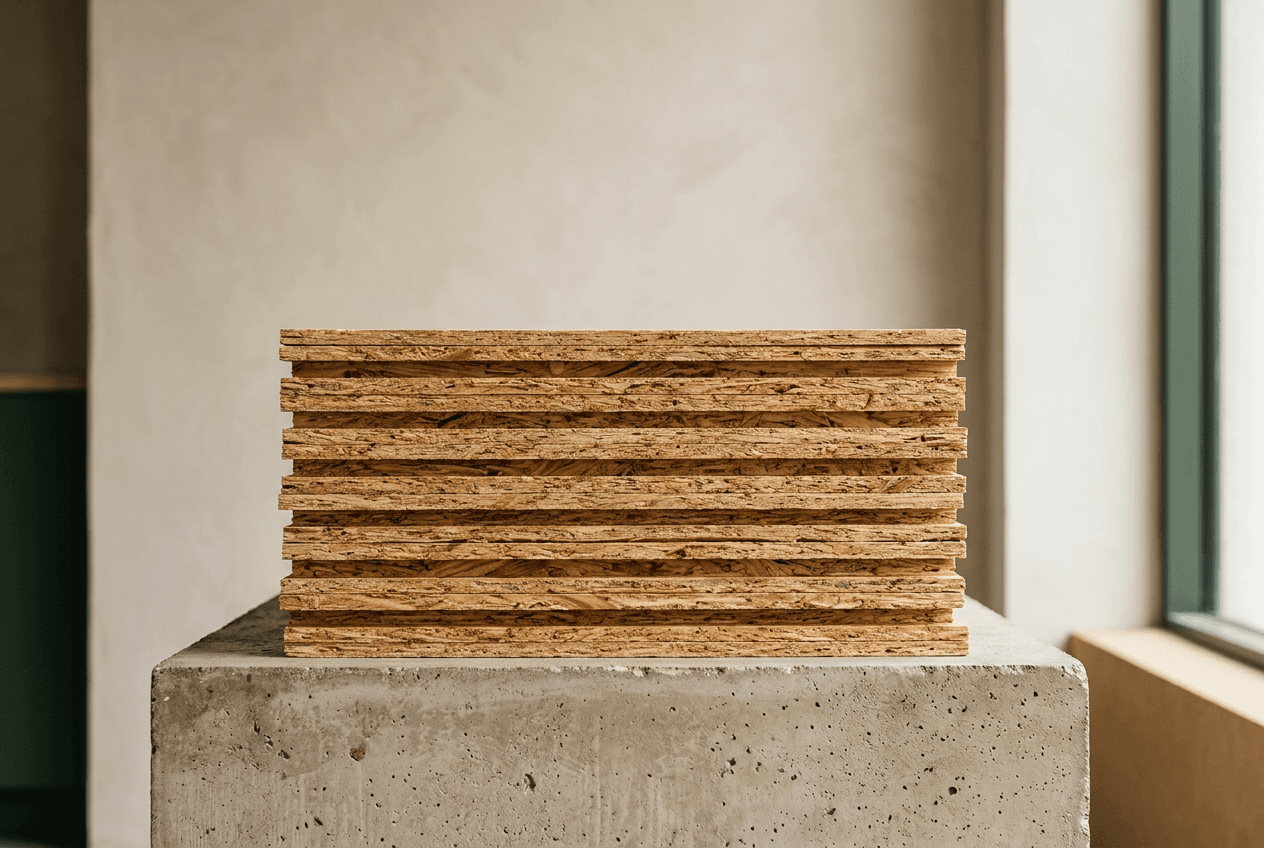
Particleboard is **non-structural with random small chips (5–20 mm) and urea resin**. OSB is **structural with cross-laminated large strands (80–150 mm) and MDI resin**. Particleboard is for cabinet boxes; OSB is for sheathing, sub-floor, and roof decks.
Our cutting department processes cut lists with **±1 mm tolerance** on a CNC saw with scoring blade for melamine-faced sheets. Edge-banding service applies matching ABS or melamine at the same cut. Cut packs ship numbered by drawing reference.
What products relate to Particleboard?
Selections that complement the work in Saudi construction projects.
Need a quote on particleboard for your project?
Send a quantity list with thicknesses, grade, and the delivery site. We respond with a formal quote within 4 working hours — unit price, total, lead time, and EN 312 certificates included.