Construction timber · commercial plywood for furniture and decor
Commercial plywood
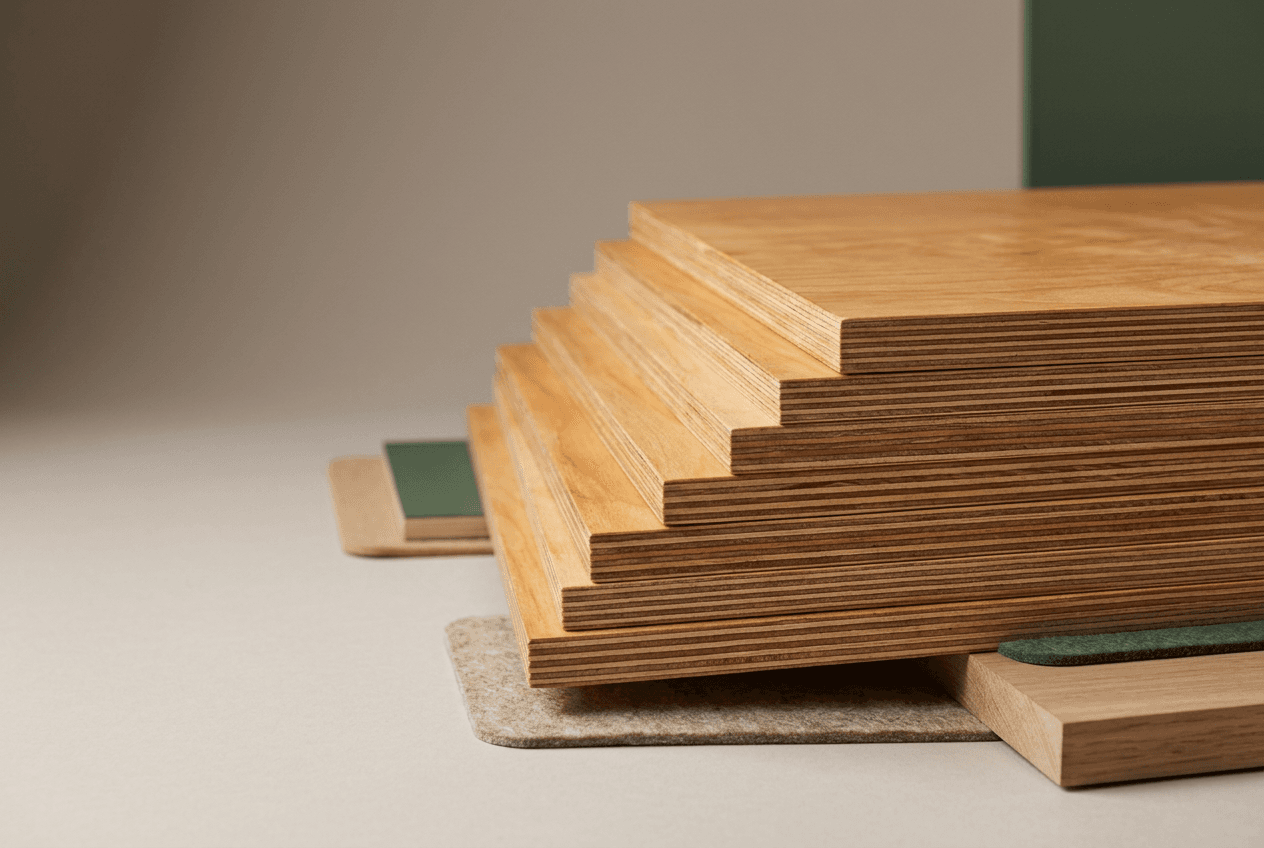
Commercial plywood is an engineered panel bonded with urea-formaldehyde MR resin, used for furniture, decor, suspended ceilings, and packaging. Stocked in Riyadh **at thicknesses 4, 6, 9, 12, and 18 mm in 122×244 cm sheets**, with density 480–560 kg/m³ and certified E1 and CARB-P2 emissions for indoor use.
What is commercial plywood?
Commercial plywood is an engineered panel bonded with urea-formaldehyde MR (Moisture Resistant) resin, designed for dry interior use in furniture, decor, and packaging. Manufactured to IS 303 at 480–560 kg/m³ density, in standard 122×244 cm sheets at thicknesses 4 to 18 mm. It is the world's best-selling plywood category by volume.
The term 'commercial' indicates general-purpose use without specialisation for structural or wet-area applications. The panel uses a mix of hardwood and softwood in interior plies, with smoother face/back plies that accept paint or veneer. Origins vary by market — Chinese, Indonesian, or Malaysian — selected to match price and supply.
The difference from tropical WBP is the resin: commercial uses cheaper urea-formaldehyde (UF), while WBP uses phenol-formaldehyde. UF resists intermittent light moisture but does not survive boiling or repeated water exposure. This restricts commercial plywood to dry interior applications.
Why is commercial plywood used in construction?
Commercial plywood is used because it is the cheapest plywood with documented indoor emissions ratings. Pricing runs SAR 35 to 95 per sheet, 30–50% below WBP plywood. It is the default choice for budget and mid-tier furniture, suspended ceilings, industrial packaging, and interior decor in villas and apartments.
In ready-to-assemble (RTA) and locally manufactured furniture, commercial plywood is the substrate of choice because its price supports a competitive retail product. The E1 and CARB-P2 ratings on our stocked batches make it acceptable for bedrooms, kitchens, and children's spaces.
For permanent suspended ceilings (offices, retail, villas), 4–6 mm commercial plywood delivers a flat surface ready for paint or wallpaper. The mid-range density of 480–560 kg/m³ balances low weight against carrying recessed lighting and HVAC ducts.
What are the specifications of commercial plywood?
Commercial plywood ships at 122×244 cm in thicknesses 4, 6, 9, 12, and 18 mm, density 480–560 kg/m³, urea-formaldehyde MR bond. Layer count runs from 3 plies at 4 mm to 11 plies at 18 mm. Emissions are E1 and CARB-P2; form-pour reuse is 2–3 cycles maximum.
| Product name | Commercial MR plywood |
|---|---|
| Origins | China · Indonesia · Malaysia |
| Wood species | Mixed hardwood and softwood |
| Layer count | 3 – 11 plies |
| Thicknesses (mm) | 4 · 6 · 9 · 12 · 18 |
| Sheet size (cm) | 122 × 244 |
| Density (kg/m³) | 480 – 560 |
| Bond type | Urea formaldehyde (MR) |
| Emissions | E1 · CARB-P2 (≤ 0.124 mg/m³) |
| Pressure tolerance | Up to 25 kN/m² at 18 mm |
| Reuse cycles | 2 – 3 cycles |
| Certifications | IS 303 · MR · CARB-P2 · E1 |
What are the construction applications of commercial plywood?
Commercial plywood serves five primary applications: budget and mid-range furniture (12–18 mm), suspended ceilings (4–6 mm), interior wall panels and decor (9 mm), industrial packaging (5–9 mm), and interior doors (12 mm). The two most-ordered SKUs are 12 mm and 18 mm.
- 01
Budget and mid-range furniture (12–18 mm)
Bedroom wardrobes, dry kitchen shelving, office desks, cabinet doors. Mid-range density holds light to medium hinges without splitting.
- 02
Suspended ceilings (4–6 mm)
In villas, offices, and retail, mounted on timber or metal grid and finished with paint or wallpaper directly after light sanding.
- 03
Interior wall panels and decor (9 mm)
TV-feature backdrops, decorative partition walls, entry hall cladding. Pricing supports large-area coverage on tight budgets.
- 04
Industrial packaging (5–9 mm)
Shipping crates, temporary stands, temporary site barriers. Light weight and low cost make it the default for single-use applications.
- 05
Interior hollow-core doors (12 mm)
In hollow-core door manufacturing, commercial plywood forms both faces over a timber frame and honeycomb infill. Door service life is 10–15 years.
What is the difference between commercial plywood and MDF?
Commercial plywood is a multi-layer panel of cross-grain veneers in a resin matrix, while MDF is a homogeneous panel of compressed wood fibres. Plywood holds screws and hinges far better and swells less under humidity; MDF is slightly cheaper and delivers a smoother face for paint and CNC routing.
For load-bearing furniture (bookcases, wardrobes), specify commercial plywood — screws hold cleanly at panel edges. For interior doors with flat faces and CNC-routed decorative panels, specify MDF — its homogeneous structure carves cleanly without splintering.
On total cost: 12 mm commercial plywood lands at SAR 45–70, 12 mm MDF at SAR 40–60. The gap is narrow, so application — not price — drives the choice. General rule: plywood for load-bearing furniture, MDF for door faces and decorative routed surfaces.
| Attribute | Commercial plywood | MDF |
|---|---|---|
| Structure | Cross-grain veneer plies | Homogeneous compressed fibres |
| Screw and hinge holding | Excellent — does not pull out | Moderate — needs special fasteners |
| Humidity swell | Low — good stability | Higher — absorbs moisture quickly |
| Surface smoothness for paint | Moderate — needs sanding | Excellent — paint-ready |
| CNC routing quality | Limited — edge splintering | Excellent — clean edges |
| Price/sheet 12 mm | SAR 45–70 | SAR 40–60 |
| Best use | Load-bearing furniture, shelving | Doors, decorative surfaces, signage |
How do I choose the right commercial plywood for my project?
Selection runs in three steps: fix thickness against application (4–6 mm ceilings, 9–12 mm walls, 12–18 mm furniture), fix origin against budget per square metre, and fix grade (standard or CARB-P2 for premium interiors). For furniture used by children, specify CARB-P2 exclusively.
For affordable-housing projects, specify Chinese origin at base E1 — pricing starts at SAR 35 and meets the application. For mid-tier projects (sold villas and apartments), Indonesian or Malaysian at CARB-P2 grade gives better durability for a 20–30% premium.
For visible furniture (cabinet faces), specify a smooth knot-free face (B/BB grade) ready for direct paint. For hidden parts (carcass interiors, back shelves), specify the budget face (BB/CC) where appearance does not matter and cost dominates.
How is commercial plywood stored and installed?
Commercial plywood stores flat on bearers 10 cm off the ground in dry shaded conditions, away from direct sun and water. Installation uses standard screws at 20–25 cm spacing along the framing, with white wood glue or industrial adhesive on edges to reinforce furniture joints.
For furniture, leave plywood for 48 hours in the workshop before cutting to acclimatise to local humidity. This reduces distortion in cut pieces caused by humidity differences between yard and workshop. Cut with a TCT 40-tooth circular saw blade for clean, sand-ready edges.
For suspended ceilings, frame at 30–40 cm centre-to-centre spacing to prevent sag under lighting load. For ceilings exceeding 12 m² in area, leave a 2 mm expansion gap between sheets to absorb seasonal humidity changes.
Does commercial plywood meet Saudi Building Code requirements?
Commercial plywood is accepted for decor and interior furniture applications under SBC, but not classified for major structural formwork. Riyadh Timber's stock ships with IS 303 mill certification and E1 / CARB-P2 emissions reports — sufficient for residential and decor engineering review.
For projects with built-in furniture in children's rooms, hospitals, or schools, specify CARB-P2 documented stock — the strictest US emissions standard. This requirement is met by selected batches from approved mills in China, Indonesia, and Malaysia.
Which Saudi projects use commercial plywood?
Commercial plywood ships into affordable and mid-tier housing developments, residential villas and apartments in Riyadh and Jeddah, ready-furniture manufacturing workshops, exhibitions and retail stands, and government schools and offices. Applications focus on built-in furniture, suspended ceilings, and interior decor.
- Affordable and mid-tier housing developments — built-in furniture and interior doors.
- Residential villas and apartments in Hittin, Al Malqa, Al Yasmin — decor and suspended ceilings.
- Local ready-furniture manufacturing workshops — substrate for wardrobes and dry kitchen casework.
- Temporary exhibitions and retail stands — partition walls and stands.
- Government schools and offices — administrative furniture and permanent ceilings.
What are common questions about commercial plywood?
Commercial plywood uses **urea-formaldehyde MR resin** for dry interior decor, while Indonesian WBP uses **phenolic resin** for structural and concrete formwork applications. Commercial is 30–50% cheaper but fails after two formwork cycles, against 5–8 cycles for Indonesian.
Yes — when **certified E1 and CARB-P2** (formaldehyde emissions ≤ 0.124 mg/m³). These levels are below safe thresholds for bedrooms and nurseries. Avoid undocumented stock from the informal market — emissions there can exceed E1 by 3x.
**Not recommended** for kitchens with leak or splash exposure. For kitchens, specify 18 mm marine plywood. Commercial plywood is acceptable only for dry kitchen zones (upper shelves, cabinets away from the sink).
**200 sheets** is the effective minimum for delivery given the lower per-sheet value. Smaller quantities are picked up from our Olaya yard. Large shipments (1,000 sheets and up) take 8–12% off the price with 3–4 weeks lead time.
Yes — it accepts **water-based and oil-based paint and engineered or natural veneer** after sanding with 120-grit paper. B/BB grade face is best for natural veneer (no knot bleed-through). BB/CC grade is sufficient for ordinary paint finish.
CARB-P2 commercial plywood costs **10–15% more** than standard E1 stock because of stricter emissions control during production. The premium is justified for visible furniture in children's rooms and hospitals where indoor air-quality codes apply.
The 122×244 cm size is most common. Larger sizes (152×305 cm) are available on special order for full doors and large furniture parts, at 500-sheet minimum and 4–6 weeks lead time. Premium adds 30% due to shipping complexity.
What products relate to Commercial plywood?
Selections that complement the work in Saudi construction projects.
Need a quote on commercial plywood for your project?
Send a quantity list with thicknesses, the delivery site, and the required emissions grade (E1 or CARB-P2). We respond with a formal quote within 4 working hours — unit price, total, and lead time included.