Construction timber · full plywood category
Construction plywood
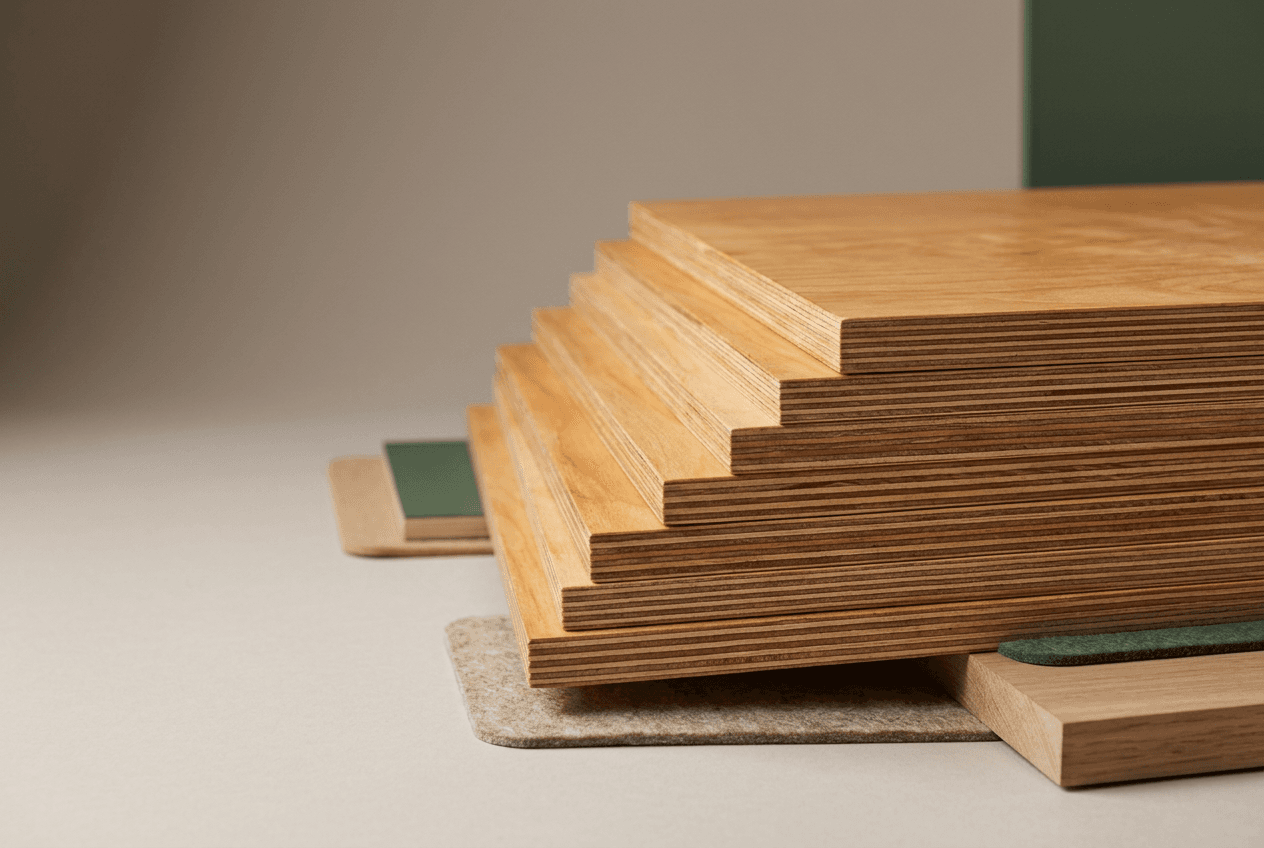
Plywood is a panel made from cross-laminated wood veneers bonded with resin, used for formwork, cladding, joinery, and ceilings. Riyadh Timber stocks the full category **at thicknesses 4 to 25 mm in 122×244 cm sheets** from Indonesia, Malaysia, China, Russia, and India in WBP, MR, marine, and FR grades.
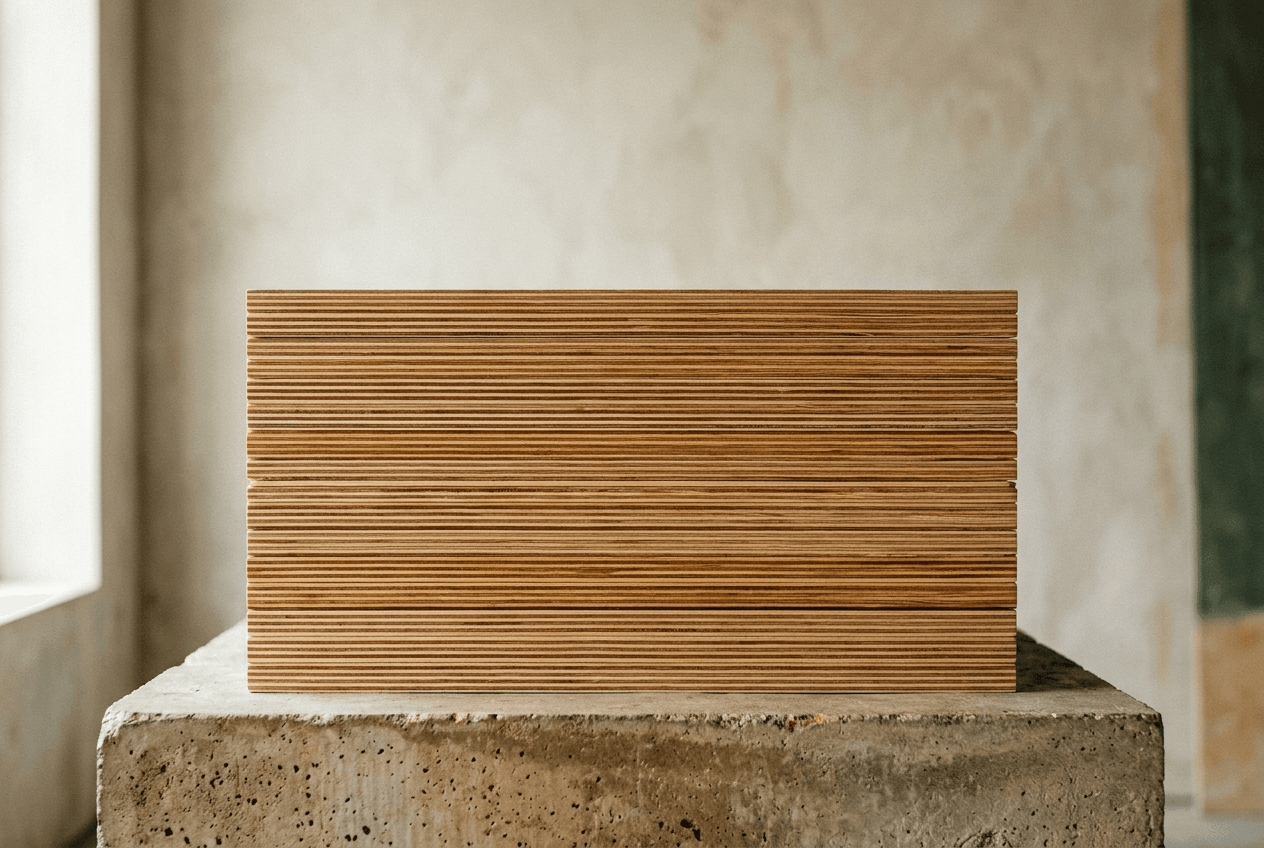
What is construction plywood?
Plywood is an engineered wood panel built from an odd number of cross-laminated veneer plies bonded with resin adhesive. Sold in Saudi Arabia at thicknesses 4 to 25 mm and a standard 122×244 cm sheet, the cross-grain structure delivers dimensional stability and resistance to bending unmatched by sawn timber.
Plywood is graded by the bond resin into four classes: MR (moisture-resistant), WBP (weather and boil proof), Marine/BWR, and FR (fire-retardant). Each grade serves a distinct application range, from dry interior decor up to repeated concrete pours and submerged-grade exposure.
Plywood differs from solid timber in three structural ways: it does not split along grain, expands and contracts less under humidity changes, and is delivered in large uniform sheets unavailable from natural wood. Engineers specify it for flat-surface and formwork applications for these reasons.
Why is plywood used in construction projects?
Plywood dominates Saudi construction because it pairs structural strength with low cost and fast installation. A single sheet covers 2.97 m² of surface, lays flat without underlayment, and accepts on-site cutting. These traits compress labour time on Vision 2030 mega-projects and standard residential builds alike.
For concrete formwork, 18 mm WBP plywood withstands lateral pressures up to 45 kN/m² and sustains up to 8 form-pour cycles. No competing wood-based panel matches this performance at the same price point — only steel formwork outperforms, at multiple times the unit cost.
For interior finishes, plywood serves as a substrate for natural veneer, paint, and laminate. Sheet pricing starts at SAR 35 for Chinese commercial plywood and reaches SAR 320 for Class A fire-retardant plywood approved by Saudi Civil Defense.
What are the specifications of plywood at Riyadh Timber?
Plywood ships at 122×244 cm in thicknesses 4, 6, 9, 12, 15, 18, and 25 mm. Available grades: WBP, MR, Marine, FR, and Film-Faced. Density spans 420 kg/m³ for Chinese poplar to 680 kg/m³ for marine hardwood. Certifications include SBC 201, ISO 9001, ASTM E84, BS 476, IS 5509, and FSC chain-of-custody.
| Category | Plywood (engineered panel) |
|---|---|
| Origins | Indonesia · Malaysia · China · Russia · India · Finland |
| Wood species | Meranti · keruing · poplar · pine · tropical hardwood |
| Thicknesses (mm) | 4 · 6 · 9 · 12 · 15 · 18 · 25 |
| Sheet sizes (cm) | 122 × 244 (standard) · 125 × 250 (film-faced) |
| Density range | 420 – 680 kg/m³ |
| Bond grades | MR · WBP · BWR · Marine · FR · Phenolic Film |
| Form-pour pressure tolerance | 15 – 55 kN/m² depending on grade and thickness |
| Form-pour reusability | 1 – 15 cycles (film-faced highest) |
| Emissions | E1 · CARB-P2 |
| Fire classification | Class A (treated) · Class C (untreated) |
| Certifications | SBC 201 · ISO 9001 · ASTM E84 · IS 5509 · BS 476 · FSC · PEFC |
What are the construction applications of plywood?
Plywood serves five primary applications: concrete formwork (18 mm), interior cladding (9–12 mm), prefabricated joinery (12–15 mm), suspended ceilings (4–6 mm), and fire-rated egress (12–25 mm). Each application maps to a specific resin grade and a thickness calculated against load and span.
- 01
Concrete formwork (18 mm WBP or Film-Faced)
Columns, beams, slabs, load-bearing walls. Indonesian WBP delivers 6–8 cycles; phenolic film-faced delivers 10–15 cycles before retirement.
- 02
Interior cladding and ceilings (4–12 mm)
Wall finishes and decorative interior panels in villas, retail interiors, and offices. 4–6 mm for ceilings, 9–12 mm for wall surfaces.
- 03
Prefabricated joinery (12–18 mm)
Kitchen cabinets, shelving, doors, tabletops. Commercial plywood for budget builds, veneered plywood for premium villas and hotels.
- 04
Fire-rated life-safety (12–25 mm FR)
Egress walls, stairs, corridors, fire doors in hospitals, schools, and towers — meeting SBC 801 and Saudi Civil Defense specifications.
- 05
Wet-area applications (9–18 mm Marine/BWR)
Under-sink cabinetry, bathroom vanities, sub-floor under wet screed, pool decking, commercial kitchen casework.
What is the difference between the four main plywood grades (MR, WBP, Marine, FR)?
MR for dry interior decor, WBP for concrete formwork, Marine for permanent wet exposure, FR for life-safety fire compliance. The differentiator is bond resin and any added chemical treatment. Pricing scales from SAR 35 for MR to SAR 320 for FR, and the choice is dictated by application context and building code.
MR (moisture-resistant) uses urea-formaldehyde resin and is intended for dry interior decor only. WBP (weather and boil proof) uses phenol-formaldehyde for concrete formwork and any short-term repeated water exposure. Marine/BWR adds higher phenolic loading for permanent wet contact. FR is any of the above with autoclave-pressure boron-phosphate treatment to satisfy SBC 801.
| Attribute | MR | WBP | Marine | FR |
|---|---|---|---|---|
| Bond resin | Urea formaldehyde | Phenol formaldehyde | Phenolic + BWR treatment | Phenolic + boron phosphate |
| Moisture exposure | Light, intermittent | Repeated, prolonged | Permanent, submersion | Per base resin |
| Typical use | Dry interior decor | Concrete formwork | Kitchens, baths, pools | Egress, stairs, corridors |
| Reuse cycles | 1–2 | 5–8 | 6–8 | Not applicable |
| Indicative price/sheet | SAR 35–75 | SAR 45–180 | SAR 110–260 | SAR 140–320 |
| Lead standard | IS 303 | SBC 201 | BS 1088 · IS 710 | ASTM E84 · IS 5509 |
How do I choose the right plywood grade and thickness?
Plywood selection runs in three steps: fix the grade against moisture and fire exposure, fix the thickness against load and span, then fix the origin against budget. Structural formwork requires 18 mm WBP Indonesian or Malaysian. Interior decor accepts 9–12 mm Chinese commercial.
For tower and infrastructure formwork, specify 18 mm phenolic film-faced plywood — its 10–15 form-pour cycles and the mirror-finish concrete face it produces are both required at that scale. For ordinary villa and residential formwork, 18 mm Indonesian or Malaysian WBP is the working specification.
For kitchen and bathroom casework, marine plywood at 18 mm is the only acceptable grade. For egress and fire-rated zones in public buildings, FR Class A plywood is mandatory under SBC 801. For premium hospitality joinery, veneered plywood with oak, walnut, or teak face at 12 or 18 mm.
How is plywood stored and installed on a construction site?
Plywood stores flat on timber bearers 10–15 cm off the ground in a dry, shaded area. Installation uses screws at 20–30 cm spacing along the framing with a 2–3 mm expansion gap between adjacent sheets. Film-faced plywood is fixed with non-metallic fasteners at the face to preserve the phenolic film.
For formwork, brush release oil at 250 ml/m² across the face before first use. This step extends life from 2 to 6–8 pour cycles. After each strip-down, scrape residual concrete with a plastic scraper — never metal — to avoid surface scoring.
For interior finishes, leave plywood on site for 48 hours before installation to acclimatise to ambient humidity. Frame at no more than 40 cm centre-to-centre spacing to keep the surface flat and prevent sag under live load.
Does plywood meet Saudi Building Code requirements?
Riyadh Timber WBP plywood meets SBC 201 structural requirements, and FR plywood meets SBC 801 fire-safety requirements with ASTM E84 Class A reports. Each shipment includes ISO 9001 and ISO 14001 certificates, and FSC or PEFC chain-of-custody documents for Vision 2030 sustainability tracking.
For government and Vision 2030 projects, we supply third-party batch-specific test reports with a 7–10 day turnaround. These reports are required to clear Saudi Civil Defense inspection and engineering review on NEOM, Red Sea, and similar mega-project sites.
Which Saudi projects use plywood?
Plywood ships into Vision 2030 mega-projects including NEOM, Red Sea, Diriyah, Qiddiya, and New Murabba, into King Abdullah Financial District towers, into private villas in Hittin, Al Malqa, Al Yasmin, and Al Narjis, into government hospitals and schools, and into retail centres along Al Olaya, Al Sahafa, and King Fahd Road.
- Vision 2030 mega-projects: NEOM, Red Sea, Diriyah, Qiddiya, New Murabba — formwork, cladding, life-safety supply.
- King Abdullah Financial District and Olaya towers — concrete formwork, office cladding, stair finishes.
- Government and private hospitals and schools — fire-retardant plywood for corridors and fire doors.
- Villas and gated communities in Hittin, Al Malqa, Al Yasmin, Al Narjis, Al Wahah — doors, cabinetry, decor.
- Hotels and resorts in Diriyah, Jeddah, Red Sea — veneered plywood faced with oak, walnut, and teak.
What are common questions about plywood?
Plywood and 'kounter' are **the same product** in the Saudi market. 'Kounter' is the local site term used by contractors and crews; 'Plywood' is the international technical term used in shipping invoices and engineering specs. The two refer to the same engineered panel.
**18 mm is the structural standard** for formwork. 12 mm suffices for short columns and shallow beams, while 21 mm phenolic film-faced is required for long slab spans. Support spacing exceeding 40 cm between bearers requires moving up one thickness grade.
Cycle count depends on grade: **1–2 cycles for Chinese MR, 5–8 cycles for Indonesian or Malaysian WBP, 10–15 cycles for phenolic film-faced**. Flat horizontal storage and release-oil treatment double the working life across all grades.
Standard WBP plywood is **not recommended** for direct rain or sun exposure. For exterior facades, specify phenolic film-faced plywood with sealed edges, fibre-cement panels, or calcium silicate boards rated for prolonged outdoor service in Riyadh's climate.
**150 sheets** — equivalent to a half-trailer load — is the effective minimum for delivery. Smaller orders are picked up from our Olaya yard or are bundled with an existing project shipment near the contractor's site to absorb logistics cost.
Our cutting department processes cut lists with a **±2 mm tolerance**. The service covers all thicknesses up to 25 mm, and pieces ship numbered and bundled by drawing reference, accelerating site installation and cutting on-site waste below 5%.
Riyadh Timber stock is **E1 and CARB-P2 rated** with formaldehyde emissions ≤ 0.124 mg/m³. These levels are accepted for residential, school, and hospital interior use under both European and US regulatory frameworks.
What products relate to Construction plywood?
Selections that complement the work in Saudi construction projects.
Need a quote on plywood for your project?
Send a quantity list with thicknesses, the required grade (WBP, Marine, or FR), and the delivery site. We respond with a formal quote within 4 working hours — unit price, total, lead time, and certificates included.