Construction timber · premium plywood with natural-wood veneer
Veneered plywood
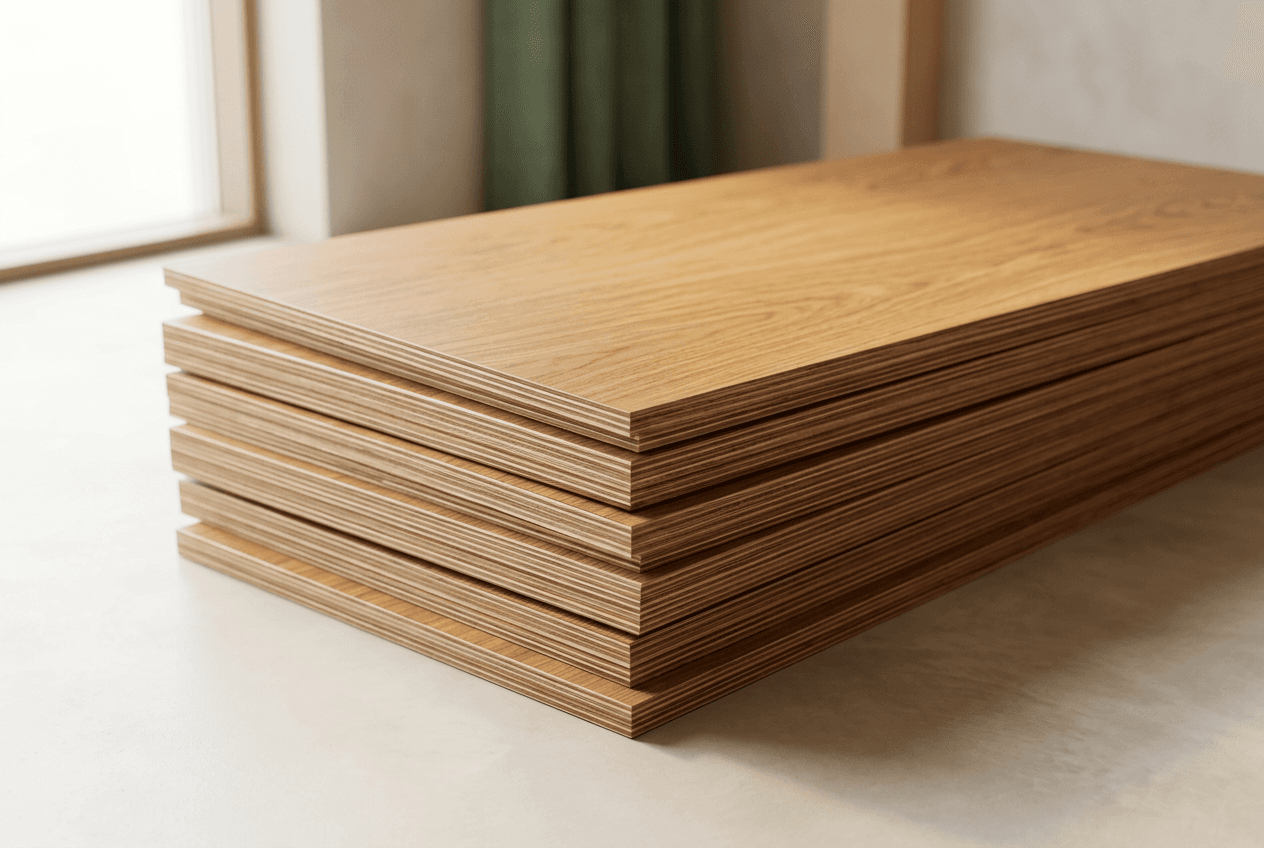
Veneered plywood is a plywood panel faced **with a thin layer of natural-wood veneer in oak, walnut, teak, or beech**, used in hotels, executive offices, and luxury villas. Available at thicknesses **9, 12, and 18 mm in 122×244 cm sheets**, with veneer thickness 0.6–3 mm, E1 emissions, and PEFC sustainability certification.
What is veneered plywood?
Veneered plywood is a plywood panel (typically WBP or MR) faced on one or both sides with a thin layer of natural-wood veneer. Veneer thickness ranges from 0.6 mm (sliced veneer) to 3 mm (sawn veneer). The result is a panel with the appearance of premium solid hardwood at roughly 70% lower cost than solid timber.
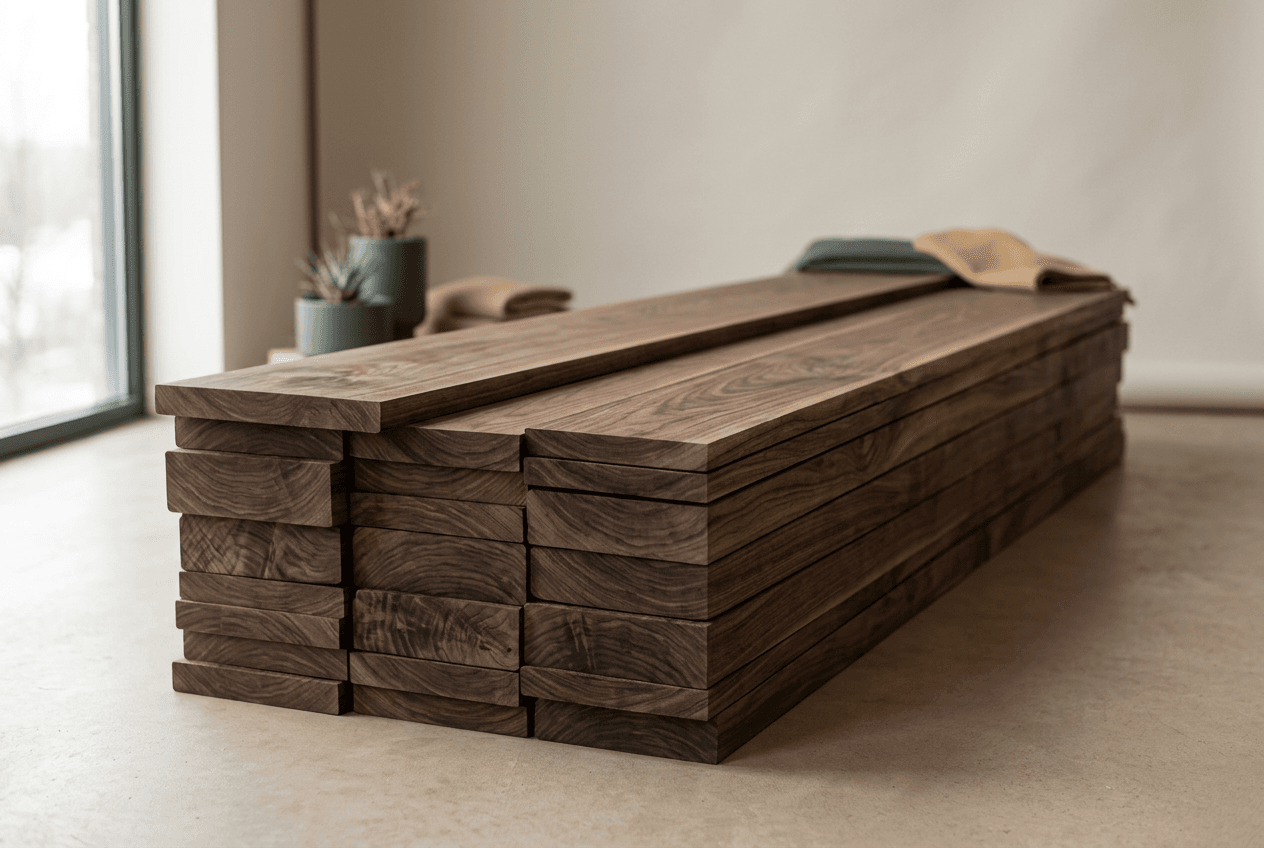
The most-requested veneer species in Saudi Arabia: **American white oak** for the contemporary light look, **American walnut** for executive offices with deep brown tones, **Burmese teak** for hotel and resort finishes, **European beech** for modern furniture, and **mahogany** for traditional executive interiors.
Veneer technology allows rare and expensive species (walnut, teak, rosewood) to be specified across large surface areas at reasonable cost. A veneered plywood sheet with 1.5 mm walnut face costs SAR 220, while solid walnut at the same thickness exceeds SAR 1,200 per sheet equivalent.
Why is veneered plywood used in construction?
Veneered plywood delivers the look of premium solid hardwood at 70–80% lower cost, with higher dimensional stability than solid timber. This makes it the working choice for hotel finishes, luxury villa interiors, and executive offices where wide expanses of premium hardwood would be uneconomic in solid form.
Second advantage: dimensional stability. Solid timber expands and contracts 4–8% with humidity changes; veneered plywood — held flat by the plywood substrate — moves only 0.5–1%. This is critical for finishes that must remain visually consistent over years, such as executive office wall panels and luxury villa doors.
Third advantage: sustainability. A 0.6 mm veneer slice from a single tree covers hundreds of square metres of veneered plywood. This reduces pressure on natural forests for rare species like teak and walnut. PEFC certification on our stock documents this for Vision 2030 sustainability targets.
What are the specifications of veneered plywood?
Veneered plywood ships at 122×244 cm in thicknesses 9, 12, and 18 mm, with natural veneer 0.6–3 mm on one or both sides. Substrate is MR or WBP plywood. Emissions E1, certifications include ISO 14001, CARB-P2, PEFC, and EN 13986. Lead time is 2–4 weeks for common species.
| Product name | Natural-veneer plywood (Veneered) |
|---|---|
| Origins | Malaysia · Indonesia · Italy · India |
| Substrate panel | WBP or MR plywood |
| Veneer species | Oak · walnut · teak · beech · mahogany |
| Veneer thickness (mm) | 0.6 · 1 · 1.5 · 2 · 3 |
| Total thicknesses (mm) | 9 · 12 · 18 |
| Sheet size (cm) | 122 × 244 |
| Density (kg/m³) | 580 – 650 (by veneer species) |
| Veneer cut patterns | Crown cut · quarter cut · rotary cut |
| Emissions | E1 (≤ 0.124 mg/m³) |
| Certifications | ISO 14001 · CARB-P2 · PEFC · EN 13986 |
| Lead time | 2 – 4 weeks for common species |
What are the construction applications of veneered plywood?
Veneered plywood serves five primary contexts: hotel and resort wall cladding (12 mm), executive offices and conference rooms (12–18 mm), luxury villa doors (18 mm), high-value built-in furniture (18 mm), and premium property entrances (12 mm). Most-requested species are American white oak and American walnut.
- 01
Hotel and resort wall cladding (12 mm)
Hotel lobbies, premium suites, and conference halls in Diriyah and Red Sea projects. Oak or teak veneer in quarter-cut pattern delivers consistent straight grain lines.
- 02
Executive offices and conference rooms (12–18 mm)
Wall cladding, conference tables, and built-in cabinetry in executive offices. American walnut in crown-cut is the classic choice for Riyadh financial-district towers.
- 03
Luxury villa doors (18 mm)
Main entrance doors and master-suite doors in villas valued above SAR 5 million. Teak or mahogany veneer delivers a classic substantial appearance.
- 04
High-value built-in furniture (18 mm)
Built-in bookcases and wardrobes, large dining tables, coffee tables in luxury villas. Natural veneer delivers a visual quality that engineered facing cannot match.
- 05
Premium property entrances (12 mm)
Entrance hall cladding in luxury residential towers and premium office buildings. Selected veneer with side lighting creates the first impression that justifies property investment.
What is the difference between veneered plywood and melamine-faced MDF?
Veneered plywood is faced with a live natural-wood veneer at 0.6–3 mm; melamine MDF is faced with a printed plastic layer simulating wood. Veneered plywood is far higher in quality, appearance, and price — used in luxury villas — while melamine MDF serves budget and mid-tier furniture.
The visual difference is clear under side-lighting: real wood veneer reflects light along actual wood fibres, while melamine reflects uniformly because it is a print. Over 5+ years melamine fades and peels at edges, while natural veneer develops deeper character with age (patina).
The price gap is large: veneered plywood at SAR 95–320 per sheet, melamine MDF at SAR 60–140. Veneered plywood is justified on projects where perceived quality forms part of property value — five-star hotels and SAR 10M+ villas where finish drives the asset narrative.
| Attribute | Veneered plywood | Melamine MDF |
|---|---|---|
| Surface | Live natural-wood veneer | Printed plastic layer |
| Visual depth | Three-dimensional with real fibres | Flat, two-dimensional |
| Repair after scratch | Possible — sand and refinish | Not possible — full replacement |
| Cosmetic life | 20+ years (improves with age) | 5–8 years (fades and peels) |
| Property value impact | Adds to asset value | Neutral |
| Price/sheet | SAR 95–320 | SAR 60–140 |
| Recommended use | Hotels, luxury villas, executive offices | Budget and mid-tier furniture, generic offices |
How do I choose veneer species and thickness for veneered plywood?
Selection rests on target colour, budget, and exposure to wear. White oak for contemporary light tones, walnut for dark executive presence, teak for classic luxury. Veneer thickness 0.6 mm for non-touched walls, 1–1.5 mm for furniture, 2–3 mm for doors and high-wear surfaces.
Cut pattern shapes appearance: **Crown cut** delivers wide artistic grain common on walnut, **Quarter cut** delivers regular straight lines common on oak, **Rotary cut** delivers wide random grain common on budget veneers. Choose pattern by intended visual effect.
For major projects requiring visual consistency across vast surfaces (hotel lobby, conference hall), specify sheets from a single **flitch** (cut block) to guarantee grain matching across panels. This requires advance ordering and a 2-week extended lead time but guarantees the final result.
How is veneered plywood stored and installed?
Veneered plywood stores flat under a breathable cover completely shielded from direct sun, which fades veneer colour. Installation uses fine concealed fasteners or Z-clip systems for wall applications, with PVA glue on the framing. Edges are sealed with PVC edge tape or matched veneer tape to hide the substrate.
Before installation, leave veneered plywood for 72 hours in the install location to acclimatise the veneer to ambient humidity. This reduces veneer cracking caused by differential expansion between veneer and substrate. Optimal installation conditions are 20–25°C and 50–60% humidity.
For finishing, sand the veneer with 220 then 320-grit paper along the grain — never circular. Two coats of clear UV varnish is the most common hotel specification, or hard-wax oil for a warmer matte finish. Spray application beats brush application for surface evenness.
Does veneered plywood meet Saudi Building Code and sustainability standards?
Veneered plywood meets SBC 201 for decor applications with formaldehyde emissions within E1 (≤ 0.124 mg/m³). Our stock ships with PEFC sustainability certification, US CARB-P2, and European EN 13986. This satisfies Mostadam Gold and LEED Gold requirements for premium project interior finishes.
For projects targeting Mostadam Platinum or LEED Platinum, we supply veneered plywood with **FSC certification** — the strictest chain-of-custody standard, above PEFC — in limited volumes with 4–6 weeks lead time. This contributes points in Materials and Resources scoring categories.
Which Saudi projects use veneered plywood?
Veneered plywood ships into Diriyah, NEOM, and Red Sea hotels and resorts, luxury villas in Hittin and Al Malqa, King Abdullah Financial District towers for executive offices, major corporate headquarters, and conference halls in five-star hotels. Most-requested species: American white oak and American walnut.
- Diriyah, NEOM, and Red Sea hotels — lobby and luxury-suite cladding in oak and teak veneer.
- Luxury villas in Hittin, Al Malqa, Al Yasmin — main doors and built-in furniture in walnut and mahogany.
- King Abdullah Financial District and Olaya towers — executive offices and conference rooms in American walnut.
- Major corporate headquarters — reception and executive office cladding in quarter-cut oak veneer.
- Five-star hotel conference halls — large wall cladding with grain-matched panels from a single flitch.
What are common questions about veneered plywood?
Veneer applied correctly (PVA bond on stable plywood, even pressure, edge sealing) **lasts 20+ years without peeling**. Peeling occurs only with cheap adhesive, application on unstable substrate, or direct water exposure. Riyadh Timber stock is sourced from EN 13986-certified mills with quality guarantees.
**Sliced** is thin (0.6 mm) cut from a soaked log with a knife — delivers regular grain lines. **Sawn** is thick (2–3 mm) cut with a saw — more durable and supports multiple sandings. **Rotary** is peeled from a rotating log with a chisel — cheapest but with wide irregular grain.
Yes — surface scratches are repaired by **light sanding with 320-grit and refinishing**, especially when veneer is 1.5 mm or thicker. 0.6 mm veneer has limited repair tolerance because sanding goes through quickly. For wear-prone surfaces (tables, entrance doors) specify at least 2 mm veneer.
**50 sheets** is the effective minimum since this is a make-to-order specification. For major projects, orders above 200 sheets from a single flitch (for grain matching) are standard, with 4–6 weeks lead time and a 10–15% price premium for the flitch reservation.
Yes — 9 mm veneered plywood accepts curve forming at radii **150 cm and above**. For tighter curves (50–100 cm), we use 4 mm flexible veneered plywood specifically engineered for radius work. This is used on circular hotel lobby finishes and curved hotel bar fronts.
Veneered plywood with **1.5 mm American walnut face** runs SAR 220–280 per sheet at 12 mm and SAR 280–320 per sheet at 18 mm. American walnut is the highest-priced of common veneer species due to raw-material cost and US import logistics.
**Not recommended** for direct water exposure. For bathrooms, we supply marine plywood with a special veneer face treated with moisture-resistant finish. This is a make-to-order product with 6 weeks lead time, used in luxury hotel-suite bathrooms.
What products relate to Veneered plywood?
Selections that complement the work in Saudi construction projects.
Need a quote on natural-veneer plywood for your project?
Send a quantity list with thicknesses, the required veneer species (oak, walnut, teak, beech), and the cut pattern. We respond with a formal quote within 4 working hours — unit price, total, lead time, and physical samples for review.