Engineered panels · pre-finished decorative MDF
Laminated MDF
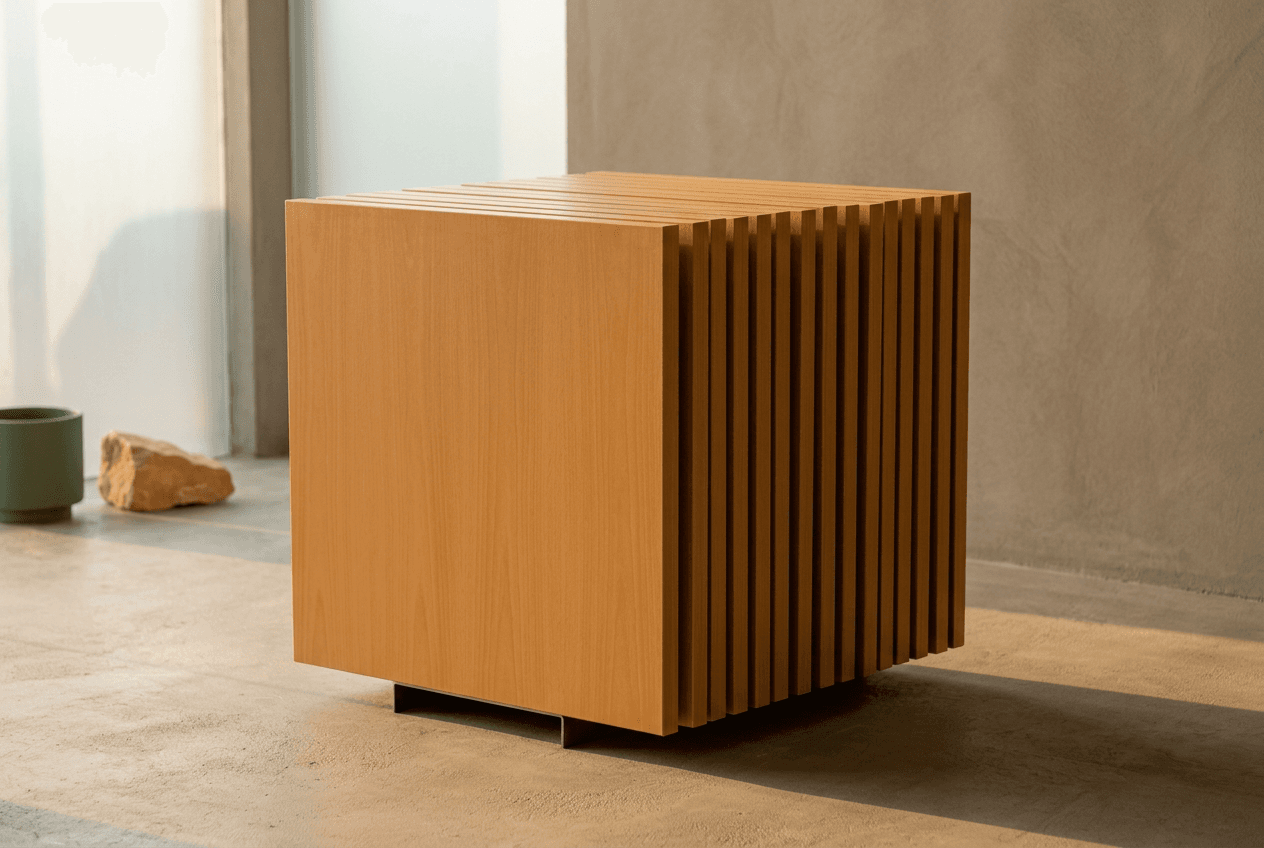
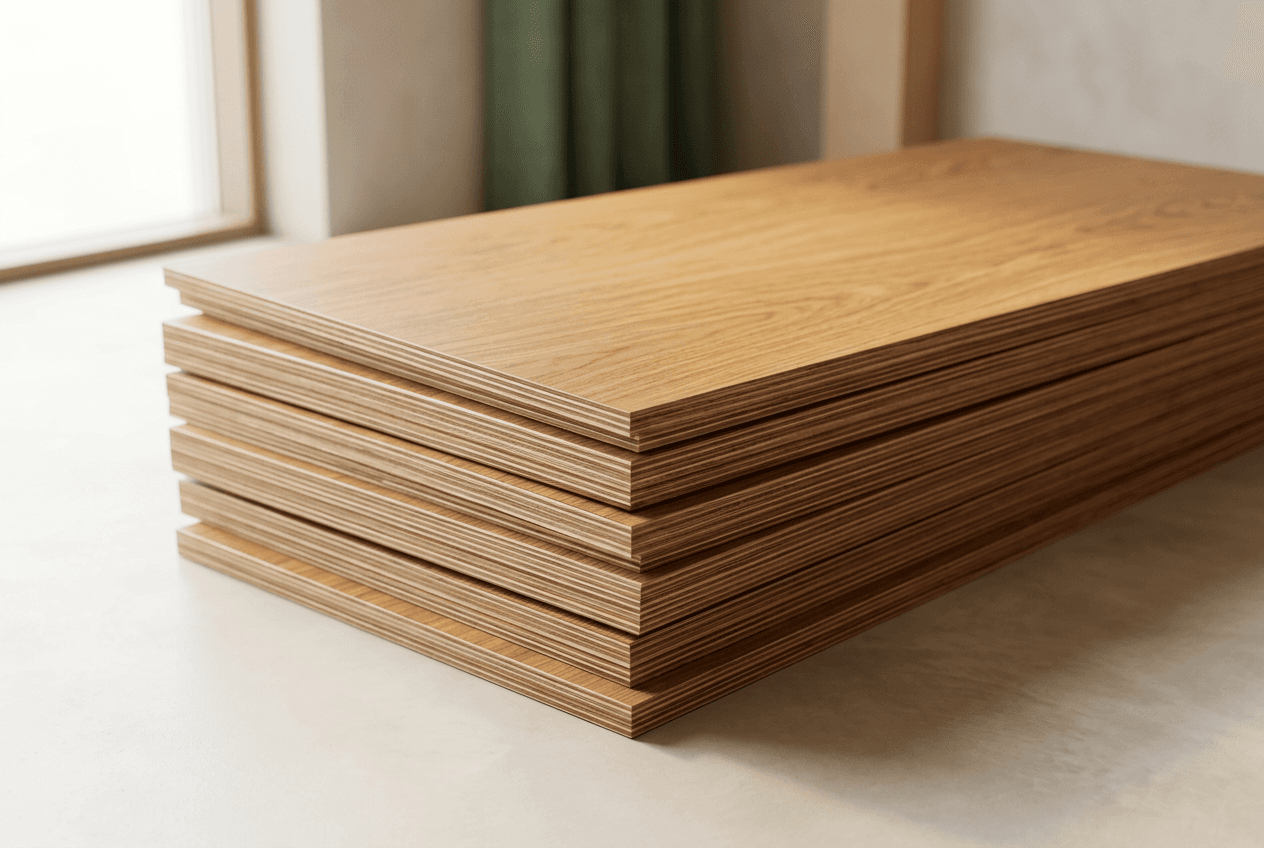
Laminated MDF is a fibreboard core pre-finished with melamine, polyester, or PVC face under heat and pressure, ready to install with no painting required. Stocked in Riyadh **at 183×244 cm with thicknesses of 9, 12, and 18 mm** in 120+ colours and textures — the production substrate for office cabinetry, wardrobes, and decorative doors.
What is laminated MDF?
Laminated MDF is an MDF core panel pre-finished on both faces with a decorative laminate — melamine, polyester, or PVC foil — pressed at 160–200 °C under 25 bar. The result is a ready-to-cut panel with a sealed, scratch-resistant face requiring no painting, sanding, or sealing on site.
EN 14322 governs melamine-faced panels in Europe. The laminate face is impregnated paper (decor + overlay) cured to the MDF core under heat and pressure, forming an integrated surface 0.15–0.30 mm thick that resists abrasion, light staining, and routine cleaning chemicals.
The 120+ colour and texture catalogue covers solid colours, wood grains (oak, walnut, maple, teak), stones (marble, concrete), and embossed textures (linen, leather, brushed metal). Pattern matching across panels in a single batch is guaranteed by the manufacturer roll number stamped on each sheet.
Why is laminated MDF used for office and residential furniture?
Laminated MDF eliminates the painting and finishing stage that consumes 30–40% of cabinet production time on plain MDF. The factory-applied face is ready to install, scratch-resistant to EN 14322 grade, and consistent across panels. For series production of office desks, wardrobes, and reception units it is the cost-and-speed standard.
Site finishing introduces variation in colour, gloss, and texture between cabinets installed weeks apart. Laminated MDF eliminates this by guaranteeing batch-matched colour from the manufacturer roll. A 200-unit office fit-out arrives uniform from sheet 1 to sheet 200.
Cleaning and maintenance are simpler than painted MDF: melamine surfaces accept neutral detergents, alcohol wipes, and routine office cleaning chemicals without dulling the gloss. Painted MDF requires re-coat every 5–7 years; laminated MDF holds its finish for 15+ years under typical office use.
What are the specifications of laminated MDF?
Laminated MDF ships in 183×244 cm sheets at thicknesses 9, 12, and 18 mm, with melamine, polyester, or PVC face options across 120+ colours. Density 720–760 kg/m³. Each shipment carries EN 14322 (melamine-faced panels), CARB-P2, and E1 emissions certification.
| Product name | Laminated MDF (melamine-faced) |
|---|---|
| Country of origin | Turkey / Italy / Germany |
| Finish types | Melamine · polyester · PVC foil |
| Thicknesses (mm) | 9 · 12 · 18 |
| Sheet size (cm) | 183 × 244 (standard) |
| Density (kg/m³) | 720 – 760 |
| Surface thickness (mm) | 0.15 – 0.30 |
| Abrasion resistance | Class 3A (EN 14322) |
| Stain resistance | Class 5 (5 = best) |
| Heat resistance | Class 6 — dry heat to 180 °C |
| Colour range | 120+ colours and textures |
| Standards | EN 14322 · CARB-P2 · E1 |
What are the applications of laminated MDF?
Laminated MDF serves five primary applications: office cabinetry (18 mm), wardrobes and bedroom furniture (18 mm), decorative doors (18 mm), reception desks (18 mm with edge-banding), and store fixtures (12–18 mm). The factory-finished face removes the on-site painting stage entirely.
- 01
Office cabinetry (18 mm)
Storage units, filing cabinets, and partitioned workstations for corporate fit-outs. Panels arrive pre-finished, cut, and edge-banded, allowing 200+ units to be installed in days rather than weeks.
- 02
Wardrobes and bedroom furniture (18 mm)
Free-standing and built-in wardrobes for villas and apartment projects. Wood-grain laminates replicate solid oak or walnut at 30% of the cost with no maintenance over a 15-year life.
- 03
Decorative doors (18 mm)
Internal doors for offices, hotels, and residential projects. Laminate finish handles daily handle contact, cleaning chemicals, and impact better than painted MDF in commercial spaces.
- 04
Reception desks (18 mm with edge-banding)
Front-of-house counters for offices, hotels, and clinics. The laminate face holds gloss and colour under daily public-facing wear, where painted alternatives show scuffs within months.
- 05
Store fixtures (12–18 mm)
Display units, gondolas, and back walls for retail fit-out. The high-cycle laminate face survives merchandise stocking, cleaning, and shopper contact without finish degradation.
What is the difference between laminated MDF and counter wood?
Laminated MDF is a decorative furniture panel at 9–18 mm with melamine/polyester/PVC face, while counter wood is a structural counter panel at 38–40 mm with HPL or laminate face on high-density MDF core. Counter wood handles 180 °C heat briefly and 40 kg point loads; laminated MDF is for vertical surfaces and shelving, not horizontal work surfaces.
Specify laminated MDF for cabinet sides, doors, drawer fronts, and decorative wall panels. Specify counter wood for kitchen counters, office desks, and any horizontal work surface receiving heat, knives, or sustained point loads.
Both share a similar visual face, but the substrate density and thickness govern the application. A counter top routed from 18 mm laminated MDF will sag, dent, and burn under typical kitchen use within months.
| Attribute | Laminated MDF | Counter wood |
|---|---|---|
| Core | Standard MDF (720–760 kg/m³) | High-density MDF (820–880 kg/m³) |
| Thicknesses | 9 / 12 / 18 mm | 38 / 40 mm |
| Surface finish | Melamine / polyester / PVC | HPL / Formica / engineered stone |
| Heat resistance | Up to 180 °C briefly (face only) | Up to 180 °C briefly (full panel) |
| Point load capacity | Vertical surfaces only | 40 kg distributed (counter use) |
| Indicative price | SAR 75–220 / sheet | SAR 180–650 / panel |
| Recommended use | Cabinet sides, doors, shelves | Kitchen counters, desks, work surfaces |
How do I choose between melamine, polyester, and PVC laminated MDF?
Melamine is the standard for office cabinetry and wardrobes with high abrasion and heat resistance. Polyester is a lower-cost option for dry, low-traffic cabinet interiors. PVC foil offers the widest colour range and 3D wraparound profiles but lower heat resistance. Match finish to traffic and exposure.
Melamine is the EN 14322 default — abrasion class 3A, stain class 5, heat class 6 (180 °C dry). It survives daily commercial use across a 15-year service life. The Riyadh Timber catalogue stocks 80+ melamine colours continuously.
PVC foil wraps over routed door profiles and curved edges that melamine cannot follow. Use PVC for shaker-style and profiled doors where the visible face must continue around a 3D edge. Heat resistance drops to 80 °C, so do not specify PVC for kitchen doors near ovens.
How is laminated MDF cut, edge-banded, and assembled?
Laminated MDF cuts on a sliding-table saw with a 60+ tooth carbide blade and a scoring saw set 0.1 mm proud to prevent face chipping. Apply matching ABS or melamine edge-banding at 180–200 °C using EVA hot-melt adhesive. Assemble with system screws or Confirmat fasteners — never standard wood screws.
The scoring saw is essential — without it, the bottom face chips at every cut, leaving visible defects on the cabinet bottom or door edge. KSA joinery shops without scoring saws should send laminated MDF cut lists to specialist cutting services rather than DIY.
Edge-banding closes the exposed MDF edge and prevents moisture migration into the core. For visible edges (cabinet front edges, door edges) use 2 mm ABS banding; for hidden edges (rear, top under crown) use 0.4 mm melamine banding for cost efficiency.
Does laminated MDF meet Saudi Building Code requirements?
Laminated MDF supplied by Riyadh Timber meets EN 14322 (melamine-faced panels), EN 622-5 (MDF core), CARB-P2 emissions, and E1 formaldehyde class, satisfying SBC 201 for residential, commercial, and hospitality interiors. Each shipment ships with EN 14322 certification and core MDF density test reports.
EN 14322 verifies the laminate face for abrasion, stain, scratch, and heat resistance — the four wear factors governing furniture lifecycle. Class 3A abrasion and class 5 stain are minimum for office and residential interior use under SBC.
Standard laminated MDF is not fire-rated. For egress corridors and hospitality public areas requiring SBC 801 compliance, specify fire-retardant MDF with melamine face, or reserve standard laminated MDF for non-critical interior fit-out.
Which Saudi projects use laminated MDF?
Laminated MDF appears in office cabinetry, wardrobes, and decorative doors on Vision 2030 sites including NEOM, Red Sea, Diriyah, Qiddiya, and New Murabba hotel and residential builds, in King Abdullah Financial District office fit-outs, in luxury villa wardrobes in Hittin and Al Malqa, and in retail fixtures along King Fahd Road.
- Vision 2030 builds: NEOM, Red Sea, Diriyah, Qiddiya, New Murabba — hotel guestroom wardrobes, office cabinetry, decorative wall panels.
- King Abdullah Financial District and Olaya towers — workstation cabinetry, reception desks, decorative office doors.
- Luxury villas in Hittin, Al Malqa, Al Yasmin, Al Narjis — built-in wardrobes, dressing rooms, bedroom door fronts.
- Retail centres along King Fahd Road and Al Urubah — display units, gondolas, store fixtures with branded laminate finishes.
What are common questions about laminated MDF?
We stock **120+ colours and textures** including solid colours, wood grains (oak, walnut, maple, teak, beech), stones (marble, concrete, terrazzo), and embossed textures. Common colours ship from continuous Riyadh stock; specialty colours arrive in 2–3 weeks from Turkey or Italy.
Standard laminated MDF uses a **standard MDF core** that swells under sustained humidity. For kitchens and bathrooms, specify laminated MDF on a moisture-resistant V313 core — the green-tinted variant available in melamine and PVC face options at a 25% premium.
Cutting requires a **sliding-table saw with a scoring saw** to prevent face chipping. Standard table saws produce visible defects on the bottom face. We provide cut-to-size service for projects without scoring-saw equipment, with ±1 mm tolerance and ABS edge-banding option.
**No** — the factory-applied laminate is the final finish, ready to install. Varnishing or painting over melamine requires a primer-bonder system and is not recommended. The laminate face cleans with neutral detergent and resists scratches and stains across a 15-year service life.
Melamine is **paper-based, pressed at 200 °C, abrasion class 3A, heat class 6 (180 °C)**. PVC foil is **plastic, applied at 80 °C, with wider colour range and 3D edge wrapping but lower heat resistance**. Melamine for office and high-traffic; PVC for profiled doors and decorative shapes.
Riyadh Timber's laminated MDF is rated **E1 — formaldehyde emissions ≤ 0.124 mg/m³** and CARB-P2, meeting Saudi, European, and Californian standards for interior residential, commercial, and hospitality use including bedrooms, offices, and children's spaces.
Yes. Our cutting department processes cut lists with **±1 mm tolerance** on a CNC saw with scoring blade. Edge-banding service applies matching ABS (2 mm) or melamine (0.4 mm) at the same cut. Numbered, bundled cut packs ship within 5–7 working days.
What products relate to Laminated MDF?
Selections that complement the work in Saudi construction projects.
Need a quote on laminated MDF for your project?
Send a quantity list with thicknesses, colours, and the delivery site. We respond with a formal quote within 4 working hours — unit price, total, lead time, and EN 14322 certificates included.