Construction timber · professional concrete formwork plywood
Film-faced plywood
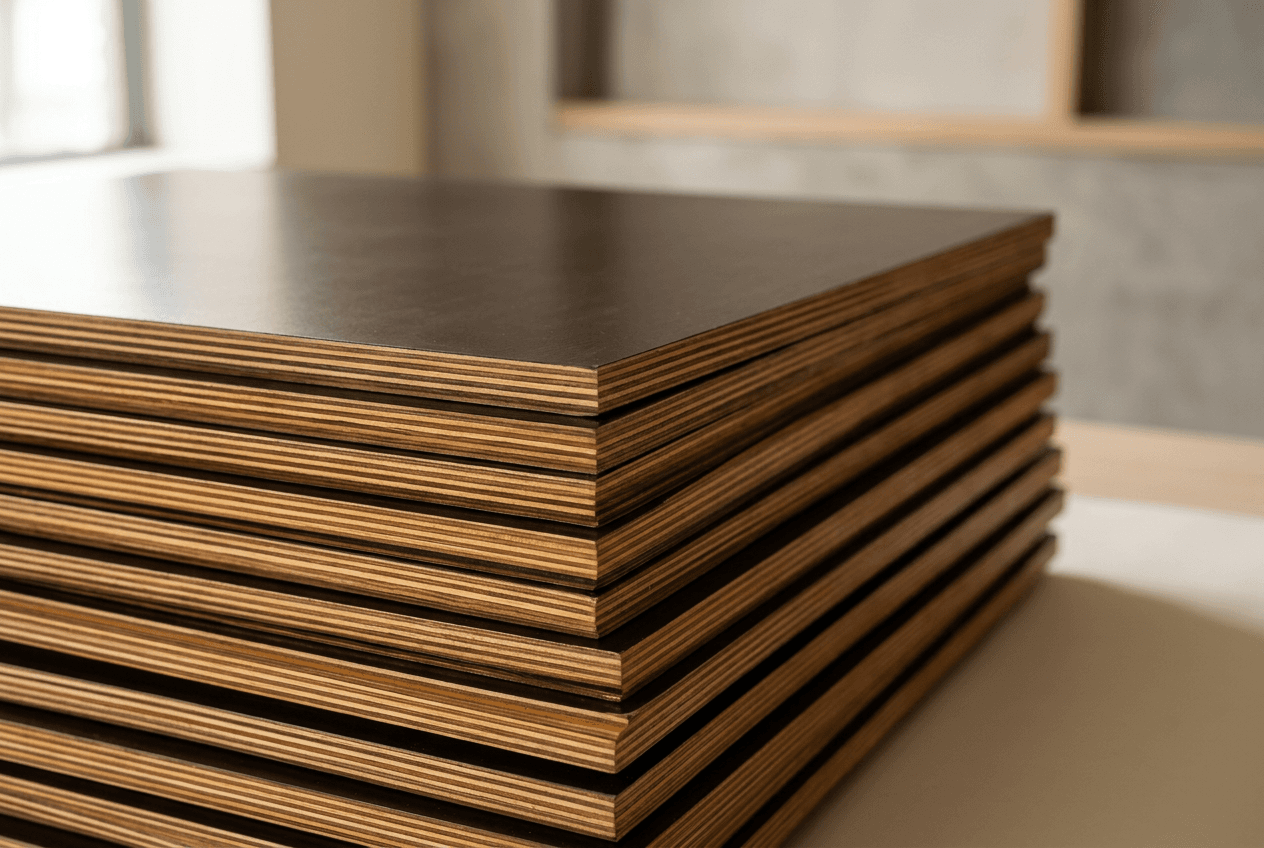
Film-faced plywood is a phenolic-bonded panel coated on both faces with **a black phenolic film at 120–220 g/m²**, engineered for high-density concrete formwork. Stocked at thicknesses **12, 15, 18, and 21 mm in 122×244 and 125×250 cm sheets**, supporting 10–15 form-pour cycles and producing a mirror-finish concrete face.
What is film-faced plywood?
Film-faced plywood is an engineered panel coated on both faces with a black phenolic film at 120 to 220 g/m². The film is fully waterproof and prevents concrete adhesion. The system is engineered for high-density concrete formwork — towers, tunnels, bridges — where surface quality and reuse cycle count are both critical.
The face film is paper impregnated with phenol-formaldehyde resin, hot-pressed onto the panel face. The resulting surface is glossy black, hard, and non-porous — the basis of its 10–15 form-pour cycle life with no release-oil application required per cycle. The 220 g/m² grade reaches 15 cycles; 120 g/m² delivers 10.
Film-faced plywood typically uses a WBP poplar core (Chinese), Siberian pine core (Russian), or birch core (Finnish and northwest Russian). Finnish and Russian birch is the highest grade because birch hardness supports 15 cycles. Chinese is the price floor at 10 cycles.
Why is film-faced plywood used in concrete formwork?
Film-faced plywood is used because it delivers lower cost per pour cycle than ordinary WBP plywood despite a higher unit price. A SAR 180 sheet running 15 cycles equals SAR 12 per cycle; a SAR 100 sheet running 7 cycles equals SAR 14.3 per cycle. The advantage scales with project size.
Second advantage: the concrete face produced after stripping is mirror-finish (off-form), needing no skim coat or paint — particularly valuable on exposed columns and architectural concrete walls. This eliminates finishing labour, a critical cost line on tower projects with exposed concrete elements.
Third advantage: the film protects the panel from contact with caustic cement water (pH 12–13), which gradually degrades the phenolic resin in standard WBP plywood. This chemical protection doubles working life. No post-manufacturing surface treatment can replicate it.
What are the specifications of film-faced plywood?
Film-faced plywood ships at thicknesses 12, 15, 18, and 21 mm in 122×244 cm and 125×250 cm sheets (the latter common on European specifications). Surface film 120–220 g/m², WBP phenolic internal bond, 10–15 cycle reuse. Certifications: EN 13986 (Europe) and GOST 53920 (Russia).
| Product name | Phenolic film-faced plywood |
|---|---|
| Origins | China · Russia · Finland |
| Core species | Poplar (Chinese) · birch (Russian/Finnish) |
| Film type | Hot-pressed phenolic film |
| Film density | 120 · 140 · 160 · 220 g/m² |
| Thicknesses (mm) | 12 · 15 · 18 · 21 |
| Sheet sizes (cm) | 122×244 · 125×250 |
| Internal bond | Phenol formaldehyde (WBP) |
| Pressure tolerance | Up to 55 kN/m² at 21 mm |
| Reuse cycles | 10 – 15 |
| Concrete face quality | Off-form finish — no remediation required |
| Certifications | EN 13986 · GOST 53920 · WBP |
What are the construction applications of film-faced plywood?
Film-faced plywood serves five primary applications: tower column formwork (18 mm), large slab formwork (21 mm), bridge and viaduct formwork (18–21 mm), tunnel and channel formwork (18 mm), and travelling reusable formwork (15 mm). The most-ordered SKU is 18 mm with 120 g/m² film.
- 01
Tower column formwork (18 mm)
Columns on 40+ storey financial and hotel towers. The mirror finish requires no skim coat or paint, removing finishing labour cost on upper floors.
- 02
Large slab formwork (21 mm)
Slabs on towers and shopping centres exceeding 500 m² per pour. The 21 mm thickness resists deflection between bearers under deep concrete pressure.
- 03
Bridge and viaduct formwork (18–21 mm)
On road infrastructure and viaducts where concrete remains exposed, the mirror surface is an aesthetic requirement. 220 g/m² film guarantees the surface across cycles.
- 04
Tunnel and channel formwork (18 mm)
Road tunnels and large drainage channels require plywood that resists caustic concrete water for many hours per pour. The phenolic film provides this protection.
- 05
Travelling reusable formwork (15 mm)
For major contractors moving formwork between sites. 15 mm with 220 g/m² film withstands the repeated transport and reassembly that lighter films cannot survive.
What is the difference between film-faced and marine plywood?
Film-faced plywood is coated with a black film that prevents concrete adhesion and supports 10–15 reuse cycles, while marine plywood has a bare wood face for adhesion in permanent installations. Film-faced is for formwork only; marine for kitchens, baths, and pools. They are not interchangeable.
For tower formwork, film-faced is the working specification because of its multi-cycle reuse and finished concrete face. For bathrooms and kitchen casework, film-faced fails because the black film does not accept tile thinset, paint, or veneer adhesive — marine plywood is mandatory there. The difference is application, not quality.
| Attribute | Film-faced | Marine |
|---|---|---|
| Surface | Glossy black phenolic film | Natural wood, accepts adhesion |
| Reuse cycles | 10–15 | Up to 6 |
| Concrete face quality | Mirror — no remediation | Rough — needs finishing |
| Adhesive and paint | No — film rejects bonding | Yes — like any plywood |
| Best use | Tower and infrastructure formwork | Kitchens, baths, pools |
| Price/sheet | SAR 95–220 | SAR 110–260 |
| Lead standard | EN 13986 · GOST 53920 | BS 1088 · IS 710 |
How do I choose film density and thickness for film-faced plywood?
Film density scales with cycle target: 120 g/m² for 10 cycles, 140 g/m² for 12, 160 g/m² for 13, 220 g/m² for 15 cycles. Thickness 18 mm for walls and columns, 21 mm for large slabs. Specify the heavier film for major projects with multi-cycle reuse.
Finnish birch with 220 g/m² film is the market premium, used on Vision 2030 mega-projects because 15-cycle life and dimensional stability under repeated transport justify the cost. Chinese with 120 g/m² film is the budget option for medium projects with limited cycle counts.
For contractors transporting formwork between sites, specify 160 g/m² film or higher. Repeated transport and disassembly scratches lighter film, and any scratch admits water into the wood — ending sheet life early.
How is film-faced plywood stored and installed?
Film-faced plywood stores flat on bearers 15 cm off the ground in a dry, shaded area, under a breathable cover. Installation uses non-metallic fasteners or wide-head screws at 20 cm spacing, with care to avoid film scratching. All cut edges are sealed with a phenolic edge sealer to close exposed pores.
The phenolic film eliminates release-oil application in early cycles, but after the seventh cycle a light release-oil coat extends life toward the 15-cycle ceiling. The film is naturally non-stick — concrete will not bond to it unaided — unlike WBP plywood, which requires release oil from the first pour.
After stripping, scrape with a soft plastic scraper, rinse with fresh water, and let dry. Deep film scratches are sealed immediately with phenolic repair coating before the next pour to prevent water ingress and premature failure.
Does film-faced plywood meet Saudi Building Code requirements?
Film-faced plywood meets SBC 201 structural requirements for formwork and ships with EN 13986 (European) or GOST 53920 (Russian) certifications by origin. Each shipment includes bending and reuse test reports plus a documented mill film-density certificate.
On projects using European engineering specifications (German or French consultants on Vision 2030 projects), EN 13986 film-faced plywood simplifies acceptance. On projects with Russian specs, GOST 53920 is the reference. Both standards are accepted under SBC 201.
Which Saudi projects use film-faced plywood?
Film-faced plywood ships into King Abdullah Financial District towers, NEOM and Red Sea hotels, Qiddiya infrastructure, Riyadh and Jeddah viaducts and tunnels, and projects with exposed architectural concrete. The application is structural multi-cycle formwork.
- King Abdullah Financial District and Olaya towers — exposed-column and large-slab formwork.
- NEOM and Red Sea hotels and resorts — architectural structural-wall formwork.
- Qiddiya and New Murabba infrastructure — bridge and viaduct formwork.
- Road tunnels and water-management projects — channel and structural-corridor formwork.
- Major contractors across the Kingdom — site-to-site travelling formwork.
What are common questions about film-faced plywood?
In the first seven cycles, film-faced plywood **does not require release oil** because the film itself isolates the concrete. After the seventh cycle, a light oil application extends life toward 15 cycles. This saves oil cost in early cycles compared to WBP.
120 g/m² film supports **10 form-pour cycles**; 220 g/m² supports **15 cycles**. The 30–40% price premium is justified on major projects with formwork transported between sites — heavier film resists transport scratches and edge crushing.
Not recommended. Film-faced plywood is **engineered for formwork only** because the film rejects tile thinset, paint, and veneer adhesive. For flooring use WBP or marine plywood; for facades specify fibre-cement or calcium silicate panels.
**100 sheets** is the effective minimum given the higher unit value. Smaller quantities ship from our Olaya yard. Full-container shipments from China or Russia (2,000 sheets) carry a 12% discount with 3–6 weeks lead time.
Chinese is cheapest (SAR 95–140), poplar core, 10–12 cycle life. Russian birch (SAR 140–180) is stiffer, 12–14 cycle life. Finnish birch (SAR 180–220) is premium grade, 15 cycle life. Choice depends on project budget and target cycle count.
Yes — cut with a TCT fine-tooth circular saw. **All cut edges must be sealed immediately with phenolic edge sealer** because exposed edges are the single weak point. Skipping this step shortens life to 5–7 cycles instead of 15.
Film is available in **black (standard), brown, and red** depending on origin. Black is the default because it makes concrete defects visible after stripping, supporting the finishing crew. Red is common in Russian production; brown in premium Chinese.
What products relate to Film-faced plywood?
Selections that complement the work in Saudi construction projects.

Need a quote on film-faced plywood for your project?
Send a quantity list with thicknesses, the required film density (120 or 220 g/m²), and a preferred origin (Chinese, Russian, or Finnish). We respond with a formal quote within 4 working hours — unit price, total, and lead time included.