Scaffolding hardware · forged steel couplers
Scaffold clamps
Scaffold clamps are forged-steel couplers that join 48.3 mm scaffold tubes into a load-bearing frame. Riyadh Timber stocks **fixed 90° and swivel clamps with slip resistance ≥ 9 kN, certified to EN 74-1 and BS 1139** — the standard hardware on Saudi tower scaffolds, facade access, and infrastructure projects.
What is a scaffold clamp?
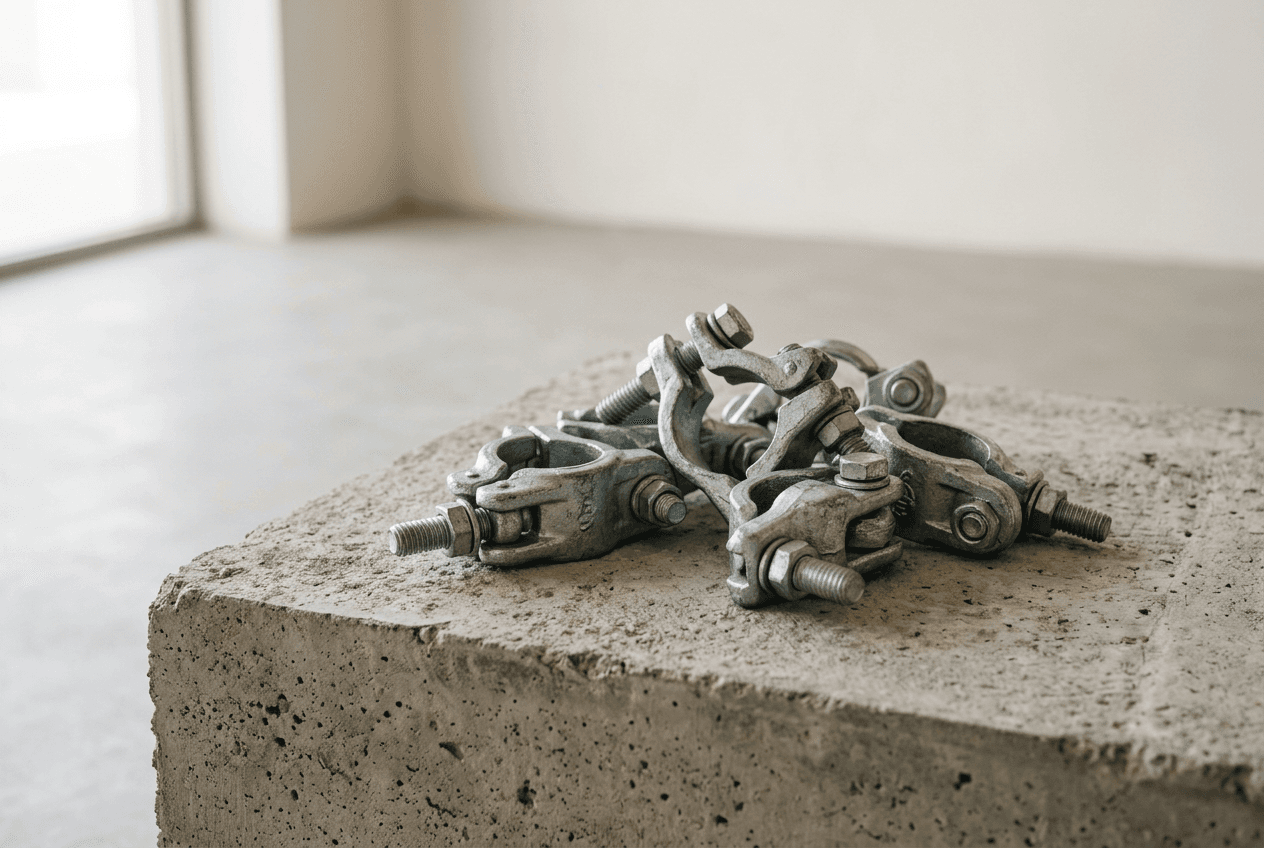
A scaffold clamp is a forged-steel coupler that joins two 48.3 mm scaffold tubes into a load-bearing scaffold frame. The clamp consists of two saddle halves and a hex bolt or T-bolt; tightened to 50 Nm, it resists slip up to 9 kN per EN 74-1. Riyadh Timber stocks fixed, swivel, sleeve, and putlog types.
Fixed clamps lock at 90° for ledger-to-standard joints — the structural backbone of any tube-and-fitting scaffold. Swivel clamps rotate freely for diagonal bracing. Sleeve couplers join two tubes end-to-end to extend a single member, while putlog couplers connect putlog tubes to ledgers.
Forged-steel construction is mandatory under EN 74-1. Pressed-steel clamps fail brittle under load and are not certified for use above 6 m on Saudi sites. Each clamp is stamped with the manufacturer's mark and the EN 74-1 reference.
Why are forged-steel scaffold clamps mandatory on Saudi sites?
Forged clamps are mandatory because they deliver guaranteed 9 kN slip resistance and ductile failure mode under EN 74-1. Pressed-steel imitations fail brittle without warning, causing scaffold collapses. Saudi project consultants and Aramco/SABIC inspectors reject any uncertified hardware on sites above 6 m or near workers.
On a typical scaffold tower, every fixed clamp at a ledger-to-standard joint carries the cumulative dead and live load above. A 9 kN slip resistance gives the safety margin against accidental displacement, wind load, and worker movement during erection.
EN 74-1 testing covers slip resistance, static load, dynamic load, and pull-out resistance under repeated load. Riyadh Timber's clamps carry CE marks, mill certificates, and on-request third-party test reports for each shipment.
What are the specifications of scaffold clamps?
Scaffold clamps fit 48.3 mm tubes with slip resistance ≥ 9 kN, ultimate strength ≥ 25 kN, and bolt torque 50 Nm per EN 74-1. Forged from S235JR steel, hot-dip galvanised to EN ISO 1461. Available as fixed 90°, swivel (variable angle), sleeve (end-to-end), and putlog (single-tube) types in Riyadh stock.
| Tube diameter | 48.3 mm OD |
|---|---|
| Wall thickness fit | 3.2 to 4.0 mm tubes |
| Fixed clamp angle | 90° rigid |
| Swivel clamp angle | 0 to 360° rotation |
| Slip resistance | ≥ 9 kN per EN 74-1 |
| Ultimate strength | ≥ 25 kN before failure |
| Bolt torque | 50 Nm hex or T-bolt |
| Material | Forged S235JR steel |
| Finish | Hot-dip galvanised, ≥ 60 microns |
| Weight (fixed) | 1.05 kg per clamp |
| Weight (swivel) | 1.20 kg per clamp |
| Standards | EN 74-1 · BS 1139 · EN 12810 |
Where are scaffold clamps used on a construction site?
Scaffold clamps are used in all tube-and-fitting scaffold construction: tower scaffolds, facade access frames, falsework towers, temporary roofs, and complex shoring. Fixed clamps form the load-bearing joints, swivel clamps the bracing, sleeve clamps extend tubes, and putlog clamps tie boards to ledgers.
- 01
Tube-and-fitting tower scaffolds
Fixed clamps join standards to ledgers and transoms; swivel clamps brace diagonals. Saudi tower work uses tube-and-fitting where modular system scaffolds cannot adapt to facade geometry.
- 02
Facade access scaffolds
Cantilever brackets, drop-down frames, and protected hoists assembled with clamps for high-rise facade cladding, painting, and maintenance work.
- 03
Falsework towers
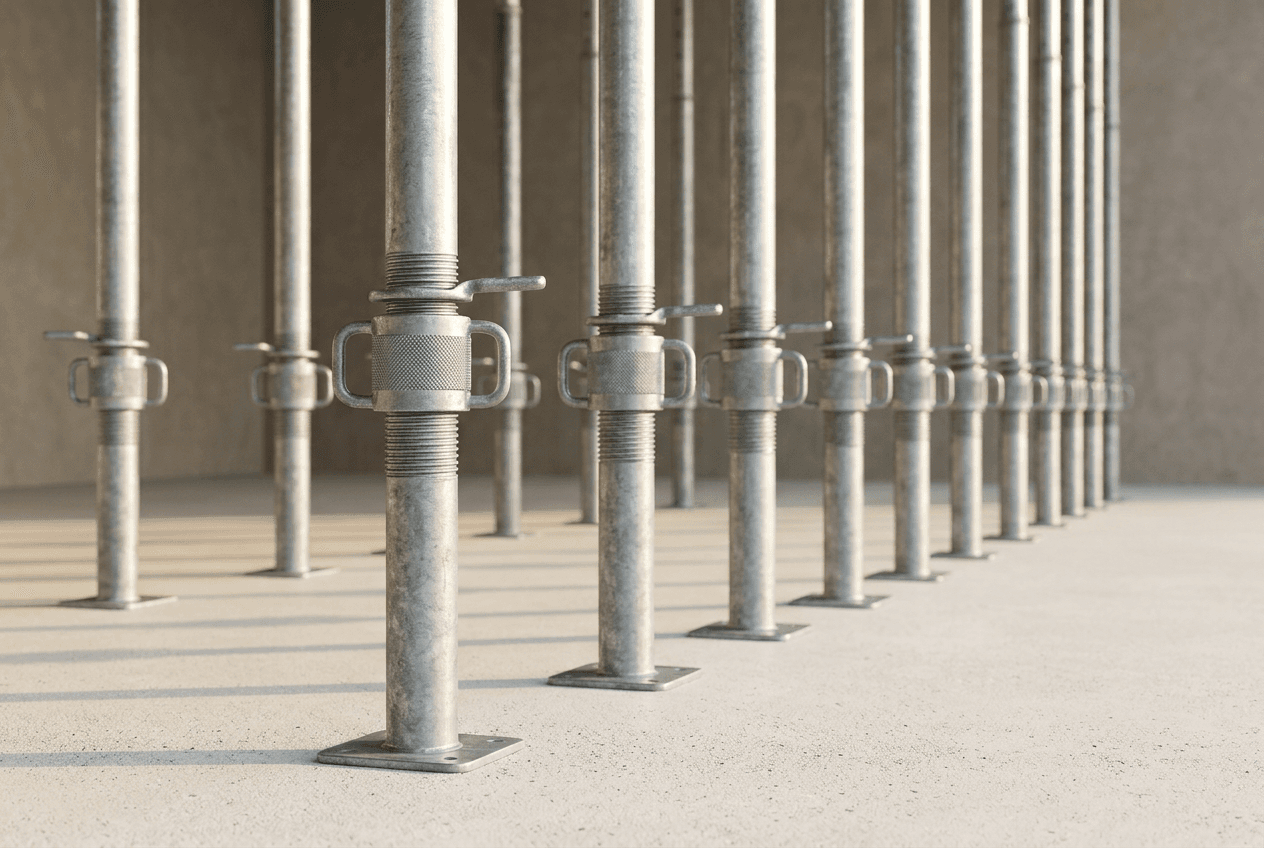
Heavy-duty falsework for slab and beam shoring above 4 m clear height — assembled from tubes, clamps, base jacks, and U-heads with engineer-stamped drawings.
- 04
Temporary roofs and weather covers
Tube frames clad with sheeting form temporary roofs over critical pours, archaeological digs, or weather-sensitive site activities.
- 05
Bracing for masonry and rendering
Lightweight scaffold platforms for masonry construction, rendering, and external finishes — typically 2 to 3 lifts using fixed and swivel clamps throughout.
What is the difference between fixed and swivel scaffold clamps?
Fixed clamps lock at 90° rigid angle for ledger-to-standard joints — the load-bearing backbone of any scaffold. Swivel clamps rotate 0 to 360° for diagonal bracing and irregular angles. Both share the 9 kN slip resistance under EN 74-1, but fixed clamps carry vertical load while swivel clamps stabilise against horizontal forces.
Roughly 70% of clamps on a standard tower scaffold are fixed (load-bearing 90° joints), and 30% are swivel (diagonal braces). On complex facade scaffolds with stepped or curved geometry, the swivel proportion rises to 40 to 50%.
Always verify that swivel clamps are tightened with the bolt accessible — never with the swivel pivot facing into the scaffold interior, which prevents inspection and re-torque. Site supervisors check clamp torque at each lift completion.
| Attribute | Fixed clamp | Swivel clamp |
|---|---|---|
| Joint angle | 90° rigid | 0 to 360° rotating |
| Primary use | Ledger to standard | Diagonal bracing |
| Slip resistance | ≥ 9 kN | ≥ 9 kN |
| Weight | 1.05 kg | 1.20 kg |
| Indicative price | SAR 8 to 14 | SAR 12 to 22 |
| Typical proportion | 60 to 70% of clamps | 30 to 40% of clamps |
| Standards | EN 74-1 / BS 1139 | EN 74-1 / BS 1139 |
How do I choose the right scaffold clamps for my project?
Match clamp type to joint function: fixed 90° for ledger-to-standard load-bearing joints, swivel for diagonal bracing, sleeve for tube extensions, putlog for board ties. Always specify forged steel to EN 74-1 — never pressed-steel imitations. Estimate 1.4 clamps per linear metre of tube as a first-pass quantity check.
On a standard tower scaffold of 30 m tube length, expect approximately 42 clamps total — split 28 fixed and 14 swivel. Add 10% spare against site loss and damage. Galvanised finish is mandatory in Riyadh climate; painted clamps corrode within 6 to 12 months on exposed sites.
Verify the EN 74-1 stamp and CE mark on each clamp before site issue. Reject clamps with cracked saddles, stripped bolts, or missing markings. Riyadh Timber clamps carry mill certificates and on-request third-party test reports for any project.
How are scaffold clamps installed and torqued?
Install clamps at every ledger-to-standard joint, with bolt heads accessible from inside the scaffold, torqued to 50 Nm with a calibrated ratchet. Site supervisors check torque at each lift completion and after any overload event. Clamps with cracked saddles, stripped threads, or missing CE marks are tagged out.
Saddle clamps wrap around the two tubes; the hex or T-bolt is tightened to 50 Nm. Under-torqued clamps slip under load — the leading cause of scaffold collapse. Over-torqued clamps strip the threads and become difficult to remove during dismantle.
Calibrated torque wrenches are required on Aramco, SABIC, and Vision 2030 mega-project sites. The site safety team logs torque readings for every clamp on critical joints. Riyadh Timber supplies certified torque wrenches alongside clamp shipments on request.
Do scaffold clamps meet Saudi Building Code requirements?
Riyadh Timber's scaffold clamps meet EN 74-1, BS 1139, EN 12810 access scaffold standards, and SBC 502 site-safety provisions. Each clamp ships with mill certificate, CE mark, and on-request third-party slip and pull-out test reports satisfying Aramco SAES-Q-001 and Saudi Royal Commission engineering reviews.
EN 74-1 specifies the test regimen: slip resistance under static load, ultimate strength to failure, fatigue under cyclic load, and pull-out resistance from bolt loosening. Each batch is tested at the factory with a sample submitted for third-party verification on critical projects.
Which Saudi projects use scaffold clamps from Riyadh Timber?
Riyadh Timber clamps support NEOM, Red Sea, Diriyah, Qiddiya, and New Murabba, the King Abdullah Financial District towers, Riyadh Metro stations, and high-rise residential projects across Olaya, Hittin, and Al Malqa. Volume contracts run from 1,000-clamp site supplies to 50,000-clamp tower mobilisations.
- Vision 2030 mega-projects: NEOM, Red Sea, Diriyah, Qiddiya, New Murabba — facade and superstructure scaffolds.
- King Abdullah Financial District and Olaya towers — facade access and falsework towers.
- Riyadh Metro stations — temporary scaffold roofs and access frames.
- High-rise residential in Hittin, Al Malqa, Al Yasmin — facade rendering and final-finish scaffolds.
What are common questions about scaffold clamps?
**500 clamps** is the effective delivery minimum, sufficient for a small tower scaffold of 350 m tube length. Smaller orders pick up from our Olaya yard or are bundled with existing project shipments to absorb logistics cost.
Our forged scaffold clamps deliver **slip resistance ≥ 9 kN and ultimate strength ≥ 25 kN** under EN 74-1 — well above the safe working load required on Saudi tower scaffolds. Each clamp is stamped EN 74-1 and CE for site verification.
Pressed-steel clamps cost about 30% less but **fail brittle without warning under load and are not EN 74-1 certified**. Saudi project consultants and Aramco/SABIC inspectors reject pressed clamps on any scaffold above 6 m or near workers — we stock forged-only.
**50 Nm with a calibrated ratchet** is the EN 74-1 specified torque for 48.3 mm clamps. Under-torque causes slip under load; over-torque strips the bolt threads. Site supervisors check torque at each lift completion using calibrated wrenches.
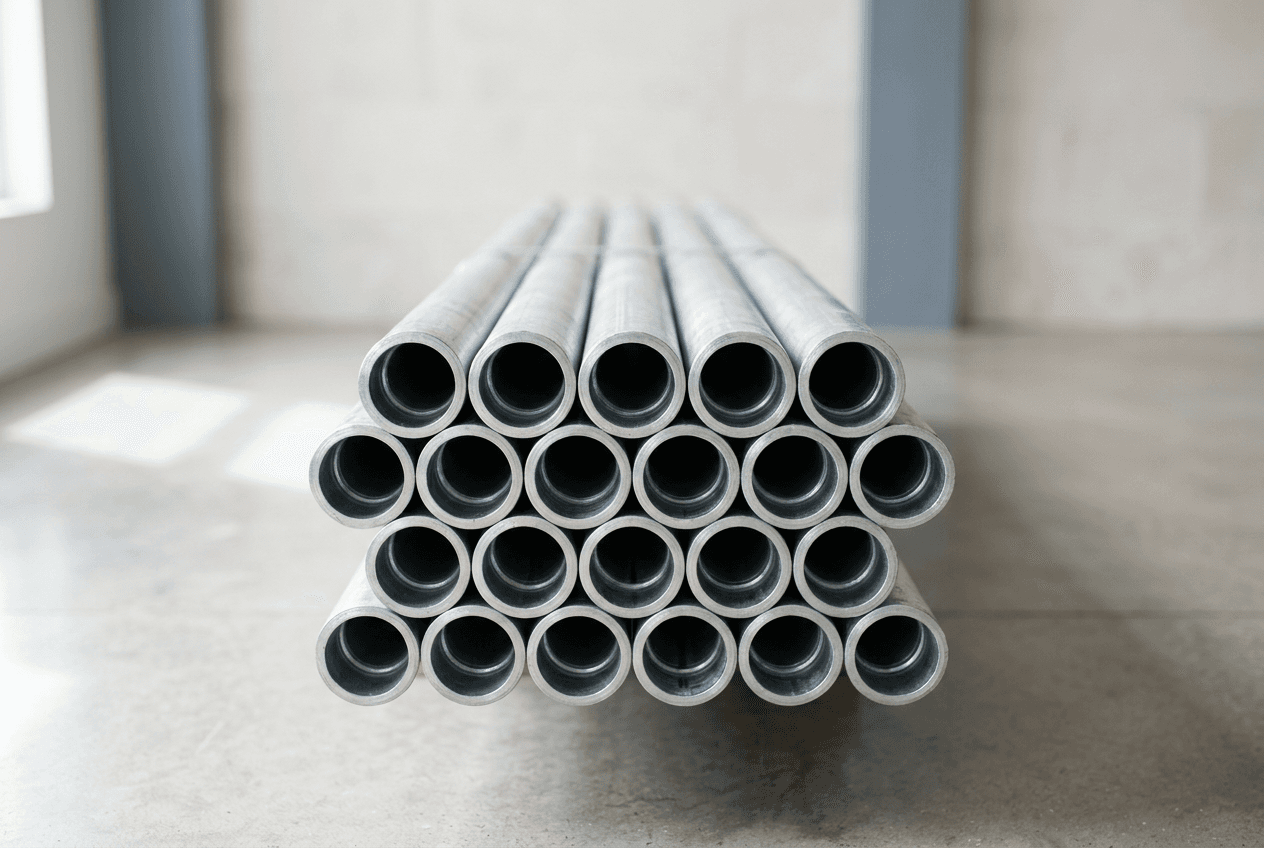
Yes. **48.3 mm scaffold tubes** in 2, 3, 4, 5, and 6 m lengths in galvanised steel to EN 39 and BS 1139, paired with clamps and base jacks for a complete tube-and-fitting scaffold. Bulk site mobilisations ship within 24 to 48 hours from Olaya.
Galvanised forged clamps survive **5 to 10 years of continuous site use** with cleaning and bolt replacement. Damaged saddles or stripped threads tag the clamp out of service permanently. Riyadh Timber accepts old clamps for trade-in against new orders on rental contracts.
**No** — the saddle is sized to fit 48.3 mm OD tubes only. Using clamps on smaller or larger tubes causes incorrect torque, slip under load, and scaffold failure. Other tube diameters require their own coupler systems, supplied separately on request.
What products relate to Scaffold clamps?
Selections that complement the work in Saudi construction projects.
Need a quote on scaffold clamps for your project?
Send the scaffold tube length and joint count from your erection drawing. We respond with a formal quote within 4 working hours — clamp quantities, total, lead time, and EN 74-1 certificates included.