Construction fixings · timber framing fasteners
Construction nails and screws
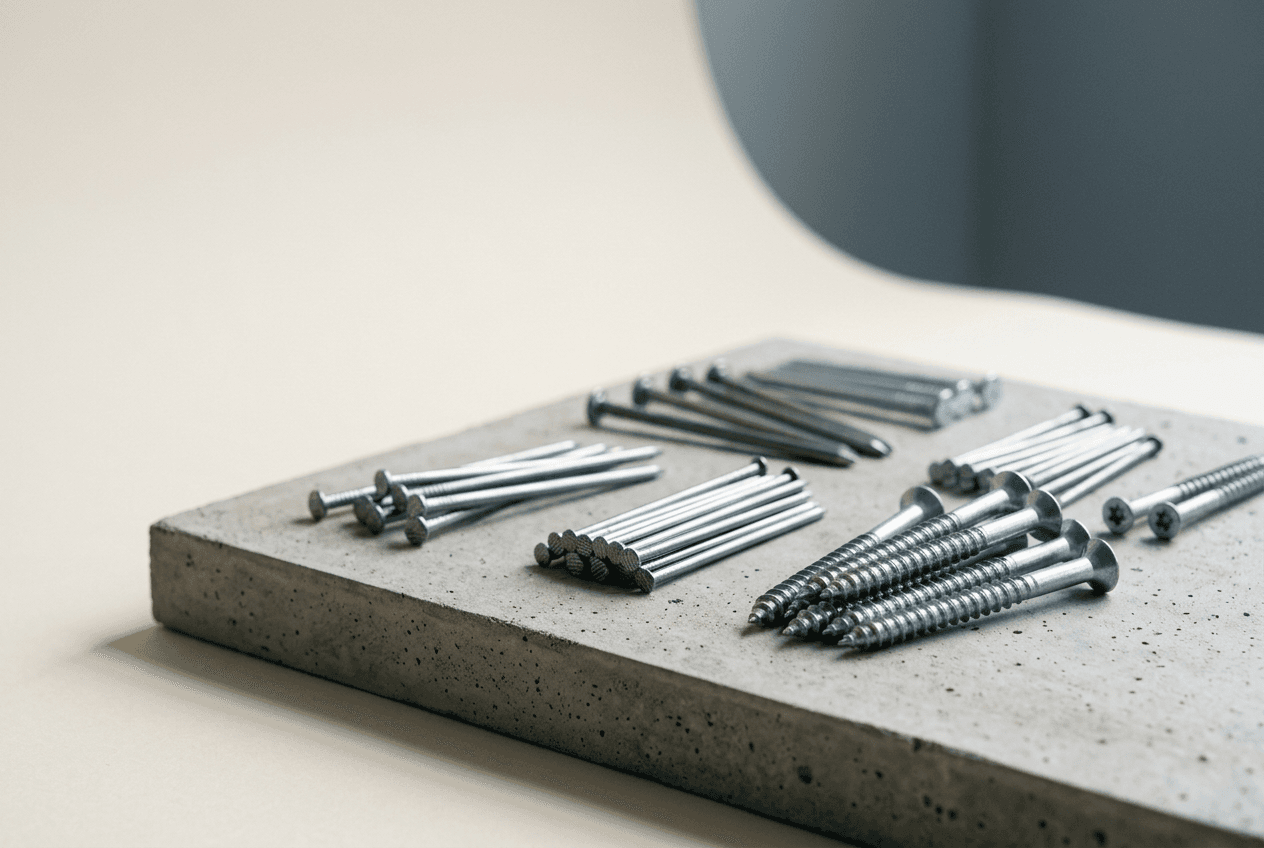
Construction nails and screws are the fixings that hold timber formwork, framing, and finish carpentry on every Saudi site. Riyadh Timber stocks **nails 25 to 150 mm and screws 3.5 to 8 mm in galvanised, coated, and brassed finishes — certified to DIN 1151, DIN 7505, and ISO 898-1** — packed in 1, 5, and 25 kg cartons.
What are construction nails and screws?
Construction nails and screws are steel fasteners that fix timber formwork, framing, and finish carpentry to bearers, frames, and substrates. Riyadh Timber stocks nails 25 to 150 mm to DIN 1151 and screws 3.5 to 8 mm to DIN 7505 in galvanised, coated, and brassed finishes, ISO 898-1 strength class 4.6 to 8.8.
Nails are driven by hammer or pneumatic gun and resist withdrawal by friction along the shank. Screws are driven by power driver and resist withdrawal by mechanical thread engagement. Both serve formwork, framing, panelling, decking, and finish carpentry across Saudi sites.
Galvanised finish is mandatory for any nail or screw exposed to weather, concrete, or treated timber. Plain steel rusts within weeks of site exposure, while hot-dip galvanised fasteners survive 5 to 10 years on exposed work. Brassed finish suits decorative interior fixings.
Why are DIN-certified nails and screws used on Saudi sites?
DIN-certified fixings are used because they deliver guaranteed shank diameter, head dimension, and steel grade to DIN 1151 (nails) and DIN 7505 (screws). Off-spec fixings with thin shanks or low-grade steel pull through timber under load, fail under torque, or rust through within months. Saudi project consultants reject any uncertified fixings on Vision 2030 sites.
DIN 1151 specifies wire-nail dimensions, point geometry, head shape, and steel grade. DIN 7505 specifies wood-screw thread profile, head type, and tensile strength per ISO 898-1. Each Riyadh Timber pack carries the standard reference, manufacturer code, and finish specification.
Timber-frame failures on Riyadh sites trace overwhelmingly to under-spec fixings rather than under-spec timber. Specifying DIN-certified nails and screws at correct length and spacing eliminates the leading cause of formwork and framing collapse during pours and erection.
What are the specifications of construction nails and screws?
Construction nails ship in lengths 25, 50, 75, 100, and 150 mm with shank diameters 2.5 to 5.5 mm to DIN 1151. Wood screws ship in diameters 3.5, 4, 5, 6, and 8 mm with lengths 25 to 150 mm to DIN 7505. Steel grade C45 minimum, ISO 898-1 class 4.6 to 8.8. Finishes: hot-dip galvanised, zinc-coated, brassed, or stainless steel.
| Nail standard | DIN 1151 wire nails |
|---|---|
| Nail lengths | 25, 50, 75, 100, 150 mm |
| Nail shank diameter | 2.5 to 5.5 mm |
| Nail head | Flat, lost-head, ring-shank |
| Screw standard | DIN 7505 wood screws |
| Screw diameters | 3.5, 4, 5, 6, 8 mm |
| Screw lengths | 25 to 150 mm |
| Screw drive | Pozidriv (PZ2/PZ3) or Torx (T20/T25) |
| Steel grade | C45 minimum, ISO 898-1 class 4.6 to 8.8 |
| Finish options | Galvanised · zinc · brass · stainless |
| Pack sizes | 1, 5, 25 kg cartons |
| Standards | DIN 1151 · DIN 7505 · ISO 898-1 |
Where are construction nails and screws used on a site?
Construction nails and screws are used in timber formwork assembly, stud-frame construction, sheet panelling, finish carpentry, decking, and roof battens. Nails serve high-volume framing and rapid assembly; screws serve quality framing, demountable assemblies, and finish work where withdrawal resistance matters.
- 01
Timber formwork assembly
75 to 100 mm galvanised nails fix plywood faces to timber bearers and stud frames at 20 to 30 cm spacing. The 100 mm length penetrates 60 mm into the bearer for full holding power.
- 02
Stud-frame construction
150 mm nails or 100 mm screws fix studs to head and sole plates. Galvanised finish for any frame exposed to weather; plain finish for interior dry framing only.
- 03
Sheet panelling and cladding
50 to 75 mm screws fix plywood, MDF, OSB, and fibre cement panels to framing at 30 cm centres along edges and 60 cm in field. Pozidriv drive heads countersink flush.
- 04
Roof battens and decking
75 to 100 mm galvanised nails or 6 mm screws fix battens to rafters. Stainless steel fasteners required for cedar shingle and treated timber to prevent staining.
- 05
Finish carpentry
Brassed or coated 3.5 to 4 mm screws fix architraves, skirting, doors, and trim. Lost-head nails for invisible fixing of moulding and decorative timber.
What is the difference between construction nails and screws?
Nails drive fast by hammer or pneumatic gun, resist shear well, but pull out under withdrawal load. Screws drive slowly by power driver, resist both shear and withdrawal, and demount cleanly. Use nails for high-volume framing and rapid formwork; use screws for quality framing, panelling, and any joint that may need demounting.
On a 200 m² formwork assembly, an experienced carpenter drives 1,200 nails per hour with a pneumatic gun versus 250 to 350 screws per hour with a power driver. Nails win on speed; screws win on holding power and demountability when the form strips.
Hybrid practice is common: nails fix the bulk plywood-to-bearer connection, screws fix the corner joints and any panel that will be re-used. Riyadh Timber stocks both in matching coil and bulk packs for the formwork specialist.
| Attribute | Construction nail | Wood screw |
|---|---|---|
| Drive method | Hammer or pneumatic | Power driver Pozidriv/Torx |
| Drive speed | Fast (1,200/hr) | Slow (250 to 350/hr) |
| Shear resistance | High | High |
| Withdrawal resistance | Low to moderate | Very high |
| Demountable | No — splits timber | Yes — clean removal |
| Best fit | Formwork, framing | Panelling, finish, demountable |
| Standards | DIN 1151 | DIN 7505 / ISO 898-1 |
How do I choose the right nails and screws for my project?
Match length to penetration depth: fixing length should be 2 to 2.5 times the thickness of the top piece. Use 75 mm nails for 18 mm plywood on bearers, 100 mm for stud framing, 150 mm for heavy timber connections. Specify galvanised for any exposed work, stainless for marine and treated timber.
Spacing follows the structural drawing: 20 cm at edges, 30 cm in field for plywood-on-bearer formwork; 60 cm centres for studs to head plates; 30 cm for panelling. Closer spacing is better than fewer, larger fixings — distributes load and resists peeling.
Steel grade and ISO 898-1 class matter for screws under high torque or withdrawal load. Class 4.6 suits general framing; class 8.8 suits structural connections and timber-to-steel joints. Riyadh Timber supplies the matching grade for each specification.
How are construction nails and screws installed?
Drive nails flush with the timber face — never proud and never deep below the surface — at the spacing on the framing drawing. Drive screws to seat the head with the underside of the head flush to the surface; over-driven screws strip the timber and lose holding power. Use pilot holes for screws into hardwood or near board edges.
Pneumatic nailers deliver consistent depth at high speed but require careful pressure control to avoid over-driving. Hand-hammered nails depend on operator skill — a missed strike that bends the nail must be pulled and replaced, never driven sideways into the timber.
Pre-drill pilot holes for any screw into hardwood (oak, beech, teak) at 70% of the screw shank diameter. Pilot holes prevent timber splitting and reduce drive torque, especially within 30 mm of the timber edge or end-grain.
Do construction nails and screws meet Saudi Building Code requirements?
Riyadh Timber's nails and screws meet DIN 1151 (wire nails), DIN 7505 (wood screws), ISO 898-1 (mechanical properties), and SBC 304 / SBC 502 site provisions. Each pack ships with mill certificate of steel grade, finish thickness, and ISO 898-1 strength class. Vision 2030 mega-projects accept these certificates for QC review.
Mill certificates list the steel grade (C45 minimum), tensile strength to ISO 898-1 (class 4.6 to 8.8), galvanising thickness (≥ 30 microns), and dimensional accuracy. The site QC team logs the fastener batch on each formwork erection record. Aramco and SABIC sites require the certificates retained for 10 years post-completion.
Which Saudi projects use construction nails and screws from Riyadh Timber?
Riyadh Timber fixings serve NEOM, Red Sea, Diriyah, Qiddiya, and New Murabba, the King Abdullah Financial District towers, Riyadh Metro stations, and high-rise residential projects across Olaya, Hittin, and Al Malqa. Volume contracts run from 50-pack site supplies up to 5,000-pack tower mobilisations.
- Vision 2030 mega-projects: NEOM, Red Sea, Diriyah, Qiddiya, New Murabba — formwork, framing, finish carpentry.
- King Abdullah Financial District and Olaya towers — formwork plywood-to-bearer fixings.
- Riyadh Metro stations — temporary frame and panelling fixings.
- High-rise residential in Hittin, Al Malqa, Al Yasmin — framing, decking, finish carpentry.
What are common questions about construction nails and screws?
**100 kg of fixings** (mixed pack sizes) is the effective delivery minimum. Smaller orders are picked up from our Olaya yard or are bundled with existing project shipments to absorb logistics cost.
**75 mm nails** — penetration of 57 mm into the bearer, leaving 7 mm clearance. The 2.0 to 2.5x rule of thumb (top piece × 2 to 2.5) gives the holding power needed for formwork against pour pressure of 45 kN/m².
**Hot-dip galvanised to ≥ 30 microns and stainless steel** are accepted for treated timber and exterior work. Plain or zinc-plated fixings react with treatment chemicals (CCA, ACQ) and corrode within months. Riyadh Timber stocks both galvanised and stainless options.
Yes. **Coil and strip nails for pneumatic guns** in 50, 75, and 100 mm lengths, sized to fit the major brands of nail gun used on Saudi sites. Coil nails ship in 25 kg cartons of approximately 6,000 nails.
**Pozidriv PZ2 and PZ3** for general framing and panelling; **Torx T20 and T25** for high-torque applications and machine driving. Slot drives are available on order; Phillips drive is generally avoided for construction screws because the cam-out causes head stripping.
Hot-dip galvanised fixings survive **5 to 10 years on exposed work** in Riyadh climate. Marine and coastal projects require stainless steel — A4/316 grade for direct salt exposure, A2/304 for sheltered marine. Plain steel rusts within weeks and is rejected on Vision 2030 sites.
Yes. **Custom lengths from 20 mm to 300 mm** are available with 50,000-piece minimum order and 3 to 4 week lead time from China or India. Standard lengths are stocked in Riyadh and ship within 24 to 48 hours of order confirmation.
What products relate to Construction nails and screws?
Selections that complement the work in Saudi construction projects.
Need a quote on construction nails and screws for your project?
Send the framing or fixing schedule with required lengths, diameters, and finishes. We respond with a formal quote within 4 working hours — pack quantities, total, lead time, and DIN/ISO certificates included.