Reinforced concrete · rebar cover spacers
Concrete spacers
Concrete spacers position rebar at the correct cover from the form face during pouring. Riyadh Timber stocks **plastic, concrete, and fibre spacers at 15, 20, 25, 30, 40, and 50 mm cover thicknesses, certified to BS 7973** — the standard cover-control component on Saudi foundations, slabs, walls, and Vision 2030 infrastructure.
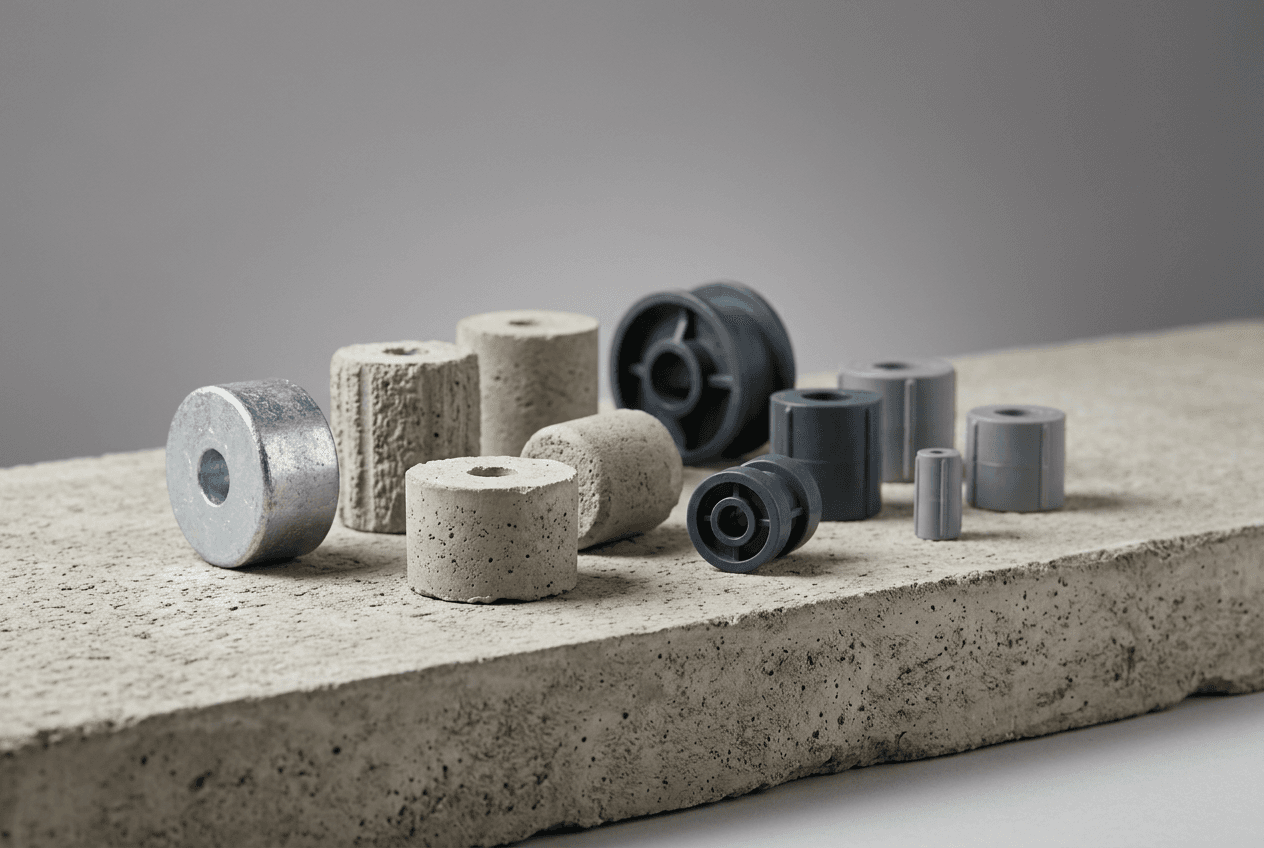
What is a concrete spacer?
A concrete spacer is a plastic, concrete, or fibre block placed between rebar and formwork to maintain the correct cover thickness during pouring. Riyadh Timber stocks spacers at 15, 20, 25, 30, 40, and 50 mm covers, with each piece carrying 5 to 8 kN of rebar load, certified to BS 7973 and EN 13670.
Cover thickness — the distance from rebar surface to the concrete face — is set by SBC 304 and the structural drawing. Insufficient cover exposes steel to corrosion and chloride attack; excessive cover wastes concrete and reduces section moment capacity. Spacers fix the cover to design value.
The three materials each fit a use case. Plastic spacers serve walls and columns (corrosion-proof, no rust mark). Concrete spacers serve slabs and foundations (high load, no thermal bridge). Fibre spacers serve precast and high-load applications where plastic deforms.
Why are concrete spacers required on Saudi sites?
Spacers are required because cover thickness is the primary defence against rebar corrosion in Saudi climate. SBC 304 specifies 25 mm minimum cover for slabs, 40 mm for beams, 50 mm for foundations, and up to 75 mm for marine and aggressive environments. Without spacers, rebar drifts to the form face during pouring and fails inspection.
Riyadh's high temperatures, dust, and coastal salt accelerate rebar corrosion when cover is inadequate. Within 5 to 10 years, exposed steel rusts, expands, and spalls the concrete face — requiring expensive repair on otherwise sound structures. Correct spacers eliminate this failure mode.
On Vision 2030 mega-projects, cover compliance is verified by cover-meter survey before final acceptance. Sites failing cover survey require remedial repair or partial demolition. Riyadh Timber spacers ship with BS 7973 certificates that satisfy QC requirements on NEOM, Red Sea, and similar projects.
What are the specifications of concrete spacers?
Concrete spacers ship at 15, 20, 25, 30, 40, and 50 mm cover thicknesses with load capacity 5 to 8 kN per piece. Plastic spacers from polypropylene or HDPE, concrete spacers from C40/50 mortar with embedded tie-wire, fibre spacers from glass-reinforced cement. Certified to BS 7973 and EN 13670, working temperature -10 to +80 °C.
| Cover sizes | 15, 20, 25, 30, 40, 50 mm |
|---|---|
| Plastic material | Polypropylene or HDPE |
| Concrete material | C40/50 mortar with tie-wire |
| Fibre material | Glass-reinforced cement |
| Load capacity | 5 to 8 kN per piece |
| Working temperature | -10 to +80 °C |
| UV resistance (plastic) | ≥ 12 months exposure |
| Rebar size fit | 8 to 32 mm bar diameters |
| Spacing on rebar | Every 60 cm typical |
| Pieces per m² (slab) | 3 to 6 spacers |
| Pieces per m² (wall) | 4 to 8 spacers |
| Standards | BS 7973 · EN 13670 · SBC 304 |
Where are concrete spacers used in reinforced concrete work?
Concrete spacers are used in all reinforced concrete: foundations, slabs, walls, columns, beams, and precast elements. The spacer type and size are chosen by element type and required cover. Slabs use 25 mm spacers at 60 cm centres; walls use 25 to 40 mm spacers; foundations use 40 to 75 mm depending on soil aggressiveness.
- 01
Slab and floor reinforcement
25 mm plastic or fibre spacers at 60 cm grid hold bottom rebar above the form. Top rebar uses chair spacers to maintain top cover; tied to bars with steel wire.
- 02
Wall and column reinforcement
25 to 40 mm plastic spacers clipped to vertical bars at 60 cm centres against form face. Wheel-shaped spacers slide along bars and lock in position before form closure.
- 03
Foundation and ground beams
40 to 75 mm concrete spacers carry the heavy mat reinforcement above blinding concrete. Tie-wire embedded in the spacer secures the bar against displacement during pouring.
- 04
Beams and lintels
25 to 40 mm plastic clip-on spacers attach to vertical and horizontal stirrups, maintaining cover on all four faces of the beam against the form.
- 05
Marine and aggressive environments
50 to 75 mm concrete or fibre spacers for projects on the Red Sea coast, near desalination plants, or in high-chloride soils — preventing premature rebar corrosion.
What is the difference between plastic and concrete spacers?
Plastic spacers are lightweight, corrosion-proof, and best for walls and columns, while concrete spacers carry higher loads (8 kN vs 5 kN) and avoid thermal bridge in marine environments. Plastic costs SAR 0.5 to 1.5 per piece; concrete costs SAR 1.5 to 4.5. Choose plastic for walls, concrete for foundations and exposed structures.
Plastic spacers leave no visible mark on the cast surface and resist all rebar staining, making them preferred for visible architectural concrete. Concrete spacers can leave a faint shadow if the spacer mix is not matched to the cast concrete, but they carry the heavy mat-reinforcement loads of foundation work.
Fibre spacers — glass-reinforced cement — bridge both worlds: high load like concrete, no thermal bridge or staining. They are 30 to 40% more expensive than concrete spacers, but are the standard answer for marine work, desalination plant foundations, and infrastructure with 75 mm cover requirements.
| Attribute | Plastic spacer | Concrete spacer |
|---|---|---|
| Load capacity | 5 kN per piece | 8 kN per piece |
| Best fit | Walls, columns, beams | Foundations, slabs, mat |
| Surface mark | None | Faint shadow possible |
| Corrosion behaviour | Inert | Bonds with cast concrete |
| Marine suitability | Limited (UV ages) | Excellent |
| Indicative price | SAR 0.5 to 1.5 | SAR 1.5 to 4.5 |
| Standards | BS 7973 | BS 7973 / EN 13670 |
How do I choose the right concrete spacers for my project?
Match spacer thickness to the SBC 304 cover requirement: 25 mm for interior slabs and beams, 40 mm for exterior beams and columns, 50 mm for foundations, 75 mm for marine and aggressive soils. Use plastic for walls, concrete for foundations, fibre for marine. Estimate 4 to 6 spacers per m² for typical reinforcement layouts.
Cover requirements are non-negotiable under SBC 304 — exposure class XC1 (interior dry) takes 20 mm, XC2 (humid) takes 25 mm, XC3 (sheltered) takes 30 mm, XC4 (cyclic wet/dry) takes 35 mm, XS3 (tidal marine) takes 50 mm. The structural engineer specifies the class and cover.
Verify the BS 7973 mark on each spacer batch. Generic spacers without certification fail QC review on Vision 2030 mega-projects. Riyadh Timber spacers ship with the BS 7973 mark, batch certificate, and on-request load-test verification reports.
How are concrete spacers installed on rebar?
Install spacers at 60 cm centres on bottom and side rebar, secured with embedded tie-wire or clip-on plastic, before form closure. Walk the rebar before pouring to verify spacers are not displaced; missing spacers are replaced before concrete arrives. Inspector signs the cover-readiness card before pour authorisation.
Wheel-shaped plastic spacers slide along the rebar and lock at the chosen position. Clip-on spacers snap onto the bar from the side. Concrete block spacers are placed under the bar with the embedded tie-wire wrapped around and twisted closed to prevent displacement.
After pouring, cover-meter survey verifies the actual cover. Sites with cover deviation > 5 mm from drawing trigger remedial work. Riyadh Timber's BS 7973 spacers, used at correct spacing, deliver cover within ± 2 mm of design value.
Do concrete spacers meet Saudi Building Code requirements?
Riyadh Timber's concrete spacers meet BS 7973 spacer-product standard, EN 13670 execution-of-concrete-structures, and SBC 304 reinforced-concrete cover requirements. Each batch ships with mill certificate, load test report, and material specification. Vision 2030 mega-projects require third-party load testing — Riyadh Timber arranges witnessed testing on request.
BS 7973 specifies the load test (minimum 5 kN at room temperature), durability (UV exposure, freeze-thaw), and dimensional accuracy. The spacer carries an embossed standard mark, manufacturer code, and cover thickness in millimetres. The site QC team logs the spacer batch on each pour record.
Which Saudi projects use concrete spacers from Riyadh Timber?
Riyadh Timber spacers serve NEOM, Red Sea, Diriyah, Qiddiya, and New Murabba, the King Abdullah Financial District towers, Riyadh Metro stations, and high-rise residential projects across Olaya, Hittin, and Al Malqa. Volume contracts run from 5,000-piece site supplies up to 500,000-piece tower mobilisations.
- Vision 2030 mega-projects: NEOM, Red Sea, Diriyah, Qiddiya, New Murabba — foundations, slabs, walls, infrastructure decks.
- King Abdullah Financial District and Olaya towers — slab and wall reinforcement cover.
- Riyadh Metro stations and elevated viaducts — rebar cover for foundations and decks.
- High-rise residential in Hittin, Al Malqa, Al Yasmin — slab and balcony reinforcement cover.
What are common questions about concrete spacers?
**5,000 pieces** is the effective delivery minimum, sufficient for approximately 1,000 m² of slab reinforcement. Smaller orders are picked up from our Olaya yard or are bundled with existing project shipments to absorb logistics cost.
SBC 304 specifies cover by exposure class: **25 mm for interior slabs (XC1-XC2), 30 to 40 mm for exterior beams and columns (XC3-XC4), 50 mm for foundations, 75 mm for marine work (XS3)**. The structural engineer specifies the class and cover for each element on the drawing.
**3 to 6 spacers per m² for slabs at 60 cm grid, 4 to 8 per m² for walls and columns**. Add 10% spare against site loss and damage. For mat reinforcement on foundations, double the count to support both top and bottom rebar layers.
Yes. Our concrete spacers ship with **BS 7973 mill certificates and load-test reports** on request. These satisfy Aramco SAES-Q-001 and SABIC engineering-standard reviews on industrial and petrochemical projects.
Plastic spacers are **limited in marine and high-UV exposure** — UV degradation reduces load capacity over 12 to 18 months. For marine work, desalination plants, or projects with > 6 month exposure before pour, specify concrete or fibre spacers rated for the environment.
Yes. **35, 45, 55, 60, 65, 70, and 75 mm spacers** are available on 2 to 3 week order from China or UAE manufacturers. Custom thicknesses for specific structural drawings are available with minimum 50,000-piece order.
Plastic spacers **clip or wheel onto the rebar with no separate tie**. Concrete spacers carry embedded tie-wire that wraps around the bar and twists closed. Fibre spacers attach by clip or steel wire. Site supervisors walk the rebar before pour to verify all spacers remain in position.
What products relate to Concrete spacers?
Selections that complement the work in Saudi construction projects.


Need a quote on concrete spacers for your project?
Send the slab area or rebar schedule with required cover thicknesses. We respond with a formal quote within 4 working hours — spacer quantities, total, lead time, and BS 7973 certificates included.