Tropical hardwood · Malaysian and Indonesian meranti
Meranti wood
Meranti wood (Shorea spp.) is a tropical hardwood from **Malaysia and Indonesia**, supplied in two types: dark red and light red. Density 550–700 kg/m³, Janka hardness 3,500–4,400 N. Stocked at 19, 25, 38, and 50 mm thicknesses for exterior doors, frames, furniture, and cladding applications.
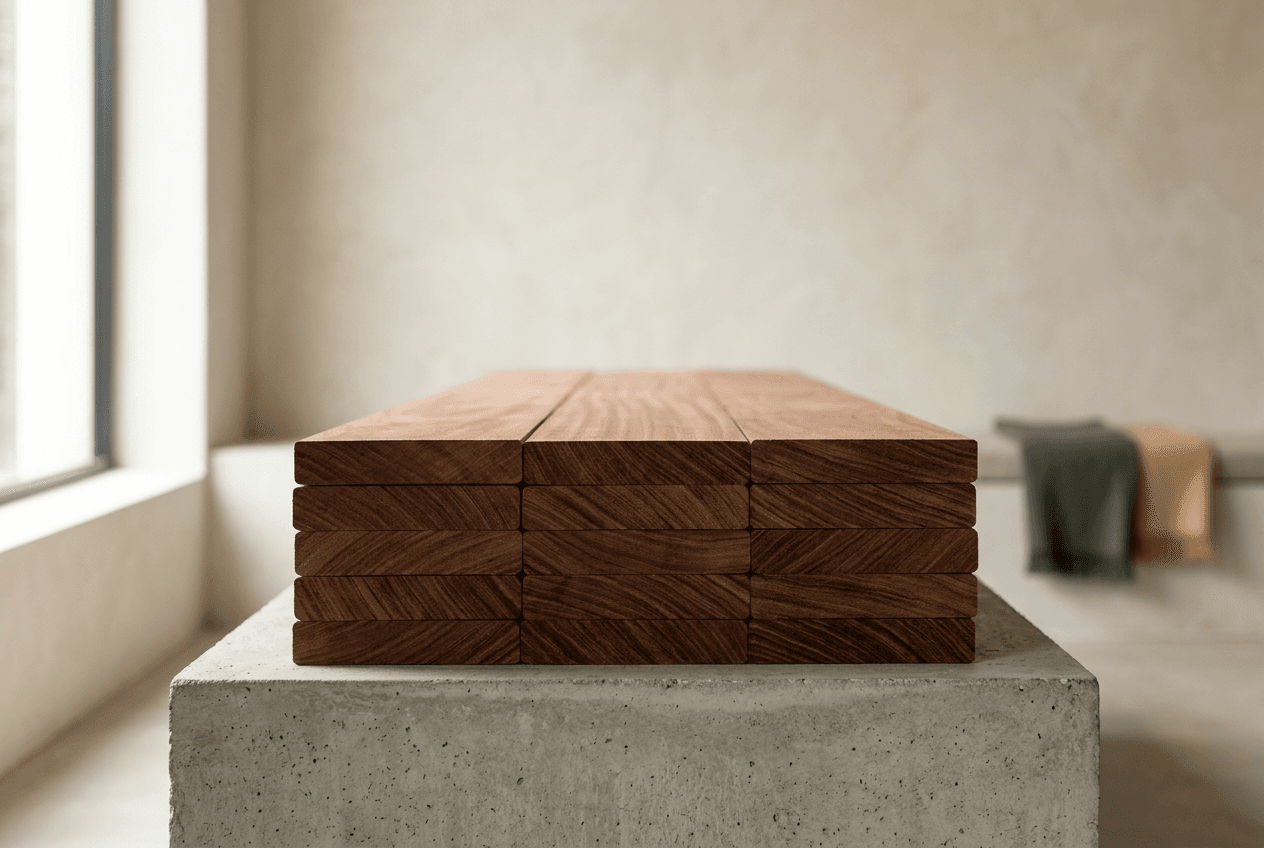
What is meranti wood?
Meranti wood is a tropical hardwood harvested from Shorea genus trees in Malaysian and Indonesian forests. It comes in four commercial types: dark red meranti, light red meranti, yellow meranti, and white meranti. Density spans 550–700 kg/m³ with Janka hardness of 3,500–4,400 N.
Dark red meranti (Shorea pauciflora) is the most-requested type, with density 650–700 kg/m³ and hardness near oak. It is used for exterior doors, windows, and frames thanks to its moisture and climatic-change tolerance. Light red meranti (Shorea leprosula) is lighter and cheaper and is used for interior furniture and cladding.
Riyadh Timber imports meranti with **Malaysian MS 837 tropical hardwood certification**, kiln-dried to 10–14% moisture content. Standard thicknesses are 19, 25, 38, and 50 mm with lengths of 2.4–4.2 m. Meranti is the practical alternative to oak at 40–50% lower cost, especially for exterior doors in Riyadh.
Why is meranti wood used for doors and frames?
Meranti is specified because it combines dimensional stability, moisture resistance, and reasonable cost. Exterior villa doors in Riyadh face 5–48 °C temperature swings and 15–70% RH, and meranti tolerates these changes thanks to its interlocked grain that resists cupping and splitting — at 40% lower cost than oak or teak.
Meranti accepts paint, stain, and oil finishes well, delivering an appearance similar to traditional mahogany at lower cost. Riyadh joinery shops use it for interior and exterior villa doors, windows, and frames because it cuts and planes easily.
Per the Malaysian Timber Council MTC, **Malaysia produces 40% of global meranti** and Indonesia 50%, with the balance from the Philippines and Papua New Guinea. Gulf supply has been stable for 30 years, making meranti a reliable choice for long-running projects.
What are the technical specifications of meranti wood?
Meranti is stocked at 19, 25, 38, and 50 mm thicknesses, lengths 2.4–4.2 m, widths 15–30 cm. Density 550–700 kg/m³ depending on type, Janka hardness 3,500–4,400 N, moisture 10–14% kiln dried. Each batch carries MS 837 and PEFC certification.
| Product name | Tropical meranti wood |
|---|---|
| Botanical name | Shorea spp. (multi-species) |
| Origin countries | Malaysia, Indonesia |
| Commercial types | Dark red, light red, yellow, white |
| Density (kg/m³) | 550 – 700 |
| Janka hardness | 3,500 – 4,400 N |
| Moisture content | 10 – 14% (kiln dried) |
| Thicknesses (mm) | 19 · 25 · 38 · 50 |
| Lengths (m) | 2.4 – 4.2 |
| Colour | Reddish brown to pale pink |
| Certifications | MS 837 · PEFC · FSC |
| Indicative price | SAR 2,800 – 5,200 / m³ |
What are the construction applications of meranti wood?
Meranti serves exterior and interior doors (38–50 mm), window and door frames (25–38 mm), mid-range furniture (25–38 mm), interior cladding (19–25 mm), and kitchen cabinet carcasses (25 mm). Dark red meranti is for exterior; light red is for interior.
- 01
Exterior doors (38–50 mm)
Main villa doors and garden doors. Dark red meranti withstands Riyadh sun and seasonal rain for 25–30 years with protective coating reapplied every 3–5 years.
- 02
Window and door frames (25–38 mm)
Door and window frames in villas and offices. Meranti's dimensional stability prevents cracking around glazing and fixings. 40% cheaper than oak at equivalent performance.
- 03
Mid-range furniture (25–38 mm)
Cabinets, tables, beds for villas and apartments. Meranti accepts walnut or mahogany stain and delivers a premium look at reasonable cost.
- 04
Interior cladding (19–25 mm)
Wall and decorative ceiling cladding in villas and shops. The reddish tone adds warmth, and the surface paints to any colour.
- 05
Kitchen cabinet carcasses (25 mm)
Internal kitchen cabinet structure before fronts are fitted. Good density holds screws and hinges without splitting, and it is 45% cheaper than oak.
What is the difference between meranti and teak?
Meranti and teak are both exterior-capable tropical hardwoods, but teak is harder (4,740 vs 4,400 N) and more water- and insect-resistant, at 3–4× the price. Meranti is the economical choice for exterior doors and mid-range furniture; teak is reserved for marine decking and luxury palace work.
Choose teak for direct water exposure such as exterior bathroom floors and pool decking. Choose dark red meranti for sheltered exterior doors and mid-range furniture. Mid-budget villas in Al Yasmin and Al Narjis use meranti instead of teak at SAR 2,800–5,200/m³ versus SAR 9,500–22,000 for teak.
| Attribute | Meranti | Teak |
|---|---|---|
| Botanical name | Shorea spp. | Tectona grandis |
| Janka hardness | 3,500–4,400 N | 4,740 N |
| Density | 550–700 kg/m³ | 630–720 kg/m³ |
| Water resistance | Good (dark red) | Excellent (natural oils) |
| Price | SAR 2,800–5,200/m³ | SAR 9,500–22,000/m³ |
| Best application | Doors, frames, furniture | Exterior decking & boats |
| Availability | Weekly stock | On order only |
How do I choose the right meranti type?
Choose dark red meranti for exterior doors and frames thanks to its higher density (650–700 kg/m³) and moisture resistance. Choose light red meranti for interior furniture and cladding for its lower cost and lighter weight. Price difference between types is 15–20%.
For exterior doors in Riyadh, use dark red meranti at 40–50 mm thickness with a density above 650 kg/m³ and a high-quality plasamine exterior coating. For interior doors, light red meranti at 38 mm is sufficient.
For furniture, light red meranti in Select grade (FAS equivalent) is the appropriate choice. For interior cladding and concealed substrates, white or yellow meranti at 19–25 mm is the economical option at SAR 2,800–3,200/m³ only.
How is meranti wood stored and installed?
Meranti stores in a dry covered area, raised 10 cm off the ground, with a 7–10 day acclimatisation period before installation. For exterior doors, both faces and edges are sealed with high-quality acrylic or plasamine coating before installation to prevent moisture entry through end grain.
Meranti is more dimensionally stable than most tropical hardwoods, expanding only 0.4% per 4% RH change. This stability makes it preferred for frames and doors that must remain straight for years. Even so, protective coating is mandatory for exterior use in Riyadh.
For exterior doors, mortise-and-tenon joinery is used with waterproof polyurethane adhesive. The recommended finish is 3 coats of water-based acrylic or oil-based plasamine, recoated every 3–5 years depending on exposure. Meranti resists termites well, unlike pine.
Does meranti wood meet international standards?
Riyadh Timber's meranti carries Malaysian MS 837 tropical hardwood grading certification, PEFC sustainability, and FSC on selected batches. It meets SBC 1001 indoor-air-quality requirements at E1 emissions and ITTO standards for responsible tropical timber trade.
MS 837 sets the meranti grading scale: Prime (highest), Standard, and Utility. Prime grade equates to American NHLA FAS and is used for visible doors and furniture. The certificate is recognised on Gulf projects and satisfies engineering review.
For LEED- or Mostadam-certified projects we provide FSC certification for meranti from sustainably managed forests in Sabah and Sarawak (East Malaysia). FSC-certified meranti contributes sustainability points under Mostadam, despite being imported.
Which Saudi projects use meranti wood?
Meranti is used in villa doors in Al Narjis, Al Yasmin, and Al Nakheel, window frames in residential compounds, administrative office furniture, mid-range hotel doors, and kitchen cabinet carcasses in housing projects. It is the most-requested species for budget-conscious exterior doors.
- Villas and residential compounds in Al Narjis, Al Yasmin, Al Nakheel, and Al Malqa — main doors, windows, frames.
- National Housing Company residential projects — window frames and interior doors in housing units.
- Mid-tier (4-star) hotels in Riyadh — interior room doors and room furniture.
- Workshops and small factories — raw stock for joinery and economy furniture.
- Corporate offices and retail outlets — interior cladding and decorative substrates.
What are common questions about meranti wood?
Minimum is **2 cubic metres** for site delivery. For workshops above 10 m³ we offer 8–12% volume discounts. Meranti is held in **weekly stock** at our Riyadh yard, so lead time is short compared to other hardwoods.
Yes, dark red meranti suits bathrooms provided **full coating is applied to both faces and edges**. It is 50% cheaper than white oak at equivalent practical performance. Premium villa bathrooms still favour white oak despite the higher cost.
In Riyadh's climate, a coated dark-red-meranti exterior door lasts **25–30 years** with recoating every 3–5 years. Without coating, it cracks and degrades within 5–7 years under direct sun.
Meranti is sometimes marketed as **'Philippine mahogany'** due to its similar colour, but it is not true mahogany. True mahogany (Swietenia) is denser, more luxurious, and 3–5× the price. Meranti is the practical alternative at lower cost with a similar tone.
Yes, meranti accepts walnut, mahogany, and chestnut stains well. Its natural reddish tone deepens under stain. **Light red meranti accepts stain better than dark red** because its base colour is less saturated.
Dark red meranti **resists termites well** thanks to its natural resin canals. Lighter types are less resistant. For projects in termite-prone regions (such as Al Qassim) additional pesticide treatment is recommended before installation.
Yes, we supply meranti at **4.2–5 m lengths** on special order with a 5 m³ minimum and 3–4 week lead time from Port Klang, Malaysia. Standard 2.4–4.2 m lengths are stocked.
What products relate to Meranti wood?
Selections that complement the work in Saudi construction projects.
Need a meranti wood quote for your project?
Send the cubic-metre quantities, thicknesses, and type (dark red or light red). We respond with a formal quote within 4 working hours — unit price, total, lead time, and MS 837 and PEFC certificates included.