Premium timber · oak, walnut, beech, teak, maple, meranti
Hardwoods
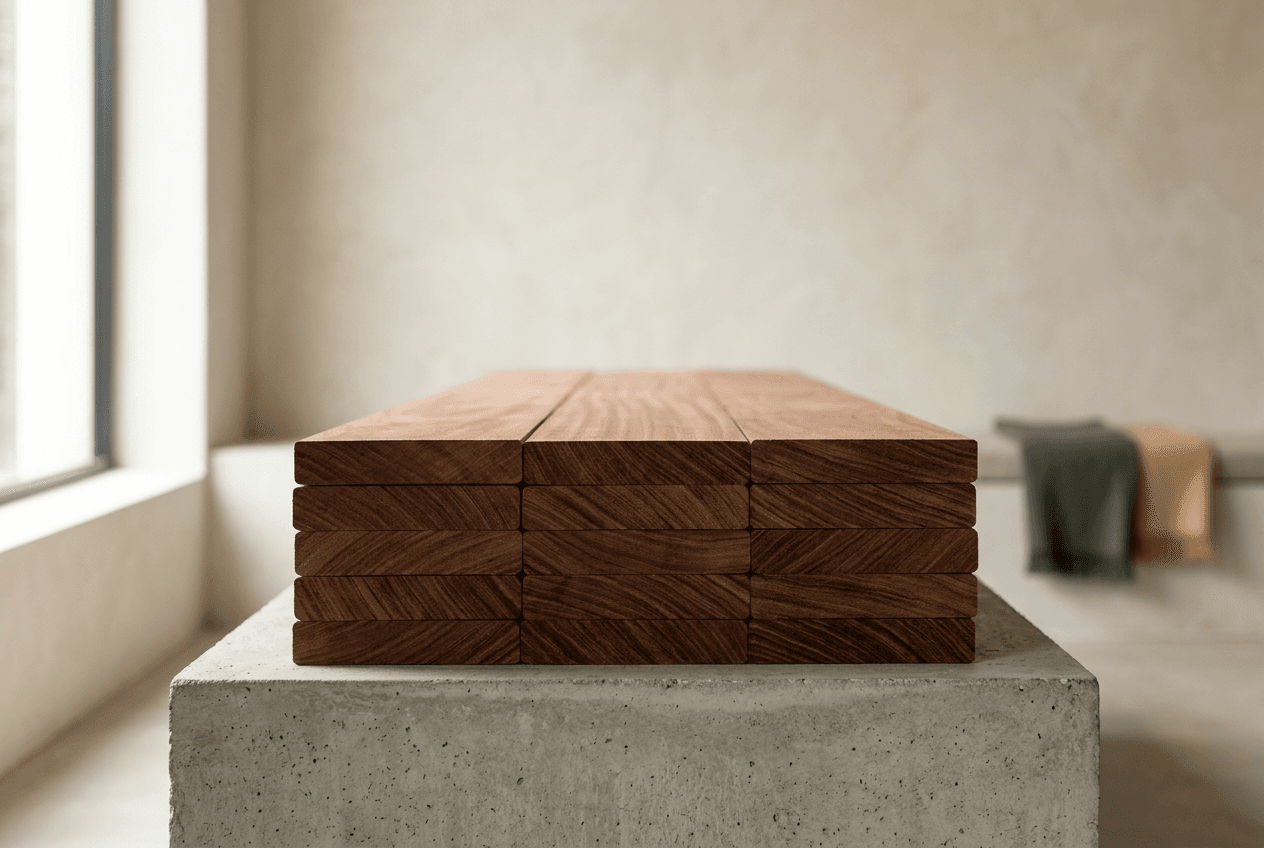
Hardwoods are dense timbers from broadleaf trees, used for premium furniture, solid flooring, executive doors, and facades. Riyadh Timber stocks **oak, walnut, beech, meranti, teak, and maple at thicknesses of 25, 38, and 50 mm and lengths of 2.4–4.2 m**, certified FSC and NHLA FAS for projects across the Kingdom.
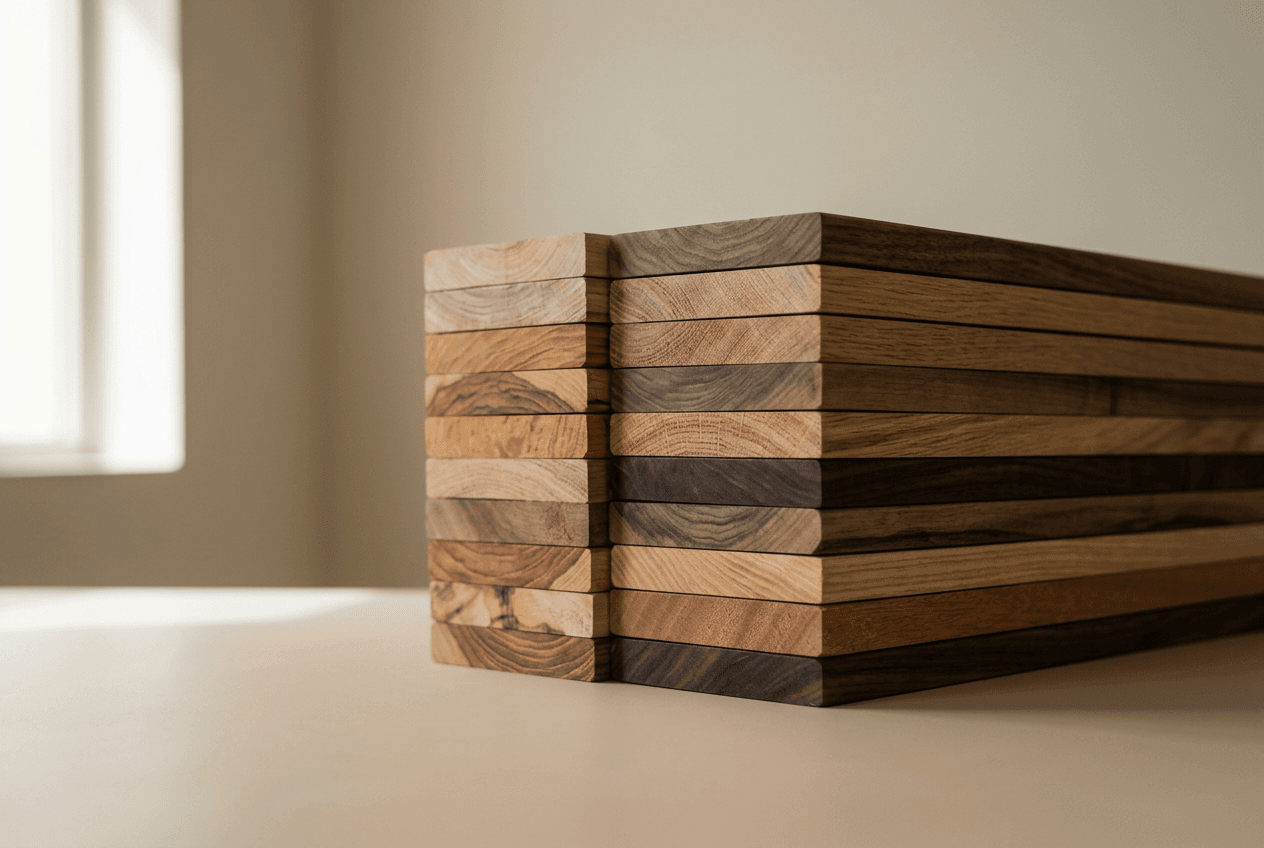
What are hardwoods?
Hardwoods are timbers cut from deciduous broadleaf trees such as oak, walnut, beech, and teak. Densities range from 550 to 770 kg/m³ and Janka hardness from 3,500 to 6,460 N. They serve premium furniture, solid flooring, and executive joinery where softwoods like pine and spruce are insufficient.
Hardwoods differ from softwoods at the cellular level. Hardwoods contain vessels (pores) that increase density and hardness, while softwoods rely on tracheids alone. This microscopic difference explains why oak survives 50 years of daily use while pine begins degrading after 15–20 years.
Riyadh Timber imports six hardwood categories: **American and European white oak, American black walnut, German and Romanian beech, Malaysian and Indonesian meranti, Burmese teak, and Canadian sugar maple**. Each species suits a defined application based on hardness, moisture resistance, and appearance.
Why are hardwoods chosen for premium Saudi projects?
Hardwoods withstand abrasion, loading, and daily use for decades, and accept gloss, matte, and repeated refinishing. Villas in Hittin, Al Malqa, and Al Yasmin use solid-wood flooring at 18–20 mm for 30–50 years of service — a lifespan unattainable with MDF or compressed parquet alternatives.
Hotels, palaces, and executive offices in Riyadh specify hardwoods for three reasons: durability (Janka 4,400–6,460 N), aesthetic value (unique colours and growth rings), and asset retention (solid wood holds value rather than being replaced). The high upfront cost becomes a long-term investment, not a recurring replacement expense.
Per the American Hardwood Export Council (AHEC), hardwood exports to the Gulf doubled between 2018 and 2024, driven by Vision 2030 and private palace projects. Saudi demand concentrates on white oak, black walnut, and hard maple for premium finish-out work.
What are the specifications of hardwoods at Riyadh Timber?
Hardwoods are stocked at 25, 32, 38, 50, and 75 mm thicknesses, lengths 2.4–4.2 m, widths 15–30 cm. Densities span 550 kg/m³ (light meranti) to 770 kg/m³ (white oak), Janka hardness 3,500–6,460 N, moisture 8–12%. Each shipment carries FSC, PEFC, or NHLA FAS certification.
| Product category | Hardwoods |
|---|---|
| Available species | Oak, walnut, beech, meranti, teak, maple |
| Origins | USA, Canada, Germany, Romania, Turkey, Malaysia, Indonesia, Myanmar |
| Thicknesses (mm) | 25 · 32 · 38 · 50 · 75 |
| Lengths (m) | 2.4 – 4.2 |
| Widths (cm) | 15 – 30 |
| Density range | 550 – 770 kg/m³ |
| Janka hardness | 3,500 – 6,460 N |
| Moisture content | 8 – 12% (kiln dried) |
| Grade | FAS · Select · No.1 Common |
| Certifications | FSC · PEFC · NHLA FAS · EN 942 · CITES (teak) |
| Indicative price | SAR 2,200 – 9,500 / m³ |
What are the construction and finishing applications of hardwoods?
Hardwoods serve solid flooring (20 mm), premium furniture (25–38 mm), executive doors (40 mm), exterior facades (25–30 mm), interior staircases (40–50 mm), and table tops (38–50 mm). Species selection depends on location and required hardness.
- 01
Solid flooring (20 mm)
Oak, maple, and walnut for villas and palaces. The high hardness withstands daily traffic and casters for 30–50 years with periodic sanding and refinishing.
- 02
Premium furniture (25–38 mm)
Conference tables, executive desks, luxury bedroom sets. Black walnut is specified for signature pieces thanks to its dark colour and pronounced grain.
- 03
Executive doors (40 mm)
Main entrance doors for palaces and offices. White oak is the first choice for moisture tolerance and ability to take carved ornamentation.
- 04
Exterior facades (25–30 mm)
Teak and dense meranti for sun-exposed timber facades. Teak's natural oils protect against Riyadh humidity without coating.
- 05
Interior staircases (40–50 mm)
Beech and oak for treads and risers in architectural villas. Beech is preferred for its abrasion resistance under repeated foot traffic.
What are the differences between the six available hardwoods?
The core differences between hardwoods are hardness, density, price, and appearance: maple and beech are hardest (6,450–6,460 N) for flooring, oak is balanced (5,990 N) for general use, walnut is softer (4,490 N) for fine furniture, teak is most expensive (4,740 N) for exterior, and meranti is most affordable (3,500–4,400 N) for doors.
Species selection starts with the application: for flooring choose maple, beech, or oak; for premium furniture walnut or oak; for exterior teak exclusively; for doors meranti or oak depending on budget. Pricing spans SAR 2,800/m³ (meranti) to SAR 22,000/m³ (Burmese A-grade teak).
| Attribute | Oak | Walnut | Beech | Teak | Maple |
|---|---|---|---|---|---|
| Hardness (N) | 5,990 | 4,490 | 6,460 | 4,740 | 6,450 |
| Density (kg/m³) | 720–770 | 610–660 | 690–750 | 630–720 | 700–760 |
| Price (SAR/m³) | 4,200–8,500 | 6,500–12,500 | 3,400–5,800 | 9,500–22,000 | 4,800–8,500 |
| Colour | Golden brown | Dark brown | Pale cream | Golden brown | Cream white |
| Best application | Flooring & doors | Premium furniture | Stairs & tools | Exterior & marine | Sports flooring |
How do I choose the right hardwood for my project?
Hardwood selection rests on three criteria: application (interior or exterior), budget (SAR 2,800–22,000/m³), and required appearance. For premium flooring choose white oak; for executive furniture black walnut; for exterior teak exclusively; for sports halls hard maple.
Start by determining whether the application is interior or exterior; exterior use in Riyadh's climate demands teak or dense meranti only. For interior, set the required hardness: flooring needs Janka above 5,000 N, while furniture is comfortable at 4,000 N.
Then calculate the budget per cubic metre, not per square metre, to avoid surprises. One cubic metre of oak yields about 40 m² of flooring at 25 mm thickness. Riyadh Timber's technical team converts your area schedule into volume and produces a formal quote.
How are hardwoods stored and installed in Riyadh's climate?
Hardwoods store in a conditioned space at 20–25 °C and 40–55% relative humidity, raised 10–15 cm off the ground on timber bearers. Installation begins after a 7–14 day acclimatisation period on site to prevent post-installation cupping, splitting, or warping.
Riyadh's dry climate (15–25% RH in summer) is harsh on European hardwoods accustomed to 45–55% RH. Slow acclimatisation is essential before installation, and timber must not sit in an over-dry conditioned room for less than 10 days before fixing.
Oak and maple flooring is laid tongue-and-groove over 3 mm acoustic foam underlay. Doors and furniture use traditional joinery (mortise and tenon) or biscuit joiners for strength and clean appearance.
Do hardwoods meet environmental and Saudi standards?
All Riyadh Timber hardwoods carry FSC or PEFC sustainability certification and NHLA FAS for American species. Teak specifically requires CITES certification to prevent trade in smuggled Myanmar timber. Each shipment satisfies SBC 201 structural and SBC 1001 indoor-air-quality requirements.
FSC (Forest Stewardship Council) certifies that timber is harvested from forests managed under 10 strict environmental and social principles. PEFC is the European equivalent, recognised in Saudi Arabia. NHLA FAS is the highest grade for American hardwoods, meaning at least 83.3% of the board face is clear of defects.
For government and LEED-targeted projects, we provide full Chain of Custody documentation including origin certificates, formaldehyde test reports (E1 < 0.124 mg/m³), and shipping invoices. These documents satisfy engineering review at the Ministry of Municipal and Rural Affairs.
Which Saudi projects use hardwoods?
Hardwoods appear in Riyadh's royal palaces, villas in Hittin, Al Malqa, and Al Yasmin, hotels including Al Faisaliah, Ritz-Carlton, and Four Seasons, Vision 2030 sites at Diriyah, NEOM, and Qiddiya, and offices in Kingdom Tower, Al Faisaliah, and the Financial District. Each project specifies species by architectural style and budget.
- Royal and princely palaces in Hittin, Al Yasmin, and Al Nakheel — carved oak doors and walnut and maple flooring.
- Riyadh's luxury hotels (Al Faisaliah, Ritz-Carlton, Four Seasons) — oak and walnut flooring in presidential suites.
- Vision 2030 mega-projects — Diriyah, AMAALA, and Qiddiya for interior facade and executive door work.
- Riyadh financial towers (Al Faisaliah, Kingdom, KAFD) — black-walnut conference tables and white-oak floors.
- Sports halls at King Saud University and elite schools — Canadian hard-maple courts for indoor games.
What are common questions about hardwoods?
**3 cubic metres per species** is the effective minimum for site delivery. Smaller quantities are picked up from our main yard in Riyadh's Industrial District. For projects above 20 m³ we offer project pricing and phased delivery aligned with the construction schedule.
White oak, meranti, and maple are stocked and ship within **7–10 days**. American black walnut, Burmese teak, and German beech require advance order with a 4–6 week lead time. Non-standard thicknesses such as 75 mm need 6–8 weeks.
All hardwoods arrive **kiln-dried to 8–12% moisture content**, the level required for interior furniture. Additional drying for flooring (6–8%) is available at SAR 120–180/m³ extra and adds two weeks of lead time.
Yes, **90% of our stock is FSC or PEFC certified**. American species also carry NHLA FAS, and teak mandatorily carries CITES certification. We deliver a copy of the certificates with every shipment.
Yes, mixed orders (for example 2 m³ oak + 1 m³ walnut + 1 m³ maple) ship in a single delivery. Combined minimum is **4 m³** to absorb logistics cost. Large projects can request phased delivery aligned with the installation schedule.
NHLA FAS means **83.3% of the board face is clear of defects**, with a 183 cm minimum length and 15 cm minimum width. Select grade is slightly lower (one defect per board accepted) and 15–20% cheaper. For visible furniture choose FAS; for concealed components choose Select.
Yes, our workshop cuts hardwoods to **±1 mm tolerance** per cut list, with planing service to final thickness. Cost is SAR 80–150/m³ depending on complexity, and pieces ship numbered and bundled by drawing reference.
What products relate to Hardwoods?
Selections that complement the work in Saudi construction projects.
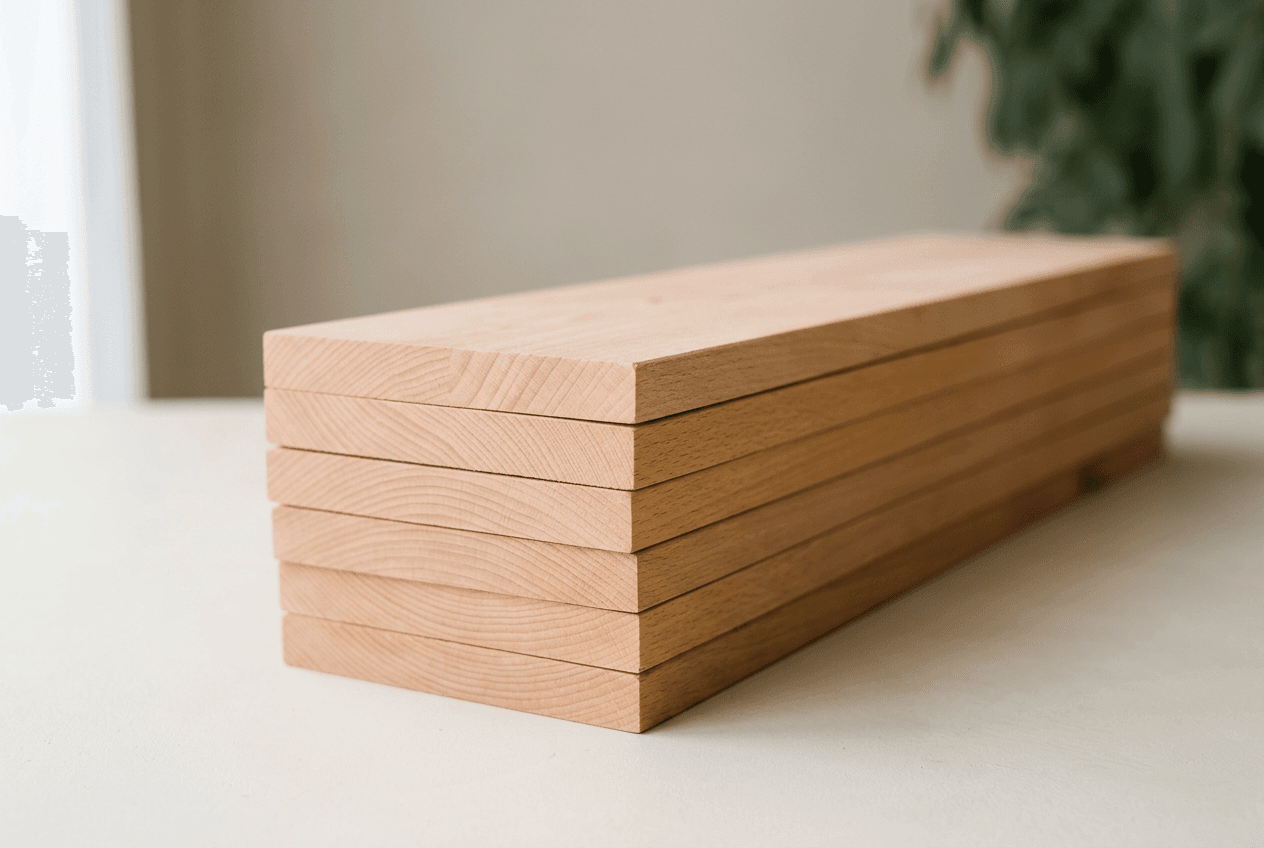
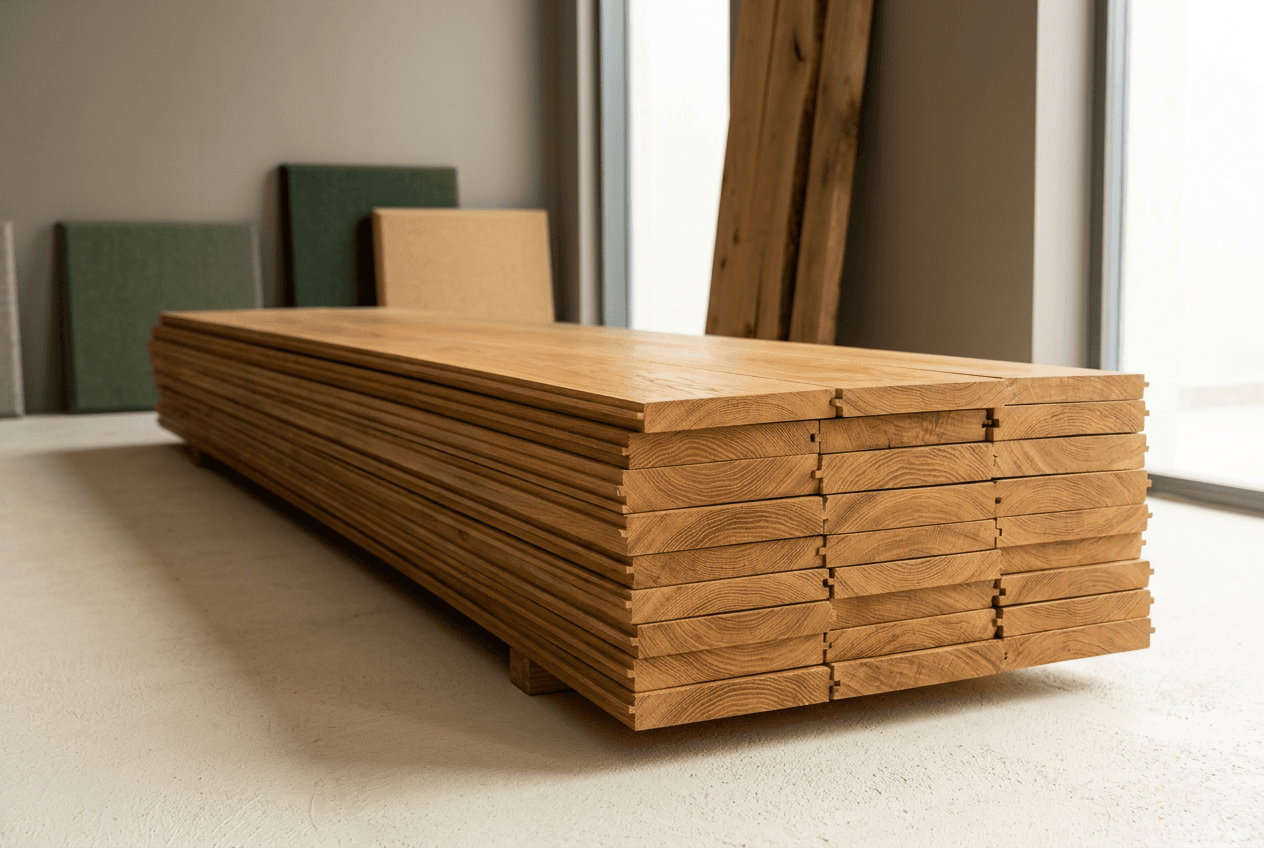
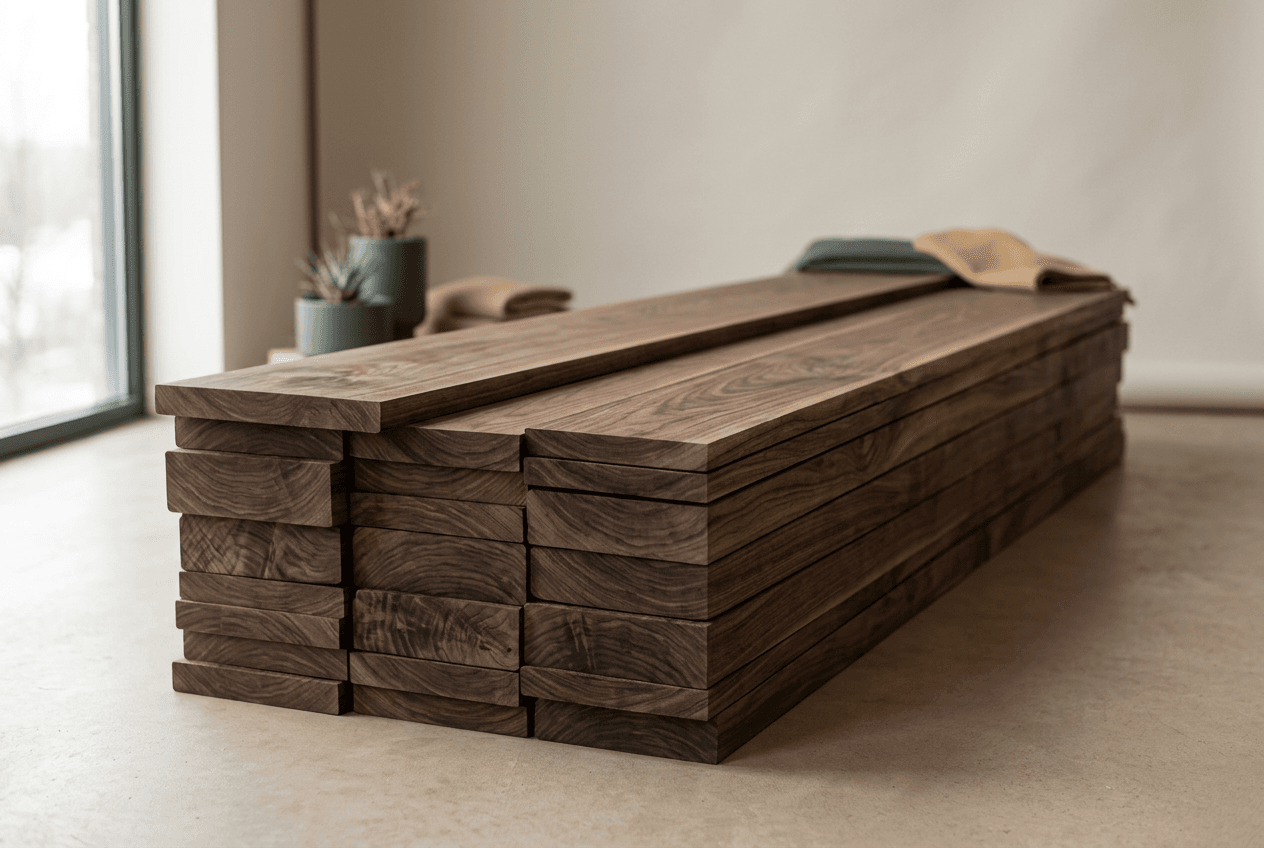
Need a hardwood quote for your project?
Send the species list with quantities in cubic metres, thicknesses, and the delivery site. We respond with a formal quote within 4 working hours — unit price, total, lead time, and certificates included.