Hardwood · high-density European beech
Beech wood
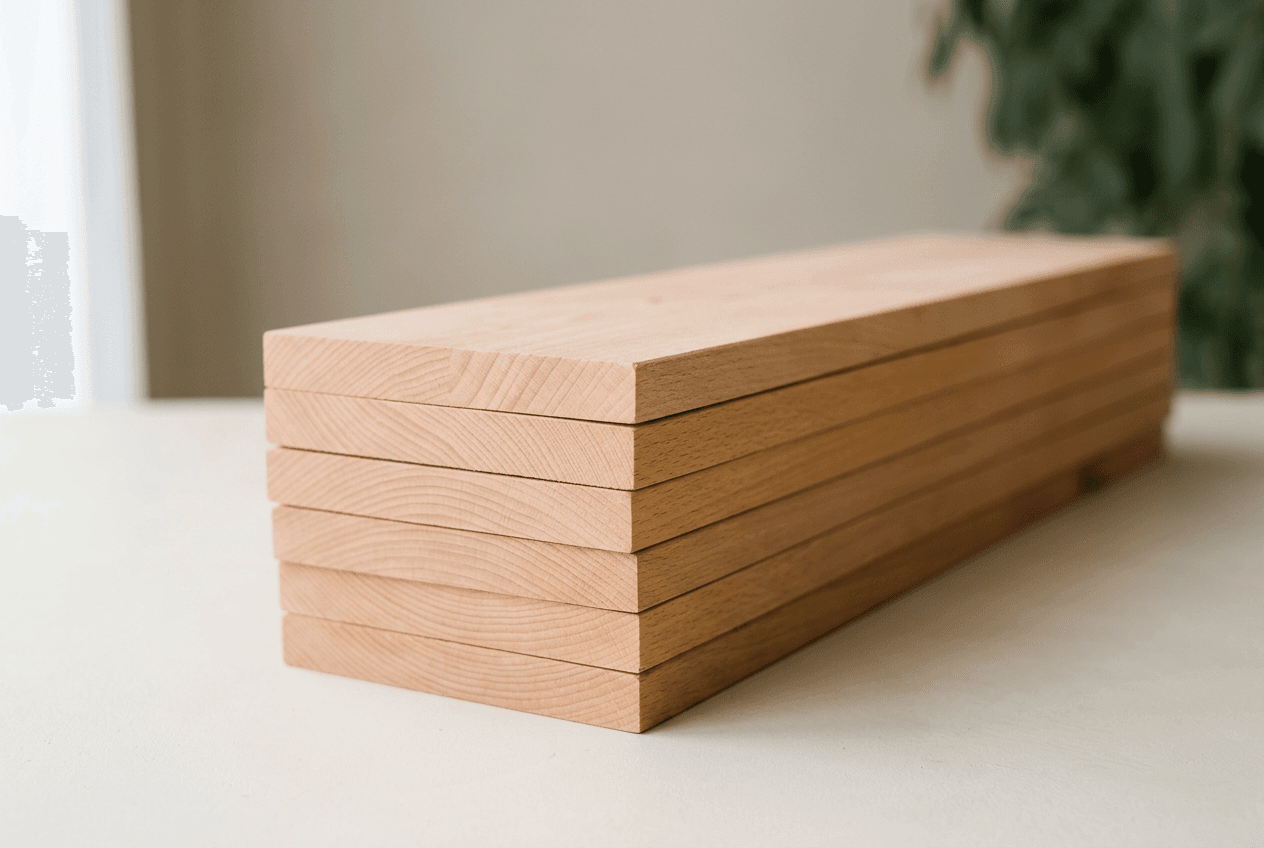
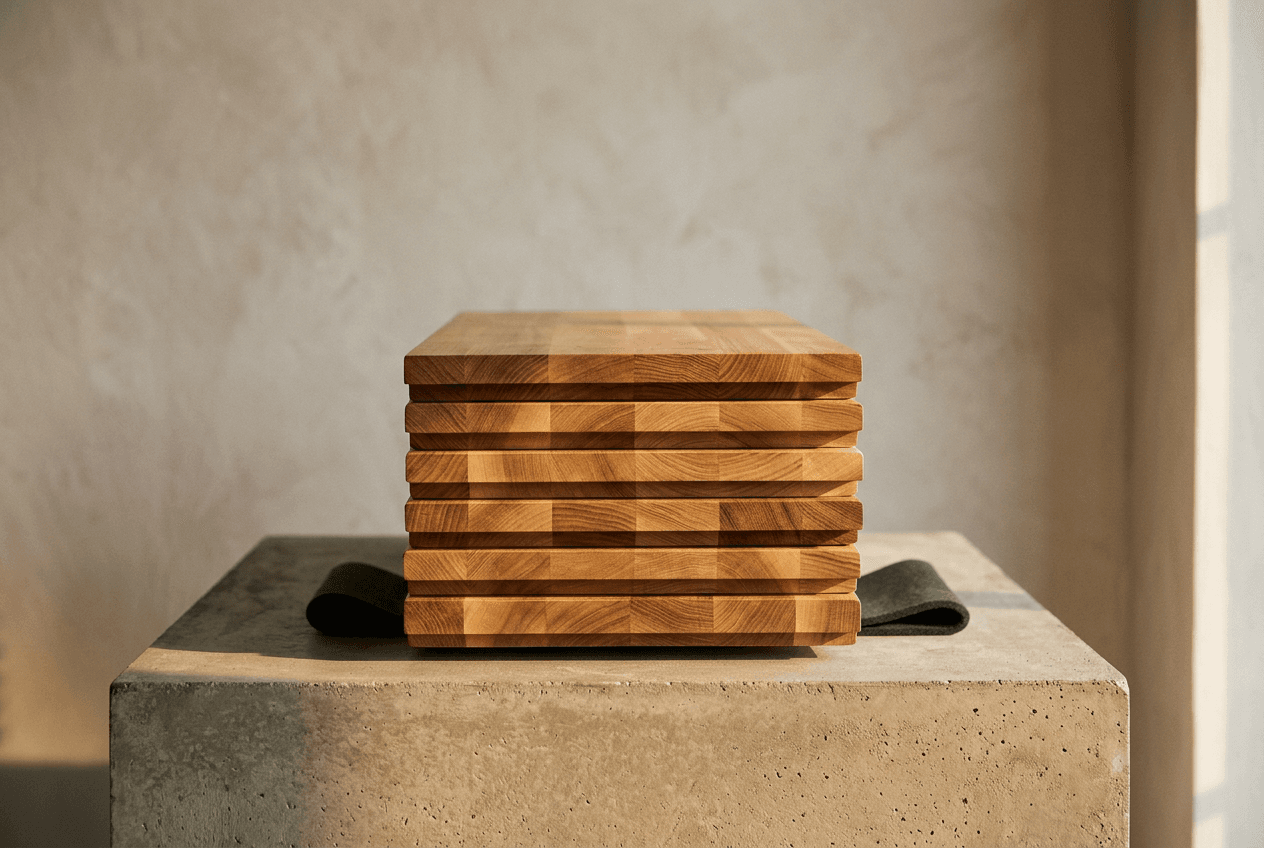
Beech wood (Fagus sylvatica) is a dense European hardwood with a pale pink-cream tone, harvested from forests in Germany, Romania, and Turkey. With a Janka hardness of **6,460 N and density of 690–750 kg/m³**, it is the preferred species for interior staircases, premium furniture, and kitchenware. Stocked at 25, 32, and 50 mm thicknesses with 2.4–4 m lengths.
What is beech wood?
Beech wood (Fagus sylvatica) is a European hardwood cut from the broadleaf beech tree of Germany, Romania, and Turkey. It features a pale pink-cream colour, fine even grain, density of 690–750 kg/m³, and Janka hardness of 6,460 N — placing it among the hardest commercial hardwoods of Europe.
The beech tree grows 30–40 m tall and lives 200–300 years. Commercial trees are felled at 80–120 years to ensure target density. The resulting timber has uniform colour and texture and is free of large knots, making it favoured for steam-bent furniture and turned components.
Riyadh Timber imports European beech kiln-dried to 8–10% moisture content, in A or B grade, and steam-treated in some batches to develop the deep pink hue prized for classical furniture. Standard thicknesses are 25, 32, and 50 mm with lengths of 2.4–4 m.
Why is beech wood used for furniture and staircases?
Beech is specified because its 6,460 N hardness exceeds oak (5,990 N) and walnut (4,490 N) at 30–40% lower cost. It withstands the repeated abrasion of stair treads and kitchen surfaces, and accepts turning and routing with high precision — making it the favoured species among classical furniture makers.
Beech combines two rare attributes: high hardness and steam-bending capability. The latter property makes it the only timber suitable for curved Thonet-style chair frames and bent furniture rails. Premium villas in Al Yasmin and Al Malqa specify beech for spiral staircases and bespoke seating.
Per the German timber federation GD Holz, beech is the most-used hardwood in European furniture manufacturing, appearing in **40% of premium German furniture**. This industrial reliability makes it a safe choice for Saudi joiners targeting a European furniture standard.
What are the technical specifications of beech wood?
Beech is stocked at 25, 32, and 50 mm thicknesses, lengths 2.4–4 m, widths 15–25 cm. Density 690–750 kg/m³, Janka hardness 6,460 N, moisture 8–12% kiln dried. Each batch carries FSC, PEFC, and EN 942 certification for European hardwoods.
| Product name | European beech wood |
|---|---|
| Botanical name | Fagus sylvatica |
| Origin countries | Germany, Romania, Turkey |
| Density (kg/m³) | 690 – 750 |
| Janka hardness | 6,460 N |
| Moisture content | 8 – 12% (kiln dried) |
| Thicknesses (mm) | 25 · 32 · 50 |
| Lengths (m) | 2.4 – 4 |
| Widths (cm) | 15 – 25 |
| Colour | Pink-cream to pale brown |
| Certifications | FSC · PEFC · EN 942 |
| Indicative price | SAR 3,400 – 5,800 / m³ |
What are the applications of beech wood in construction and furniture?
Beech wood serves premium furniture (25–38 mm), interior staircases (40–50 mm), kitchenware (25–32 mm), steam-bent chairs (25 mm), and turned and decorative components (32–50 mm). Its high hardness withstands intense daily use without wear.
- 01
Interior staircases (40–50 mm)
Treads and risers in luxury villas. The 6,460 N hardness withstands 50 years of daily traffic with refinishing every 7–10 years.
- 02
Premium furniture (25–38 mm)
Bedrooms and classical living-room sets. Beech's regular grain accepts gloss finish with precision and yields a traditional European appearance.
- 03
Steam-bent chairs (25 mm)
Dining chairs and Thonet-style bentwood backs. Beech is the only timber that bends under steam without fracturing, with a 12% defect rate at most.
- 04
Kitchenware (25–32 mm)
Cutting boards, spoons, rolling pins, knife handles. Beech imparts no taste or odour and withstands knife abrasion better than softer woods.
- 05
Turned components (32–50 mm)
Lathe-turned table legs and decorative columns. Beech accepts the lathe to ±0.2 mm tolerance without grain tear-out.
What is the difference between beech wood and maple wood?
Beech and maple are nearly identical in hardness (6,460 vs 6,450 N) and density, but differ in colour (beech pink-cream, maple cream-white) and price (beech SAR 3,400–5,800/m³, maple SAR 4,800–8,500). Beech is 30% cheaper and ideal for stairs and furniture; maple is paler and best for sports flooring.
Choose beech for classical furniture and interior staircases where the pink hue is desired and European furniture-making consumes large volumes. Choose maple for sports flooring and concert-hall floors where a uniform pale tone and resistance to direct lighting are critical. Both accept stain well, but beech bends under steam while maple does not.
| Attribute | Beech | Maple |
|---|---|---|
| Botanical name | Fagus sylvatica | Acer saccharum |
| Janka hardness | 6,460 N | 6,450 N |
| Density | 690–750 kg/m³ | 700–760 kg/m³ |
| Colour | Pink-cream | Cream-white |
| Price | SAR 3,400–5,800/m³ | SAR 4,800–8,500/m³ |
| Steam-bending | Excellent | Poor |
| Best application | Stairs & classical furniture | Sports flooring |
How do I choose the right beech grade?
Beech is offered in two main grades: Grade A (Steamed Beech) for visible furniture with uniform pink colour and no large knots, and Grade B for hidden frames and substrates. Grade A is 20–25% pricier but mandatory for visible parts; Grade B suffices for legs, rails, and internal posts.
For staircases choose 40–50 mm thickness in Grade A and lengths above 3 m to minimise visible joints. For bent chairs choose Steamed Beech, which is more pliable under steam. For turned components and small legs, Grade B is sufficient and saves 25% of cost.
How is beech wood stored and installed in Riyadh?
Beech is sensitive to humidity swings; store in a conditioned space at 20–25 °C and 45–55% RH with a 10–14 day acclimatisation period before installation. Joints are mortise-and-tenon or biscuit; direct sun exposure must be avoided as beech yellows quickly.
Beech is the most humidity-sensitive of European hardwoods, expanding 1% per 4% RH change. Site acclimatisation is therefore mandatory, and over-drying below 8% MC is forbidden to prevent splitting. Premium Hittin villa air-conditioning is set to 22 °C and 45% RH year-round to protect such furniture.
For interior staircases, beech is glued to a hardwood substructure of oak or meranti with screws fixed from below (concealed) and PVA D3 adhesive on the joints. Finishing uses natural oils or water-based polyurethane lacquer to retain the original pink hue.
Does beech wood meet European and Saudi standards?
Riyadh Timber's beech carries FSC or PEFC sustainability certification and EN 942 for European hardwoods, and meets SBC 1001 indoor-air-quality requirements with formaldehyde emissions under 0.124 mg/m³ (E1). Each batch ships with a German or Romanian origin certificate and a density test report.
EN 942 sets requirements for hardwoods used in interior joinery: moisture content, hardness, grading, and allowable defect limits. Our certified German beech ships with the origin certificate matched to the consignment number — a document accepted on every government and private project in Riyadh.
For LEED- or Mostadam-certified projects, beech qualifies as a renewable material and contributes sustainability credits. Mostadam-certified villas in the Riyadh Smart District use beech for staircases to capture two points under the renewable-materials category.
Which Saudi projects use beech wood?
Beech wood appears in luxury villa staircases in Hittin and Al Yasmin, bespoke seating at Al Faisaliah and Ritz-Carlton hotels, classical executive office furniture in Kingdom Tower, and kitchenware production for hospitality supply contracts. Beech is the species of choice for Saudi designers replicating European furniture standards.
- Luxury villas in Hittin, Al Yasmin, and Al Malqa — interior staircases, bespoke chairs, classical bedroom sets.
- Riyadh's luxury hotels (Al Faisaliah, Ritz-Carlton, Four Seasons) — bentwood chairs for restaurants and suites.
- Executive offices in Kingdom Tower, Al Faisaliah, and the Financial District — classical office furniture, locally manufactured.
- Premium joinery workshops in Riyadh and Jeddah — raw stock for custom-furniture makers.
- Riyadh fine-dining restaurants — dining tables and Thonet-style bentwood chairs.
What are common questions about beech wood?
The minimum is **3 cubic metres** for site delivery. Smaller quantities are picked up from the Industrial District yard. For workshops above 10 m³ we offer 10–15% volume discounts and phased deliveries.
Yes, we supply **Steamed Beech** with the uniform pink hue. Premium is SAR 400–600/m³ and lead time is 4–6 weeks. Preferred by classical-furniture makers and bentwood-chair producers.
In air-conditioned villas, beech lasts **50+ years** with refinishing every 7–10 years. Its 6,460 N hardness withstands daily traffic, and oil or lacquer finish protects against staining and abrasion.
**No**, beech is unsuitable for exterior use. It rots quickly under direct moisture and lacks natural oils. For exterior applications in Riyadh, choose teak or dense meranti.
German beech is 5% denser and more uniform in colour; Romanian beech is 10–15% cheaper at near-equivalent quality. For visible premium parts choose German; **for hidden frames and substrates choose Romanian** to control cost.
Yes, beech accepts stain well thanks to its uniform grain. Walnut and smoked stains produce a black-walnut appearance at 40% lower cost. Sample testing is recommended before full production runs.
Yes, our workshop cuts beech to **±1 mm tolerance** and planes to final thickness. The service includes mitre cuts and rebating for joints. Cost is SAR 80–120/m³ depending on complexity.
What products relate to Beech wood?
Selections that complement the work in Saudi construction projects.
Need a beech wood quote for your project?
Send the cubic-metre quantities, thicknesses, and required grade. We respond with a formal quote within 4 working hours — unit price, total, lead time, and FSC and EN 942 certificates included.