Premium hardwood · certified Burmese and Indonesian teak
Teak wood
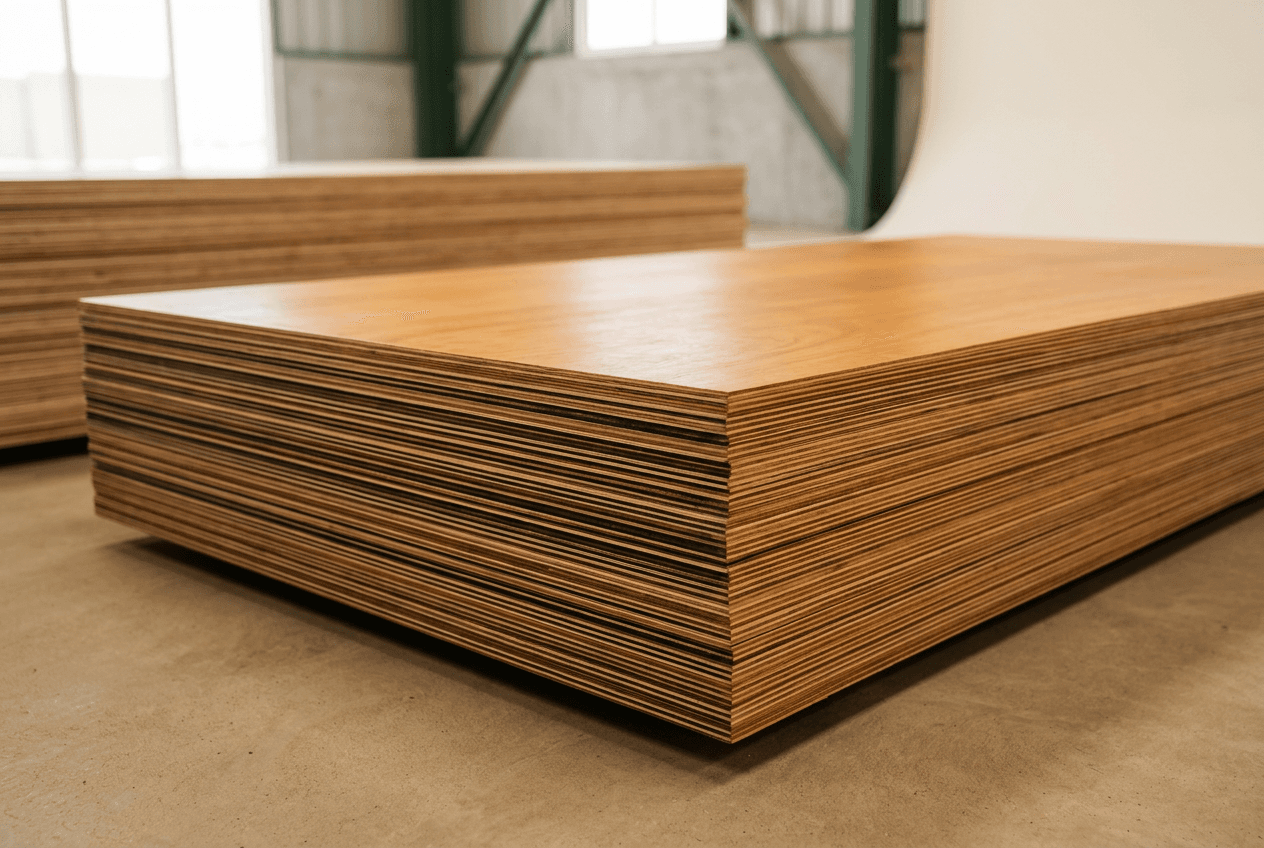
Teak wood (Tectona grandis) is a tropical hardwood from Myanmar, Indonesia, and South America. It carries **natural oils that make it water-, insect-, and sun-resistant without coating, with a Janka hardness of 4,740 N and density of 630–720 kg/m³**. Stocked at 25–75 mm thicknesses for boat decks, exterior decking, and premium furniture.
What is teak wood?
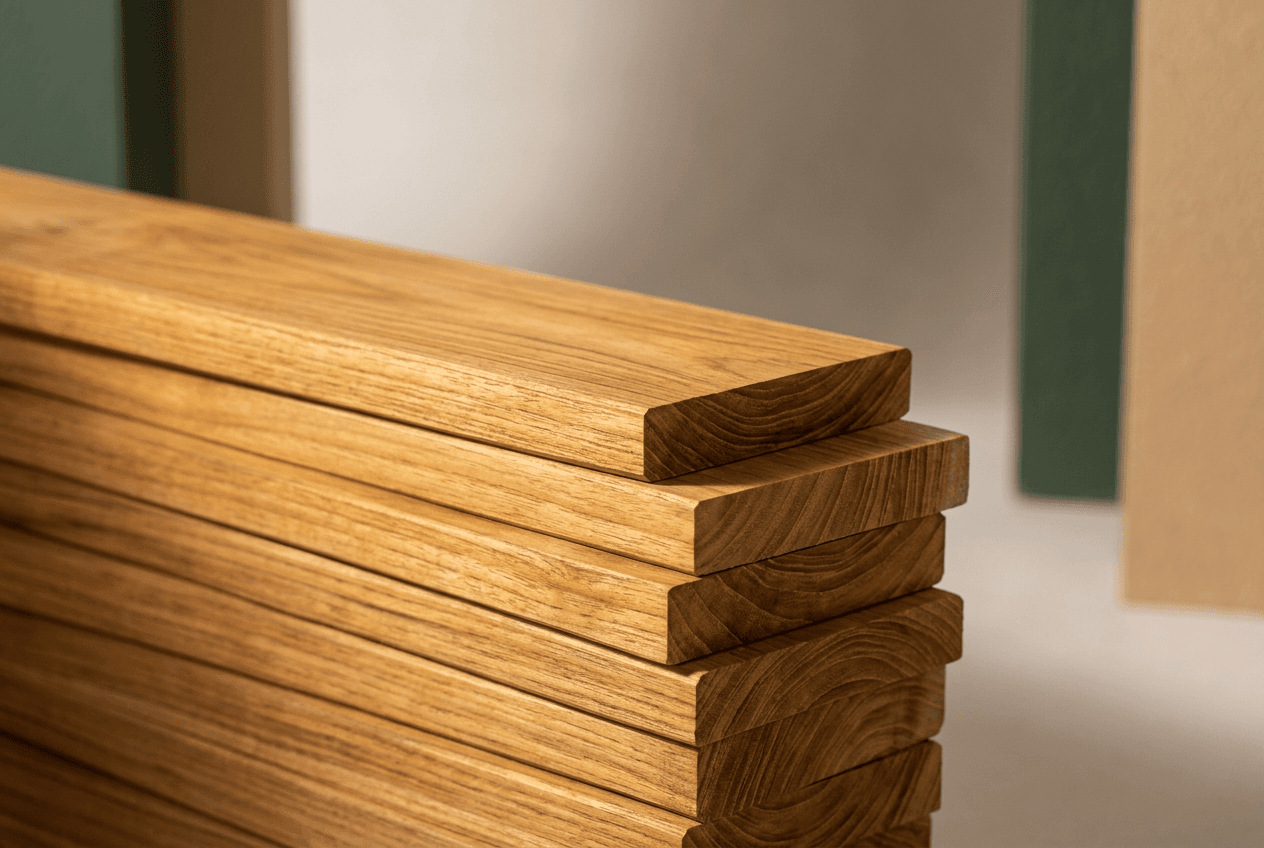
Teak wood (Tectona grandis) is a tropical hardwood considered 'the king of hardwoods' because it contains natural oils (silica and tectoquinone) that protect it from water, sun, insects, and rot. Sourced from Myanmar (premium), Indonesia (plantations), and South America. Density 630–720 kg/m³, hardness 4,740 N.
Old-growth Burmese teak is the most luxurious type but is subject to international sanctions and trade restrictions due to Myanmar's conflicts, making it scarce and very expensive (SAR 22,000/m³). The practical alternative is **Indonesian plantation teak with FSC, PEFC, and CITES certification**, at SAR 9,500–14,000/m³.
Teak's unique attribute is its ability to remain outdoors for 50–75 years without any coating, as the natural oils create a self-sustaining protective barrier. This makes it the only species globally certified for yacht decking and luxury pool surrounds. It is recommended only for projects that justify its high cost.
Why is teak used in yachts and luxury palaces?
Teak is specified because it is the only timber resistant to water and sun without coating. Natural oils concentrate at 2–4% in the heartwood and act as a self-sealing barrier against moisture and UV. A Burmese-teak yacht deck remains in good condition for 50 years, against 7–10 years for any other treated timber.
Luxury yachts in Jeddah and Marina Al Imara select teak exclusively for decks because it resists salt water and tropical sun. Royal palaces and Hittin villas use teak for **pool surrounds and open-area decking** thanks to its ability to remain in service without major maintenance.
Per ITTO and CITES, **natural Burmese teak is listed as a regulated and threatened species**, traded only with CITES certification. Riyadh Timber imports only legally certified teak from Indonesian (Perhutani) plantations or South America, with full documentation to protect projects from customs and legal review.
What are the technical specifications of teak wood?
Teak is stocked at 25, 38, 50, and 75 mm thicknesses, lengths 1.8–3.6 m, widths 12–25 cm. Density 630–720 kg/m³, Janka hardness 4,740 N, oil content 2–4% in heartwood, silica content 1.4%. Each batch ships with mandatory FSC and CITES certificates.
| Product name | Teak wood |
|---|---|
| Botanical name | Tectona grandis |
| Origin countries | Myanmar, Indonesia, South America |
| Commercial types | Old-growth Burmese, Indonesian plantation, South American |
| Density (kg/m³) | 630 – 720 |
| Janka hardness | 4,740 N |
| Natural oil content | 2 – 4% (heartwood) |
| Thicknesses (mm) | 25 · 38 · 50 · 75 |
| Lengths (m) | 1.8 – 3.6 |
| Colour | Golden brown to honey brown |
| Certifications | FSC · CITES (mandatory) · PEFC |
| Indicative price | SAR 9,500 – 22,000 / m³ |
What are the applications of teak in construction and marine?
Teak serves yacht and boat decks (25–38 mm), exterior decking (25–30 mm), pool surrounds (38 mm), premium garden furniture (25–50 mm), executive exterior doors (40–50 mm), and luxury palace furniture (25–75 mm). It requires no coating or additional protection.
- 01
Yacht and boat decks (25–38 mm)
Decks exposed to salt water and tropical sun. Teak's natural oils and silica content resist salt erosion, keeping the deck in good condition for 50+ years.
- 02
Exterior decking (25–30 mm)
Open building rooftops and balcony decks. Naturally aged teak develops a silver patina if left unoiled — a desired appearance in modern design.
- 03
Pool surrounds (38 mm)
Pool perimeters in palaces and villas in Hittin and Al Yasmin. Non-slip when wet, and does not burn the foot under Riyadh sun thanks to low heat absorption.
- 04
Premium garden furniture (25–50 mm)
Garden chairs and tables in villas and resorts. Teak tolerates being left outdoors year-round without covering or moving, and its appearance improves with natural ageing.
- 05
Executive exterior doors (40–50 mm)
Doors of palaces and luxury villas. Teak withstands direct sun for 40 years without warping, and unlike other timbers does not require recoating every 3 years.
What is the difference between teak and meranti?
Both are exterior-capable tropical hardwoods, but teak is harder (4,740 vs 4,400 N) and oil-loaded so it needs no coating, while meranti requires protective finish. Teak is 3–4× more expensive and suits marine and palace applications; meranti suits sheltered exterior doors at reasonable cost.
Choose teak for surfaces directly exposed to water and sun without shelter — pool surrounds and yacht decks. Choose meranti for sheltered exterior doors and mid-range furniture. The fundamental difference is that teak is invested once for 50 years; meranti requires recoating every 3–5 years.
| Attribute | Teak | Meranti |
|---|---|---|
| Botanical name | Tectona grandis | Shorea spp. |
| Janka hardness | 4,740 N | 3,500–4,400 N |
| Natural oils | 2–4% (self-protecting) | Below 0.5% |
| Coating required | Optional (for colour) | Mandatory for exterior |
| Exterior life | 50+ years uncoated | 25–30 years coated |
| Price | SAR 9,500–22,000/m³ | SAR 2,800–5,200/m³ |
| Best application | Marine, pool surrounds | Doors and frames |
How do I choose the right teak type?
Choose Indonesian Perhutani-plantation teak for premium projects at reasonable cost (SAR 9,500–14,000/m³), delivering 80% of Burmese quality. Choose old-growth Burmese teak only for royal palaces and luxury yachts with open budgets (SAR 18,000–22,000/m³). Choose South American teak for large structural applications.
Old-growth Burmese teak comes from 80–120 year-old trees with high density and rich oils. Indonesian teak comes from 20–30 year-old plantations at slightly lower density and resistance. Visually, Burmese is a deep golden brown, Indonesian is lighter and may include streaks.
For exterior decking and pool surrounds, Indonesian teak suffices. For yacht marine decking, Burmese is preferred despite the cost. For premium interior furniture, both are acceptable depending on budget. Riyadh Timber provides CITES documentation on every batch to guarantee origin legality.
How is teak wood stored and installed?
Teak stores in a conditioned or covered area, raised 10 cm off the ground, with a 7–10 day acclimatisation period before installation. For exterior decking, fix with A4 stainless steel (Marine grade) screws onto a teak or galvanised steel substructure with 4–6 mm expansion gaps between boards.
Teak's natural oils interfere with some adhesives; use polyurethane adhesives formulated for oily wood (such as West System G-Flex) or slow-cure epoxy. Standard PVA glue does not work with teak. To remove surface oil before bonding, wipe with acetone immediately before applying adhesive.
To preserve the original golden tone, apply teak oil every 6–12 months. To allow natural silvering, leave uncoated. Both appearances are desirable in modern design, and the choice is purely aesthetic.
Does teak wood meet CITES and Saudi law?
Riyadh Timber's teak carries mandatory CITES (Convention on International Trade in Endangered Species) certification on every batch, plus FSC sustainability certification and origin certificates from Indonesia or Myanmar. CITES is mandatory for Saudi customs to prevent confiscation of shipments containing smuggled Burmese teak.
Myanmar is subject to international sanctions following the 2021 military coup, and the EU and US have prohibited Burmese teak imports without CITES. **Saudi Arabia follows the same approach via the Saudi Food and Drug Authority**, requiring CITES on every batch. Riyadh Timber provides full certification with each shipment.
For government and LEED-certified projects we provide, in addition to CITES, FSC Chain of Custody documentation from plantation to port. FSC-certified teak earns sustainability points and qualifies as a renewable material from sustainably managed forests.
Which Saudi projects use teak wood?
Teak appears in private yachts in Jeddah Marina, royal palace pool surrounds, decking on luxury Hittin and Al Yasmin villa rooftops, garden furniture in Red Sea hotels, and Vision 2030 projects including NEOM and AMAALA. It is the only premium timber certified for marine applications in the Kingdom.
- Private yachts at Jeddah and Abha Marina — yacht and boat decks of Marine-grade old-growth Burmese teak.
- Royal palaces and princely residences in Hittin and Al Yasmin — pool-surround flooring and exterior doors.
- Red Sea and AMAALA hotels (Vision 2030) — decking, garden furniture, rooftop walkways.
- NEOM projects — exterior flooring and furniture for coastal villas and luxury resorts.
- Premium sports clubs and stadiums — decking around pools and outdoor tennis courts.
What are common questions about teak wood?
Minimum is **1 cubic metre** for delivery given the high unit price. For large projects (yachts, pool surrounds) above 5 m³ we offer 5–8% project pricing. Smaller quantities are picked up from the main Riyadh yard.
Burmese teak is **wild old-growth at 700–720 kg/m³ density with deep golden colour and rich oils**; Indonesian is **plantation grown at 630–680 kg/m³ with a lighter tone**. Burmese is more luxurious and 40–50% more expensive; Indonesian is the practical option at 80% of the quality.
**No, teak does not require mandatory coating**. Its natural oils protect it for 50+ years. Optional teak-oil application every 6–12 months preserves the golden tone. Without coating, it naturally turns silver — a desired effect in modern design.
Indonesian teak has a **4–6 week lead time** from Jakarta. Burmese teak with CITES requires 8–12 weeks due to complex export procedures. Thick stock (75 mm) and short lengths (under 1.8 m) are sometimes available from stock.
Yes, but it is **overspecification cost-wise** because cheaper hardwoods (oak, walnut) deliver a similar interior appearance. Teak justifies its price only in exterior and marine applications where its unique self-protection has actual value.
Plantation teak delivers **75–85% of natural Burmese quality** in density and oil content. The difference is invisible in most applications and only shows in extreme marine use. For architectural projects, FSC-certified plantation teak is the optimal choice.
Yes, naturally aged (silver) teak can be **restored to golden colour by light sanding, cleaning, and reapplication of teak oil**. This is performed every 10–15 years and renews the appearance. Cost is SAR 150–250/m² depending on condition.
What products relate to Teak wood?
Selections that complement the work in Saudi construction projects.
Need a teak wood quote for your project?
Send the cubic-metre quantities, thicknesses, and type (Burmese or Indonesian). We respond with a formal quote within 4 working hours — unit price, total, lead time, and FSC and CITES certificates included.